
 |
During my younger hunting days, I was fortunate to be a hunter who stood mountain gaps waiting for Williard Morrow’s hounds – Old Sam, Brownie and the others – to chase game into view. Our quest was for the two top big-game animals in North Carolina, bear and wild boar, Russian boar specifically.
A big game license was required in addition to our hunting license. Any hunter was as happy with a black menacing Russian boar as he was with a black bear.
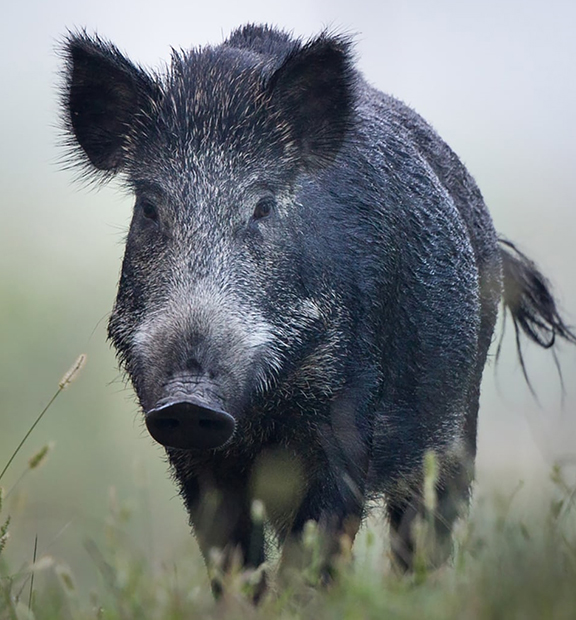
Hunters came from all over America to hunt Russian boar in Cherokee and Graham counties. Here was the habitat of a unique animal – the Russian boar. Running up to 400 pounds or more, up to 4 feet at the shoulder and on the business end of that long black snout long-curved tusks that ground against each other in a self-honing sharpness, the Russian boar was the bane of many a careless hound.
Hunters quickly learn a surgical needle and thread are necessities when going after the “Rooshin.” A bayed boar can slice and dice a pack of good hounds. The status of the Russian boar has declined today, with the N.C. Wildlife Resources Commission reclassifying the once-regulated game animal to that of “feral swine,” in part because the boar breed with escaped domestic pigs, thus diluting the purity of the breed.
The story of the wild boar in America began with the first explorers. Columbus brought pigs with him. DeSoto was known for a herd of pigs he brought with him, and over the years some of these hogs would escape and live off the land – resisting all efforts for their eradication. States like Texas, Georgia and South Carolina have all been unable to eradicate feral swine. A domestic pig going feral was common across America, but the Russian boar is a different story.
That story begins in 1840 when Dr. Enos Hooper bought 13,000 acres of mountain land in what was then Cherokee County (Graham County today). The family would later lose the land, but the name of the peak centering their property retained Hooper’s name – Hooper Bald.
In 1910, George Gordon Moore, a Canadian businessman, decided to build a hunting preserve on Hooper Bald. He built a 14-room 4,000-square-foot lodge with indoor plumbing and one of the first phones in the area. He built a nine-high split-rail fence around 600 acres for wild boar, and a 10-foot wire fence around 1,500 acres to contain the buffalo.
By 1912, Moore had brought in by rail to Andrews bison, elk, cinnamon bear, mule deer and 13 wild boar from the Ural Mountains. He released them within his fenced preserve.
Things did not go well. The bear climbed the high fences and escaped, as did the wild boar. Local residents cut the fences to allow the game to be hunted outside the preserve. Moore himself rarely visited the lodge and preserve.
The caretaker was Cotton McGuire, who married to one of the descendants of Enos Hooper. By the 1920s, Moore was in financial difficulties and McGuire had worked without pay. Moore met with McGuire in New York and gave McGuire $1,000 – and all rights to the N.C. property.
McGuire lived on Hooper Bald for 30 years, moving into the lodge after his caretaker’s house burned. What game remained was allowed to be hunted for a fee. The charge for an elk was $100. The last buffalo would be shot by Bill Moore in 1926, and the last elk was taken by Claude Hyde around 1930.
Only the Russian boar remained and prospered, becoming so popular among hunters that official hunting seasons began in North Carolina in 1936, although the boar did not receive official “game animal” designation from the state until 1979.
Meanwhile, the National Park Service and Great Smoky Mountain National Park declared war on the wild boar, due to its natural proclivity to root. In the national park, that meant disrupting the balds as they dug for grubs, and indiscriminately rooting through rare wildflowers.
The park today has an eradication policy. They want to rid the park of the boar, as it is considered an invasive species. Everyone seems to agree – except the boar that stubbornly maintain a presence there. With a gestation period of 140 days and a litter running between 6-12 piglets, eradication is a tough battle.
Eventually, the Wildlife Resources Commission reclassified the wild boar downward, and today the Russian boar has no regulated season. Private landowners can hunt the boar day or night on their on land anytime. The same goes for 94 other counties.
However, in the six western North Carolina counties, even though there is no limit or closed season, the only time boar can be taken on N.C. Game Lands is during any open season for other game – and the hunter is restricted to whatever arm is legal at that time; i.e., black powder, bow, rifle or shotgun in their respective seasons. Boar can be hunted during the spring turkey season, but only if using a shotgun.
Boar do not hibernate and can move up to 20 miles a day in search of food, although they usually stay within 5 miles of their home range. The boar feed on anything edible and have proved to be adaptable animals.
When searching for a lost person in the Smokies, one rescue squad member was told by a ranger, “Bear will eat everything but a person’s shoe soles – and the boar will eat that.”
The ancient Greeks considered the boar an animal of mythical proportions. Among the legends was the boar’s tusks caught fire if annoyed. But these days the mighty Russian boar that once equaled the black bear in hunter popularity is considered little more than a nuisance, despite having a presence in western North Carolina for over 100 years.
Bruce Voyles’ local history column runs every other week in the Cherokee Scout. Email him at RoadsLessTraveled@cherokeescout.com.