
 |
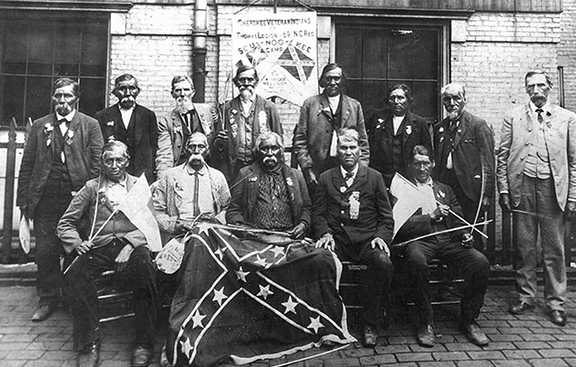
W.H. Thomas is a legend in North Carolina history. He was a white man adopted into the Cherokee tribe by Chief Yonaguska, elected chief, lobbied against the Cherokee Removal and founder of western North Carolina’s most famous Civil War unit – the Thomas Legion of Cherokee Indians and Highlanders, also known as the 69th N.C. Infantry.
The legion concept was one of a combined infantry, cavalry and light artillery, training and fighting as a single unit. The concept was also adopted by Wade Hampton of South Carolina, but both Thomas and Hampton soon discovered the Confederates thought putting the artillery elsewhere was more effective, and the legion concept was rarely used.
Before the war, Thomas ran a chain of five successful trading posts from Whittier to Murphy, aided by his speaking fluent Cherokee, and he was a personal friend of Confederate President Jefferson Davis, whose acquaintance made when in Washington opposing the Cherokee Removal. With the coming of the Civil War, the 60-year old Thomas easily obtained a commission from the governor to raise his legion, shooting for 2,500 men, brigade strength.
Thomas’ name recognition had many western North Carolinians enrolling in his legion, including a large group of Cherokee County men recruited to battalion strength by William C. Walker, a longtime friend of Thomas who had served in the N.C. House.
A large group of the Eastern Band of Cherokee Indians also enlisted under his banner. There was an ulterior motive to Thomas’ efforts, as he wanted to utilize his troops as guards of western North Carolina, particularly in the gaps and passes of the Smokies, and hopefully keep his Cherokee troops out of the bloodbath in Virginia. The initial Cherokee battalion called itself the Junaluska Zouaves. Two hundred Cherokee enlisted at first, and eventually 400 would serve, which was almost every able bodied Cherokee.
The troops signed three-year enlistments instead of the customary one year, but with the unstated gentleman’s agreement the Cherokee troops would not serve outside of North Carolina.
One part of the Thomas Legion was detached to Virginia and saw gruesome fighting during Jubal Early’s Shenandoah campaign that took Confederate troops within sight of Washington before the legion’s troops were returned to North Carolina. The bulk of the Legion remained in east Tennessee and western North Carolina, actively engaged with Union irregular units and pursuing deserters and outliers.
In 1862, the legion took part in Kirby Smith’s invasion of Kentucky, and it was at Baptist Gap, 10 miles from the Cumberland Gap, that the legion gained some notoriety. In an attack on a small Union position, led by a Native American member of the legion, 2nd Lt. John Astooga, he was killed (translation of his name “standing in the doorway”).
This popular officer was the grandson of Junaluska, and the outraged Cherokee took the position also quite publicly took the scalps of the Union defenders, to the chagrin of Thomas. Scalping was considered an outrage by the whites, and Thomas did what he could to quieten the atrocity by quickly returning the scalps and offering an apology. He ordered the scalping hushed, but by some accounts that did not stop the practice in isolated instances throughout the war.
After the rout of Goldman Bryson’s Union guerrillas at Evans Mill (Gowen’s Cove today) it was a Thomas Legion group led by Lt. Campbell Taylor that tracked Bryson down and killed him, capturing John Ledford at the same time. Taylor brought Ledford back to Murphy and hung him on the square without due process.
The legion was attributed as the force that attacked Union sympathizer William S. Gentry’s residence in Hanging Dog, guaranteeing the safety of the occupants if they surrendered after threatening to burn the house if they did not. Gentry and two sons surrendered, were taken to Tomotla, tied to a mulberry tree and executed. The next day, a Lovingood brother-in-law was shot when he came to retrieve the bodies.
In retaliation, Squire William Walker of Valleytown was taken prisoner by Union irregulars and sent to a Yankee prison camp, where he died in captivity.
It was not long after that, Lt. Col. William C. Walker of the Thomas Legion was home on sick leave, accompanied by his son, also a member of the Thomas Legion. Surrounded by Union irregulars, Walker was shot and killed in his home, and the son captured with plans to kill him away from the home, but the troops were convinced to spare the young soldier because of his youth.
The Walker family legend is the son recognized some of the men in that group that killed his father and extracted his revenge on several of the party, even after the war had ended. Some troops from the Thomas Legion were involved in what some consider the last battle of the Civil War.
Only two years after the war, Thomas was declared insane and was in and out of mental hospitals for the remainder of his life. He died in Morganton in 1893.
The Thomas Legion battle flag survives and is housed at the Museum of the Cherokee in Cherokee, Walker’s Ames sword survives and is a valued heirloom among his descendants.
The novel 13 Moons by Charles Frazier is based loosely on the life of Thomas. Frazier says the primary character is not Thomas but that character and Thomas “share the same DNA.”
A detailed factual history of the Thomas Legion is Storm in the Mountains by Vernon Crow.
In the interest of full disclosure, there was a Cherokee Countian named Tilman Quinn who is listed on the muster rolls of the Thomas Legion. He was your author’s great-great-grandfather – and, like many men who would later become “outliers,” he would finish the war as a member of the 3rd Tennessee Mounted Infantry (Union).
Bruce Voyles’ local history column runs every other week in the Cherokee Scout. Email him at RoadsLessTraveled@cherokeescout.com.