
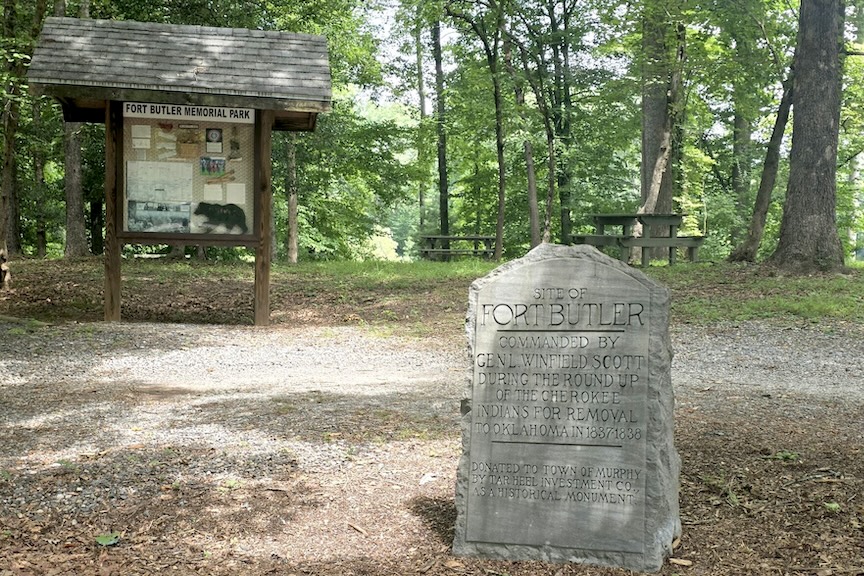
MURPHY – The Murphy Town Council approved a resolution to give Fort Butler Park in Murphy to the Eastern Band of Cherokee Indians.
The council approved the resolution on July 6, giving Fort Butler Park and Historical Site to the EBCI at no cost.
“This is an important step for our community,” Murphy Mayor Tim Radford said. “Fort Butler is tied to a painful chapter in Cherokee history. While the park is located in Murphy, I believe the Eastern Band of Cherokee Indians should have the opportunity to care for this site and share its history in their own voice.”
Community leaders discussed the long-term stewardship of Fort Butler Park, starting the conversation on on conveying the property to the EBCI.
“The more I thought and prayed about it, the more it made sense,” Radford said. “This is not Murphy stepping away from its history. It is about recognizing that history honestly, showing respect, and placing stewardship of this important place with the people most directly connected to its story.”
Both parties will now work toward completing the legal process to transfer the land from the Town of Murphy to the EBCI. Until the process is complete, Fort Butler Park will remain under the Town of Murphy’s ownership and maintenance.
There will be a formal ceremony to recognize the transfer and significance of the site once the process in finalized.
Tia Lambert suggested that the Town of Murphy consider transferring the city to the EBCI, which led to a broader discussion on the best future for Fort Butler — a place closely connected with Cherokee history.
In a statement regarding the transfer, the Eastern Band of Cherokee Indians Principal Chief Michell Hicks thanks the Murphy Town Council, Radford and Lambert for their advocacy and support of returning Fort Butler Park and the historical site.
“There have been many conversations with th Executive Office to help make this possible, and I am very thankful,” Hicks said.
Hicks also said that returning Fort Butler and the land is “an important part of preserving our history and strengthening our sovereignty.”
“It allows us to ensure that this story is told truthfully, that those who suffered here are honored, and that future generations understand both the hardships our people faced and the resilience that continues to define the Cherokee people today,” Hicks said.
He said that preserving Fort Butler Park “honors its history and helps future generations better understand its significance remains an important priority.”
Fort Butler was a military headquarters during the Cherokee Removal in 1838. The fort was where Cherokee families were detained before being forced from their homeland on the Trail of Tears.
It is located on a hill overlooking present-day Murphy and the Hiwassee River. Just down the hill, Cherokee Street follows the route of the former Unicoi Turnpike that the Cherokee people were taken to Fort Cass in Tennessee.
Fort Butler got its name from Benjamin Butler, Andrew Jackson’s attorney general.
In 1838, the United States Army prepared for a forced removal after a May deadline passed for the Cherokee people to leave their lands. General Abraham Eustis took command of the fort and troops came straight from the end of the Second Seminole War in Florida.
Fort Butler had barracks, officers quarters, offices, shops and kitchens, along with other buildings on the land.
General Winifred Scott traveled from Fort Cass to Fort Butler in order to direct the forced removal of the Cherokee people in June of 1838.
In the summer of 1838, over 3,000 Cherokee prisoners from Western North Carolina and Georgia passed through Fort Butler on the way to Fort Cass. Roughly 1,000 prisoners were sent from Fort Butler to Fort Hembree in present-day Hayesville.
The land now serves as the Fort Butler Memorial Park and has been a memorial to the historical significance of the land since the 1970s.