
 |
It was a low-key event. A bluegrass festival was coming to Cherokee County. Two full days of open air entertainment.
The promoter had an expanse of land off Sunny Point Road with a stage, a large shed near the top of the ridge and a lot of local advertising.
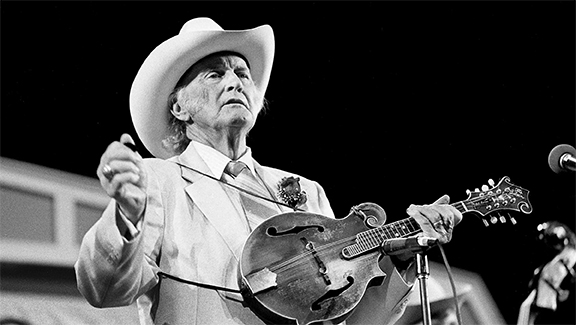
The headliner was the legendary inventor of bluegrass music, Bill Monroe.
While I admit I enjoy occasional bluegrass music, I am not a hardcore fan.
I do not attend bluegrass events.
My musical tastes are more esoteric. My concert ticket stubs range from 1970s oldies groups like The Grass Roots and Paul Revere & the Raiders to Vince Gill or The Eagles (yes, I know that Vince Gill is now an official member of the Eagles, and his added harmonies are icing on an already sweet cake the last time I saw them).
Still, seeing a legend is seeing a legend. I’ve driven to Houston to see Judy Collins last year, one of the performers at the top of my bucket list. Monroe was never on that list, but I was living in Hiwassee Dam, working at the Cherokee Scout, fresh out of journalism school and on a tight budget. The tickets were affordable on even a newspaper reporter’s salary.
I do not know what we expected, but parking was easy and open, thanks in part to a slow drizzling rain that had begun early Saturday morning. We arrived about 5 p.m., ate a quick dinner purchased from the concession stand and set up our lawn chairs, surprised we could get so close to the stage. We had raincoats in deference to the rain, which was still a light mist.
The opening acts played, and a little after dark the most prominent name in bluegrass music came to the stage at this small festival in Cherokee County.
Monroe played in some of the most desired venues in America with some of the biggest names in music. He was a longtime member of the Grand Ole Opry when that was the pinnacle of country music. He had played in front of tens of thousands of people.
But on this night, it was not to be. Because in isolated Cherokee County during a drizzling rain, the crowd Monroe drew was less than 300 people. I counted.
The full band wore matching cowboy hats, well dressed, and I was frankly a little embarrassed for Monroe. He stepped to the microphone and said he liked to support bluegrass festivals and understood when they started it took time to build them into something larger. Then he said something that made me a fan forever.
“I know the crowd is a little small, but we came here to play, and you came to hear us play, and that is what we are going to do,” Monroe said. And they did, as if they were playing Carnegie Hall. Flawless bluegrass flowed from the stage.
After a few songs, Monroe spoke again to the crowd.
“Now since there are not a lot of people here, we are going to go off our playlist, and are there any requests?” he asked.
A few titles were shouted from the crowd, which they played. I can forever brag that on that particular night the legendary artist played my favorite Monroe song at my request, “Uncle Pen.”
It is a song written about his uncle who was influential in his music development. In a high lonesome wail, Monroe sang, “Uncle Penn played the fiddle / Lord how it’d ring / you could hear it talk / you could hear it sing.”
One of the crowd shouted out, “Foggy Mountain Breakdown.” There was a hush over the crowd.
Lester Flatt & Earl Scruggs made that song famous as the background music for the movie Bonnie & Clyde, perhaps the most recognizable and famous bluegrass song ever written. Monroe did not write it. Flatt & Scruggs played in Monroe’s band when they started, and when they left to start their own bluegrass band Monroe took it as a personal insult.
Legendary for holding a grudge, when Flatt & Scruggs and Monroe were at the Grand Ole Opry at the same time, Monroe would not speak to and turned his back as they walked past.
Now in this small mountain bluegrass festival an unknowing attendee has requested the unrequestable. Monroe paused, a shocked look on his face, and he answered the man.
“Well, that’s not one of our songs, that’s a Flatt & Scruggs song,” he said. Again a pause. “But we know how to play it. Boys,” he nodded and the band broke into the song as if it was one of Monroe’s own. That night, Foggy Mountain Breakdown was one of theirs for sure.
Much of the time when Monroe would break into a mandolin lead or while he was singing, he would close his eyes. I wondered if that was his style, or if he was closing his eyes to avoid eyeing the meager attendance.
Monroe did his full set. As he said, he had come to play. There was not another Sunny Point Festival.
Years later, I was working as executive director of the National Knife Museum, and at a nearby knife show we announced that after the Saturday night show closing, I would give a guided tour of the museum with stories and anecdotes behind some of the knives. Only three people showed up for the tour.
One of the guests said since there were so few people here, it was fine if I wanted to cancel the tour. My mind went back to that rainy night in a pasture near Murphy.
“No,” I said, paraphrasing Bill Monroe, “You came here for a tour, and I came here to conduct a tour, so let’s start. Take, for instance, this knife …”
I still take inspiration from the lesson I learned from Bill Monroe.
Bruce Voyles’ local history column runs every other week in the Cherokee Scout. Email him at RoadsLessTraveled@cherokeescout.com.