
 |
When the Hernando De Soto and Juan Pardo expeditions passed through this area, there was little permanent impact on the world of the Cherokee. They were like tourists – coming through and going home.
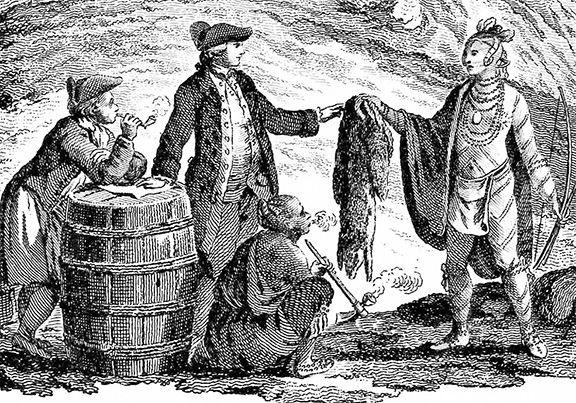
That changed forever around 1670, when traders began to make overtures to the Cherokee. They were not looking for gold of the mineral variety, but gold in two other forms – furs and skins, collectively known as buckskins, and slaves.
For many years, the plantations in the West Indies
were worked by Native Americans captured by a rival tribe and sold into slavery. The British would buy the captives from the tribe and ship them to a life of servitude.
The British expanded across South Carolina from Charles Town, and in 1684 Henry Woodward ventured into the lower Cherokee towns establishing trade relations, promising protection against their enemies in exchange for the Cherokee funneling furs and pelts to Charles Town and allowing only Carolina traders.
Soon traders were moving among the Cherokee, trading metal cooking pots, axes, firearms, knives, beads and mirrors in exchange for the valuable buckskins used for European clothing.
At first, these traders had free reign, living with the Cherokee much of the year, often taking a Cherokee wife and raising a Cherokee family. The traders gained influence among the Cherokee, much to the discomfort of the whites in charge in Carolina, fearing the traders might abuse that influence.
Governmental control was implemented when in 1707, South Carolina took control of the trade with a Board of Commissioners of Indian Affairs, overseeing the traders and regulating prices from Fort Moore (Augusta, Ga., today).
Rules were changed in 1717 to allow pack horses, and traders were required to buy an 8 pounds license and post a 200-pound bond. Traders from Virginia and Georgia were required to also buy licenses from South Carolina.
Originally, goods would be carried up the centuries old Indian Path on the backs of bearers. But as the trade expanded, soon trains of up to 100 horses bearing goods would be led into the Cherokee lands. While there was trust involved, there were also exploited rates by the traders, robbers and the Cherokee were known to steal traders’ wares.
In 1721, the British wanted a geographic line drawn delineating the Cherokee boundaries and asked the Cherokee to elect one person to represent them as a spokesman. This representative became the first chief to represent the entire Cherokee nation.
Based on their Mississippi River explorations, the French laid claim to western North Carolina and were sending traders of their own into the Cherokee territories. Fort Toulouse near what is Montgomery, Ala., today sent emissaries and traders from the western approaches, most often with the Overhill Cherokees in Tellico but some traders ventured up the Hiwassee River by 1730. In 1736, a French trader had settled with the Overhill Cherokee with the purpose of winning the Cherokee’s allegiance to the French and was active there until 1743.
Buckskin trade with the Cherokee eventually took a backseat to the profitable plantations operating near Charles Town, and trader regulations eased allowing anyone a trader’s license, with no control of their excessive markups, and increasingly adding whiskey to their inventories.
The neglected Cherokee became disenchanted with their British trading partners, who were also trading guns to the Creek, one of the Cherokee’s constant enemies. In a placating move, South Carolina built Fort Prince George in 1753 near what is today Westminster, S.C., promising a second fort in the Overhill towns on the Tennessee River. It would be called Fort Louden.
The South Carolina trade monopoly ended when the crown took over the Board of Trade, opening the door for North Carolina settlers to move to the edges of Cherokee land – where they became tempting targets for Cherokee raiders.
Cherokee joined the British at the outbreak of the French and Indian War, and when some of their horses were stolen by white men, they stole horses from another group of white men, which turned into a skirmish in which several were killed. Tensions increased.
The British demanded the killers be turned over for justice, but instead the Cherokee laid siege to Fort Prince George. The Charles Town Council declared war, and the governor led an army for relief of the fort.
A Cherokee delegation met with Governor Littleton to defuse the hostilities, but despite a promise of safe conduct the delegates were made hostages and held at Fort Prince George.
Twenty-four white men had been killed in the previous year within Cherokee territory, and Littleton now demanded 24 Cherokee be turned over for execution in exchange for the seized delegates. A compromise was reached. The delegates were released but 20 Cherokee remained hostage until the guilty could be located and turned over.
Littleton returned his army to Charles Town in fear of a spreading smallpox epidemic, while encouraged by the French, some English traders were killed. Fort Prince George was again besieged, and the commander of the fort killed when lured outside the fort. The Cherokee hostages were murdered. White settlements on the Yadkin and Catawba rivers were attacked.
A revenge army under Col. Archibald Montgomery raised the siege and began a campaign of burning Cherokee towns, destroying crops, and forcing the Cherokee into the mountains.
The Cherokee War had begun, and a fearful price would be paid even by those isolated Cherokee living in the county’s valley towns.
The traders who introduced the Cherokee to firearms, inflated prices and whiskey ran for their lives to the white settlements. Their era had ended, even though the white traders’ Cherokee descendants like John Ross would someday lead the Cherokee nation in the trying times of the Removal.
Bruce Voyles’ local history column runs every other week in the Cherokee Scout. Email him at RoadsLessTraveled@cherokeescout.com.