
 |
There is a scene in the classic Clint Eastwood movie Dirty Harry in which he meets the villain at one of San Francisco’s legendary landmarks atop Telegraph Hill, Coit Tower.
That tower and the lady for which it is named have a direct connection to another landmark, this one in Murphy, N.C. It is called the Murphy Pyramid, located on the hill above
the fire station, and easily visible from the old train depot.
The story begins in the 1820s, when a Scotsman trader comes into what is now Cherokee County and establishes a trading post and ferry at the junction of the Hiwassee and Valley Rivers. The man is A.R.S. (Archibald Russell Spence) Hunter, and he names the community that arises around this spot after himself, Huntington. He is made postmaster of Huntington in 1835.
A couple of years later, 1837, Fort Butler is built on the hill above Hunter’s store. The fort is established as a part of the Cherokee Removal. One of the regimental surgeons, Charles McPhail Hitchcock, fell in love with and married Hunter’s 17-year-old daughter, Martha.
Hitchcock would go on to serve in the Seminole War and the War with Mexico, where he saved the life of a wounded Jefferson Davis. Hitchcock arrived in San Francisco in 1851, along with Martha and their daughter Lillian. As medical director of the West Coast, he and his family became a part of San Francisco’s elite.
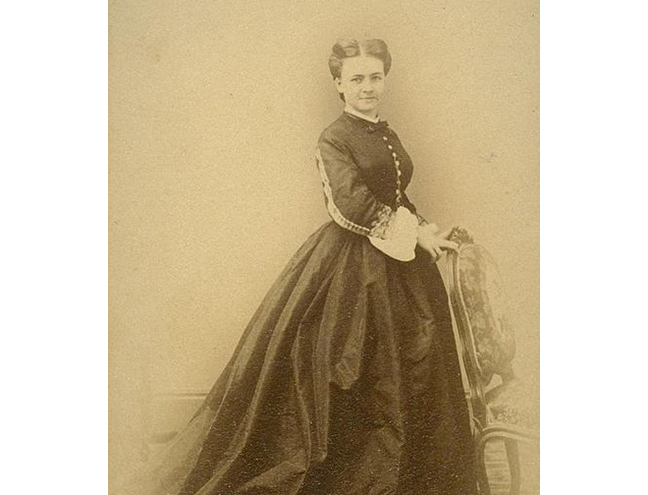
At 15 on her way home from school, Lillian saw firefighters struggling with ropes to haul a fire engine up a steep San Francisco hill. She dropped her books and grabbed a rope, urging others in the crowd to help. From that moment, she became a patron of the firefighters, who adopted her as an honorary firefighter of Knickerbocker 5.
She was fascinated
with firefighting for the remainder of her life, and always wore a “5” pin. She would sign her name “Coit5.”
Often when Company 5 went on a call, they would return to coffee and a waiting dinner, compliments of Mrs. Coit. Many times she would drop what she might be doing and join the firefighters in extinguishing a blaze.
Lillian, better known as Lillie, became a well-known San Francisco socialite. She was also one to flaunt convention, an avid hunter, cigar smoker and poker player.
She married Howard Coit, a caller at the San Francisco Stock & Bond exchange during the heyday of the Comstock Lode. Lillie traveled Europe collecting treasures and was welcomed in the courts of Napoleon III and the maharaja of India. Between her father’s and husband’s estates she was wealthy.
On a visit to Egypt she became enthralled at the pyramids. Upon her return she ordered a pyramid built to honor her grandfather, A.R.S. Hunter, the founder of Murphy. Hunter, his wife, and Lillie’s aunt would
be disinterred from their burial sites and moved to
be buried under the pyramid, on a small hill in
western North Carolina where the Hiwassee River flows, near where her grandfather built a store, and where her father and mother met.
When she died at 85, in 1929, Lille left one-third of her fortune ($225,000) to the City of San Francisco for the purpose of “Adding to the beauty of said city which I have always loved.” The result was Coit Tower, a 200-foot tower on top of San Francisco’s Telegraph Hill, built in the shape of a fire hose nozzle. It was completed in 1933, with enough money left over to build a statue in Washington Square of three firefighters, one of the few statues to honor firefighters prior to 9/11.
Lillie also established a lecture series in the name of her parents, subsidized by her estate and continuing today at the University of California Berkley.
The Murphy pyramid is a monument and final resting place to the founders of Murphy. This is still a private property and not open to the public, maintained by the estate of Lille Hitchcock Coit.
Bruce Voyles’ local history column runs every other week in the Cherokee Scout. Email him at RoadsLessTraveled@cherokeescout.com.