
 |
I discovered bicycles around the fifth grade, enthralled by the speed and mobility available for my roaming, and soon discovering that riding on the one paved road, Route 4 – Hiwassee Dam Access Road today – was far easier than the wooded game trails.
Off the school bus, it was straight to my bike. Two friends joined me in riding back and forth on the brief flat-road segment. There was a time limit. When the first person drove by who worked at Tennessee Copper Co., it was time to get off the road. A stream of cars would be following.
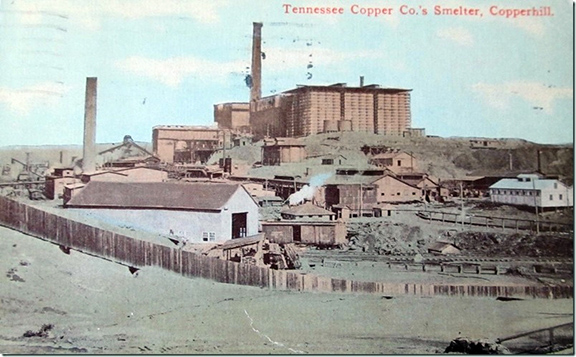
Many in the community worked at the place we knew simply as “The Company.” Like most company towns, the changes in that company had widespread effects on surrounding communities, especially a company that supported sports activities, provided housing, the YMCA, a company store and credit union.
Though located in Tennessee, that company had a profound impact in N.C. communities closer to Copperhill than Murphy.
The end of the era of copper mining here ended in my lifetime after more than 100 years of production.
Tennessee Copper sold to Cities Service, which sold to another place, and every step of the way the company that once employed more than 5,000 people spiraled to nothing.
Copper mining began shortly after the Cherokee Removal in an area near the village of Chief Duck, Ducktown. That community would lead copper mining in what we know as the Great Copper Basin.
A smelter operation stared near the town of McCays, across the river from McCaysville, Ga.
When two train stations were combined by the L&N Railroad, the new depot was named “Copper Hill.” In 1911, the city fathers would change the name of McCays to Copperhill.
Several mining and smelting companies merged into one company in 1936, a necessity during the Great Depression, with the result giving the newly formed Tennessee Copper title to more than 21,000 acres. The company was publicly traded, with headquarters in New York City.
Older methods of smelting copper resulted in more than 50 square miles of severe erosion around the company, and as early as 1906 the State of Georgia was suing the company for emission damage. A taller smokestack to alleviate the issue only spread the pollution even further.
Plus, the elusive control of emissions and byproducts going into the Ocoee have always been a thorn in the side of copper smelting. One of the efforts to find a solution was to harness the gasses from the process and convert it into sulfuric acid.
This innovation was hailed as one of the major achievements of the industrial age, invented at Tennessee Copper. The company was soon the largest producer of sulfuric acid in America.
While the company would venture into other products – soap, copper sulfate and ferri-floc, among others – it was the sulfuric acid that was the primary product. The copper mines produced the ore that was smelted to produce the gas.
Even after mining ceased, raw materials from other sources was shipped in to continue producing acid.
The volume was impressive.
In 1958, the company sold 14,660 train cars of acid, along with 4,050 18-wheeler loads.
That volume captured the attention of others, and in 1963 Cities Service merged with Tennessee Copper, which employed 5,260 people. (The name would be retained until 1970, when the operation was renamed Cities Service.)
By 1965, 5,000 tons of copper ore were brought to the surface every day.
In 1969, a $70 million construction project, “Project Copperhill,” began that was supposed to increase the company’s output by 25% to 40%. It did not work.
One major component, a pellet plant to convert the iron byproduct into more sellable pellets would only operate for six years. (My first job out of high school was working at Project Copperhill – in an 8-foot ditch with a 4-foot shovel.)
By 1982, Cities Service was re-evaluating, and a group of investors led by Bruce Davis (formerly with Hooker Chemical during the Love Canal pollution controversy) purchased it, changing the name to Tennessee Chemical Co.
It was not smooth sailing. Copper prices tanked, mining costs high and for extra income the company was forced to start some of their 20,000 acres and 5,000 acres of mineral rights.
The company’s railroad rolling stock was sold, and a mine collapse at Calloway mine was a further detriment. Davis obtained
loans from the four unions representing company workers, but it was still not enough.
Mining began in earnest around 1850 in the Copper Basin and ended in July 1987. An estimated 95,000,000 tons were taken from the ground.
Despite their best efforts, Tennessee Chemical filed for bankruptcy in 1989.
A year later, with liquidation looming, a Swiss company, Boliden Intertrade, purchased the company, renaming it BIT Manufacturing, overseeing the sale of remaining company land. In 1996, the remaining workers struck – and maintained that strike until 2004.
In 1997, BIT Manufacturing changed their name to Intertrade Holding, and sold to a Canadian company Marsulex. By December 2000, the workforce had dwindled to 40.
Growth Management Services purchased the plant from Marsulex in 2001, but with the proviso they could no longer produce sulfuric acid. The company shipped only 94 cars of acid that year, compared with 7,022 cars only four years earlier.
What was left for income was the sale of the mountains of calcine byproduct, which retained enough value it was profitable to ship the calcine to China, where byproducts could be extracted, thanks in part to China’s lax environmental restrictions. Such extraction would be impossible in the United States due to environmental regulation.
In 2008, what was left
of the once proud huge industrial facility, whose product came to name the town and the region, was sold to Pilot Chemical Corp., with 32 of the remaining 40 employees laid off. What remains is a sad ghost of what once was.
Thanks to Sandy Forrister for her assistance and otherwise unobtainable information. She was one of the last remaining at the Copperhill offices.
Bruce Voyles’ local history column runs every other week in the Cherokee Scout. Email him at RoadsLessTraveled@cherokeescout.com.