
 |
Growing up at Hiwassee Dam, I was as close to Copperhill, Tenn., as I was to Murphy, and Ducktown, Tenn. was 3 miles closer than either of those. Murphy was a 30-minute drive. The Tennessee state line was only 15 minutes away.
The television stations we received were either Chattanooga or Knoxville, Tenn. In our community, if asked where you worked, the answers would vary for Cherokee County-based business.
“I work at Clifton” would be an answer, or Clifton would be substituted for Levis, or Magnavox, or American Thread. But for many in that end of extreme western Cherokee County, a more typical answer was, “I work at The Company.”
There was no need to explain further. For while there were companies designated by name, there was only one referred to as “The Company” – Tennessee Copper Company and the mines at Copperhill.
It was in 1843 that copper was accidentally discovered by a gold prospector on Potato Creek. It was the beginning of what we would come to know as the Great Copper Basin, an area that reaches into Georgia and North Carolina, but most of which is in Tennessee.
In 1850, the first mine, Hiwassee, began operation. Within five years, there were five more. The ore was sent by cart to Dalton, Ga., the nearest railroad, until in 1853 when workers (many of the Cherokee who hid from the Cherokee Removal) using hand-hammered drills and black powder built a road bordering the Ocoee river, The Copper Road.
Soon, four-horse teams were pulling 500-pound loads of copper to Cleveland. A two-day trip each way, the drivers would stop for the night at a way-station built by the owner of the mining operation named the Halfway House. (A marker stands there today near Greasy Creek.)
Copper-smelting operation began in 1854.
During the Civil War, the operating mines were seized by the Confederate Army, with the area supplying 90 percent of the copper used by the Confederacy. A Union raid did much damage until the Battle of Missionary Ridge, when Union control resumed and the Unionist mine owners who fled during the war returned and increased production by switching to steam engines.
The mines would produce 24 million pounds of copper ore, but by the 1870s the cost of transporting the ore outweighed the profit, with all mining ceasing by 1879.
When the Marietta and North Georgia Railroad built a line connecting the area to Knoxville in 1889, the mining operations resumed. The nearby town of McCays changed its name to reflect the local industry, becoming Copperhill in 1908.
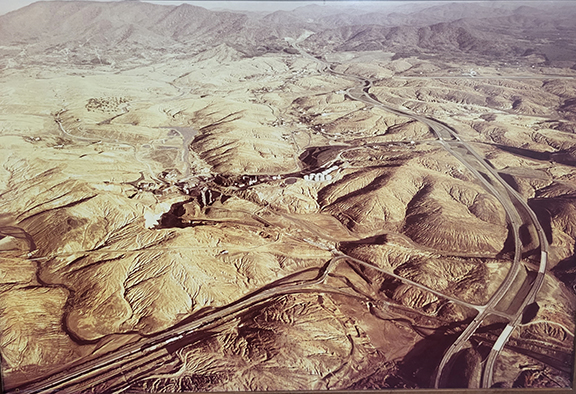
The smelting operations requiring massive amounts of wood, and the resulting acid fumes producing acid rain that killed off all other vegetation, creating a moonscape of erosion that became something unique to the area. Eventually, 32,000 acres would be affected, called by some the largest manmade biological desert in the nation.
New companies were born with the resumption of mining. A London-based company reopened one of the mines, calling itself Ducktown Sulphur Copper & Iron Company.
In 1899, the Tennessee Copper Company was formed, combining many of the mining operations in the Basin. To offset the acid rain, large smokestacks were built. While that did help locally, it dispersed the acid rain even further, resulting in environmental lawsuits by Georgia at the turn of the century that went to the U.S. Supreme Court.
The court handed down an injunction that would have ended mining in the area, except for a technological advance that allowed the company to capture the smelting fumes and convert the gases into sulfuric acid.
Massive amounts of sulfuric acid would be supplied to Volunteer Ordnance Manufacturing in Chattanooga during the Vietnam War. At one point, the operation at Copperhill produced 25 percent of the nation’s sulfuric acid.
More than 30 mining operations would eventually be operated in the Copper Basin, but the industry consolidated under the Tennessee Copper Company. The company later added the production of copper sulfate in the 1920s, adding soap and ferri-floc as by products over the years, eventually growing into a company employing 2,500 workers, many of them residents of Cherokee County.
Cities Services purchased the Tennessee Copper Company in 1963, beginning in the early 1970s expanding their iron production with construction of iron roasters and a pellet plant in Cantrell Flats near Copperhill.
The history of The Company is part of my personal history. Your author missed his last day of high school to go to work at the contractor of the Cantrall Flats expansion, spending the next few months in an 8-foot ditch with a 4-foot shovel.
Cities Service hired crews of college students as laborer crews in the summers. I was one of those a year after the shovel job.
In 1982, a group of investors seeing the asset rich company’s availability purchased the company, renaming it the Tennessee Chemical Company, selling off land, railroad equipment and closing mining in 1985, with the final open
pit mine remaining in operation until 1987. With the assets of the company looted, what was left of the company filed for bankruptcy in 1989.
The 32,000 eroded acres were reclaimed starting in 1932, eventually planting more than 18 million trees with the aid of the company, Tennessee Valley Authority and Civilian Conservation Corps.
A part of that heritage remains, a small company that exists for selling the mountains of calcine and slag that was the byproduct of the earlier operations.
The Burra Burra mine site is on the National Register of Historic Places, with many of the original buildings still standing. Among them is one that houses the Ducktown Basin Museum with countless artifacts and large pieces of mining equipment on display.
The State of Tennessee purchased the site in 1983, making it the first state-owned historic industrial site. The museum is open to the public each week, closed on Wednesday and Sunday.
Each year around the Fourth of July the museum hosts a reunion of all former employees of The Company.
Bruce Voyles’ local history column runs every other week in the Cherokee Scout. Email him at RoadsLessTraveled@cherokeescout.com.