
 |
The event described was at Parsons Construction Co. in Copperhill, Tenn., in 1972. Parsons had contracted with Cities Service to expand the iron roasters in Cantrell Flats alongside the highway going into Copperhill. The men gathered in a circle were not discussing construction.
Instead it was a bet. A $50 bet in 1970s money. (A 1970 Volkswagen Beetle could be bought new for $1,995 then.) The bet was five state capitals are closer to Murphy than our own in Raleigh, N.C.
The group took a compass, the old type with a point on one end and pencil on the other and drew a circle with the radius set from Murphy to Raleigh. A third party kept count and noted the capitals as the pencil went through that state and its capital fell within the closer range.
Columbia, S.C., was one, Atlanta, Ga., number two. Third took in Montgomery, Ala., fourth was Nashville, Tenn., and the winning fifth state was Frankfurt, Ky. The winner took his $50 and folded it into his wallet. That man was my Dad.
Sometimes growing up in extreme western North Carolina in those days, we felt as if we were living in the land that time forgot – or at least the land that the rest of the state forgot.
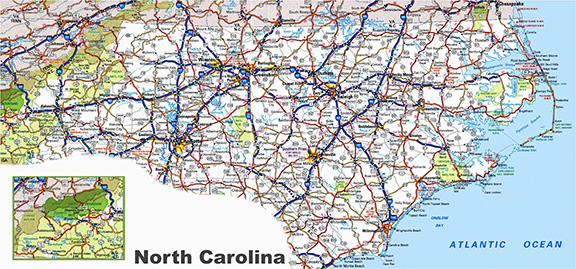
Illustrated with this column is a map of the state of North Carolina. To me it serves as conclusive proof that to some North Carolinians the state ends at Asheville. The map ends there. Take a look.
Growing up here I felt I had more in common with people from Copperhill, Blue Ridge, Murphy and Blairsville than I did with North Carolinians from Charlotte or Winston-Salem. A year at Western Carolina reinforced that theory.
Playing high school basketball I never understood why we would take day-long bus rides with a late night return to play schools like Glenville or Highlands when we could have played Copper Basin or West Fannin and been back at home in time to watch James Garner in Nichols.
My band played our gigs in Murphy, Copperhill, Blue Ridge and Blairsville. All were within 45 minutes of my home. I finished college in Georgia, made a career in Tennessee before returning home and was never more than a couple of hours from Murphy. Raleigh seems to be at the other end of the world.
According to Google maps, Raleigh is 355 miles and a 5½-hour drive from Murphy. Columbia is 228 miles and four hours. Atlanta is 118 miles and two hours. Montgomery, Ala., is 274 miles and a 4½-hour drive from here. Nashville takes three and a half hours to drive from Murphy, 224 miles away. Frankfurt is 308 miles away and five hours by auto. We would only have to go 11 miles further out to include Tallahassee, Fla., within that circle.
For western North Carolina residents, it is easy to suspect our interests sometimes get lost in the legislative processes of our state representatives and senators. Such suspicions are nothing new. John Sevier felt the same way when he lived in what was then western North Carolina.
Sevier had led his Overmountain men from the Watauga settlements, then a part of North Carolina, to defeat Ferguson’s Tories at Kings Mountain during the American Revolution. Later Sevier entered Cherokee County with the intention of war on the Cherokee, saw he was outnumbered, and instead retreated home through the Unicoi Gap.
And he felt that the mountaineers in the remote settlements were not being properly respected by their Eastern neighbors. In 1784, Sevier let the neglect he felt from the N.C. General Assembly boil over.
The mountaineers still sent representatives to the General Assembly, but they also wrote their own state constitution, elected their own assembly, seceded from North Carolina by forming their own state, the state of Franklin, encompassing a swath of land from what is now Knoxville, Tenn., to Elizabethton.
N.C. Gov. Alexander Martin was outraged and threatened force. The federal governing body, the Confederation Congress, refused to recognize the new state of Franklin, and plans for the new state crumbled.
Sevier wasn’t done. He won election to N.C. Senate three years later in 1789. His Franklin episode had brought the representation problem to the forefront.
The State of North Carolina, recognizing the difficulty in representing the needs of its extreme western regions, decided to wash their hands of the issue and ceded North Carolina’s western regions to the U.S. government.
In 1796, the U.S. government would turn those lands that had previous been western North Carolina into the State of Tennessee.
While John Sevier failed in his attempt to create the state of Franklin, he was more successful in the creation of a new state that he felt would better represent him and his mountain neighbors, the State of Tennessee. John Sevier was elected the first governor.
Bruce Voyles’ local history column runs every other week in the Cherokee Scout. Email RoadsLessTraveled@cherokeescout.com.