
 |
There was a knock at the door of Mrs. Edith Anderson’s sixth-grade class at Hiwassee Dam School, and two young high schoolers stuck their head in the door. “Anyone have creative writing?” they asked. A few papers were gathered and the two disappeared down the hall. Unfamiliar with the term, Mrs. Anderson explained to that if I wrote something I could submit it for publication to the high school newspaper.
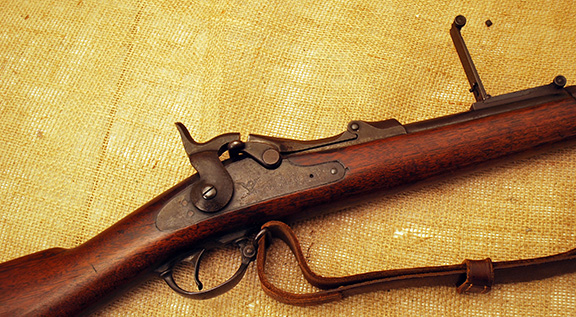
I prepared my first story around a family heirloom, a 45-70 trapdoor Springfield rifle that hung on the gun rack over my bed. I entitled my piece, “To Shoot a Springfield,” describing the experience of loading and shooting the 1880s era rifle. Never mind that I had never shot the rifle, or seen it fired.
I submitted the story. It was published. My name in print. My mother came home beaming from PTA. She had talked to Mrs. Barbara Sampson, the high school English teacher.
“I was introduced to her and she asked if I was the parent of THE Bruce Voyles that wrote the article in the school newspaper, and how impressed she was with the writing.” It was my turn to beam. I was hooked. I’ve been writing ever since.
I wrote sports for the Hiwassee Dam Hi-Lites paper when I reached high school, poetry in college (which led to a free-ride poetry writing scholarship), editing the Georgia State University Review and writing a column for the college newspaper, followed later with 19 books about knives, the knife section of World Book Encyclopedia, owning and editing knife magazines, three novels, and soon a collection of these columns – expanded with more details and photographs – to be titled, “Mountain Roads Less Traveled.”
That sixth-grade submission started it all. After reading the article, my Dad took the Springfield from the gun rack and led me outside.
“If you wrote an article about shooting it, you probably should shoot it.” I did, my one and only time. Trapdoor Springfields were not made to shoot modern ammunition.
Over the years, Dad reminded, “That was your great-grandad’s gun, he used to shoot fish in the Hiwassee River with it, but always keep it, because it is the gun that Jim Rose used to shoot Julius McClure’s arm off.”
I kept the rifle, researched the family legend, the impetus for the recent Jim Rose columns in this space.
In the 1919 gun battle in which Julis McClure lost his arm, newspaper reports state Rose was using a Springfield government rifle, one he purchased from an Army deserter along with 500 rounds of ammunition. That rifle was likely a U.S. Army World War 1 1903 bolt-action Springfield rifle. It was time to keep digging.
The trapdoor Springfield was introduced in the 1870s as a breechloading rifle adapted from leftover Civil War era barrels at the Springfield Armory. A heavier caliber and longer-reaching rifle was needed by the Army for the Indian Wars. The 45-70 came to be after accuracy tests, with a range of up to 600 yards and accurate on a man-sized target at 300 yards, and powerful enough, the saying goes, to shoot through a horse and hit the Indian hanging off the saddle on the other side. With innovative Buffington sights the rifle was even more accurate.
The rifle was a favorite of the buffalo hunters, including one used in killing 5,000 buffalo to feed the railroad workers by Buffalo Bill. He named his trapdoor Springfield “Lucrecia Borgia.”
With my rifle’s use in the 1919 Rose-McClure shootout unlikely, there were other Rose stories that fit. One that he killed John Thompson at age 16 (in 1890) to obtain a superior rifle Thompson owned. This was before the 30-40 Krag rifle was introduced by the Army during the Spanish-American War.
Some riflemen were known to narrow a trapdoor’s front sight to make the gun even more accurate. One feature of my trapdoor Springfield is a worn silver quarter had been used to replace the front sight.
When Buster Duggan terrorized Monroe County, murdering the son of Rose’s good friend, Bart Boring, by several accounts Rose was enlisted to come help take revenge on Duggan. Rose’s shooting skills were respected and Duggan was heard to remark that Boring “even had Jim Rose helping him.” Duggan feared for his life.
A Duggan accomplice in the murder, Joe McCully, was shot from ambush while sitting on his mowing machine. Julius McClure accused Rose as that shooter in a 1920 interview with an Asheville newspaper.
Days after McCully’s death, as Duggan was washing his face on the back porch he was killed by shooters concealed in the corn crib – 300 yards away. Rose was considered one of the few men who could accurately make that shot.
Duggan’s wife was kneading dough for biscuits when the shot was fired – and after penetrating Duggan and the wall, the bullet came to rest in the bread bowl. It was a .45-70 caliber bullet.
Combining a family legend that my Springfield had been owned by Jim Rose, the actual possession of the 45-70 Springfield through four generations, the narrow front sight for more accuracy, and Buster Duggan being killed with a 300-yard shot from a 45-70, and Rose, was actively hunting Duggan, there is a strong case that the rifle is the Buster Duggan rifle.
But then again, all my proof is family legend with aligning circumstances, albeit a family legend I heard from my childhood. Legends are often unprovable good stories. Like my Springfield.
More important is I own that rifle. Legend or no, it will never be sold. My grandson will own the rifle of his great-great-great-grandfather. I own nothing else that belonged to my great-grandfather.
Bruce Voyles’ local history column runs every other week in the Cherokee Scout. Email him at RoadsLessTraveled@cherokeescout.com.