

Bruce Voyles
I was sitting on the front porch of my Hiwassee Dam home, 9 years old, looking up the long “S” curve of Hiwassee Dam Access Road 1314 when I heard a strange sound echoing off the mountains, growing louder, until the source came into view. Mounted atop a small car were two massive loudspeakers, repeating the same booming words as it passed: “Singing school. Mount Carmel. Starts Monday. Come one, come all.”
I stood up, transfixed, as the car passed and the words faded away into the hills as the car continued on in the direction of Hiwassee Dam, spreading his message.
I proudly attended the first day of singing school, more to get a closer look
at those massive loudspeakers than to sing. I didn’t know my attending the school was my own participation in a valued Southern tradition.
The term “singing school” meant one thing, a musical master would teach shaped note music, usually in a church, a seven note system in which each do, re, me, fa, so, la, te was assigned a shape – and a note on the music scale, a simpler way to improve congregational and social singing.
Shaped-note singing was not new, a system with four notes and singing schools to promote the system date to 1801, but it was not until the Civil War that two Civil War veterans revolutionized shaped-note singing.
It is said the idea was born when a Union soldier visited his Confederate brother-in-law being held in a Yankee prison camp.
Aldine S. Keiffer and Ephriam Ruebush standardized the seven shaped-note system, and in the 1870s started a publishing company supported by singing schools to teach their seven shaped notes system and aided by the magazine Musical Million. The company would publish music into the 1940s.
Trained musicians quickly trashed the informal musical system, labeling them “dunce notes,” but that did not slow things down.
When James D. Vaughn started his Southern gospel publishing company, he went beyond singing schools to promote his music. He started a radio station and began broadcasting Southern gospel music, a musical category he invented and promoted by forming a quartet to tour and promote the shaped note music he published.
In the days, following their performance quartet member would also teach shaped-note singing in a singing school. By the 1920s ,there were 16 Vaughn quartets touring, singing and teaching shaped notes.
Vaughn’s contributions would be rewarded in 1972 with induction to the Gospel Music Hall of Fame housed at Dollywood in Pigeon Forge, Tenn.
One member of a Vaughn quartet was V.O. Stamps, who left to start his own Dallas-based publishing company with investor J.R. Baxter in 1924. Stamps & Baxter published inexpensive paperback publications for use in singing conventions, and they, too, started quartets to promote their music publications. They would soon expand with
offices in Chattanooga, Tenn., and Pangburn
Ark.
By the end of World War II, Stamps & Baxter were sponsoring 35 quartets and broadcasting Southern gospel music from KRLD radio in Dallas at night with a boosted signal that could be heard nationwide.
Among those who started as Stamps & Baxter quartets were the Speer Family and Blackwood Brothers.
Stamps & Baxter were the first to publish songs that have become classics, include such standards as “Victory in Jesus,” “Precious Memories” and “Just a Little Talk with Jesus.”
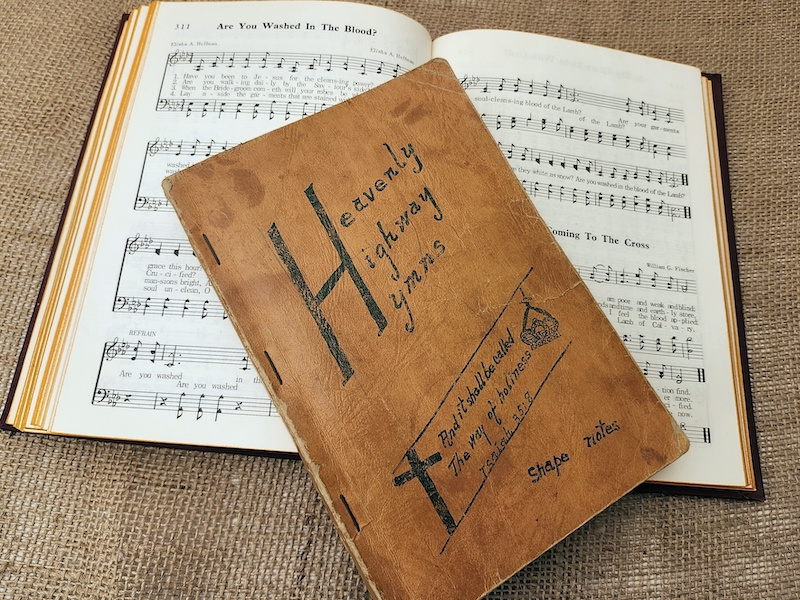
One of their hymnal titles was the brown covered “Heavenly Highway Hymns.” They were distributed in every pew at my home church at Hiwassee Dam, Mount Carmel. In Ken Burn’s History of Country Music on PBS he shows Johnny Cash singing from that same brown hymnal. His copy is on display today at the Johnny Cash Museum in Nashville, Tenn.
And it was at Mount Carmel that I attended a shaped-note singing school, taught by the Rev. Briscoe Hankins. His blackboard was an unrolled piece of oil cloth on easels, and he taught
and entertained, offering rewards of pencils and pocket combs for children who would sign the loudest or some other minor task. I won a pencil.
He would give free piano lessons during the day before the nightly singing school.
Hankins’ dinner was
provided by the congregation, and one of those afternoons he had supper at my parents’ home, regaling us with tales of teaching schools in faraway places (to me) like Mountain City, Tenn.
I did not know Hankins was no stranger to our community, as his children attended the old Hiwassee Dam School in the 1940s, where Bear Paw is today. He would later move to Etowah, Tenn., but return to the area to teach singing schools.
He died in Etowah in 1981. He was 75.
Singing schools usually lasted two weeks, and became community wide social events resembling tent revivals, attended by adults and children.
Shaped-note singing is in a revival today, and while singing schools taught in church have faded from popularity, there are several schools around the U.S. teaching shaped-note singing. One of the nearest to us is the North Georgia School of Gospel Music in Dahlonega. Even though Stamps & Baxter closed their publishing company in 1986, the Stamps & Baxter School of Music is still teaching shaped note singing in Murfreesboro, Tenn.
My daughter attended East Tennessee State University, pursuing a minor in Appalachian Studies, and in a class about shaped note music the professor showed his class a short video of shaped-note singing at a country church. My daughter recognized the church before the professor identified the location. It was Ebenezer Baptist Church in Cherokee County.
Even today, even though I cannot effectively read the shaped-note music Hankins tried to teach me, I can still hear his melodic voice, not singing the words but instead substituting
the names of the shaped notes, singing, “Do, Do, Re, Me So.” It always brings a smile.
Bruce Voyles’ local history column runs every other week in the Cherokee Scout. Email him at RoadsLessTraveled@cherokeescout.com.