
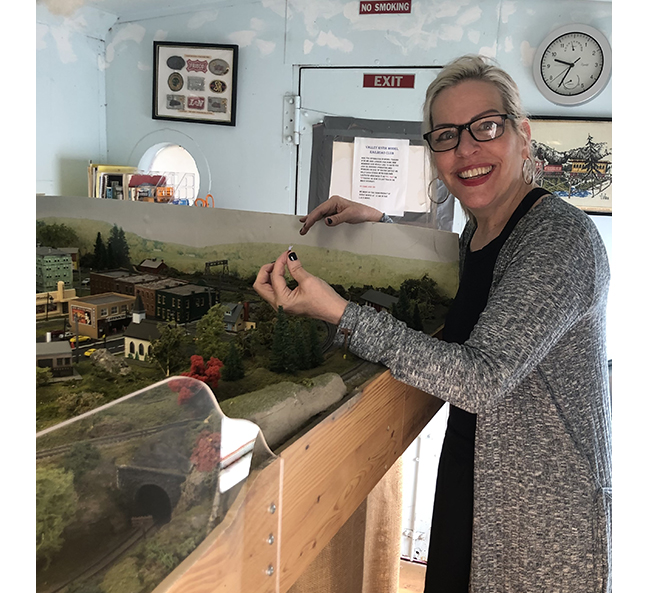
I grew up in Canton, Ohio, inside a township with numerous train tracks. The route to church crossed three separate sets of tracks – and if we weren’t pressed and groomed and seated in the family van on time, the trip to church became a minefield of anxiety.
Our father had the route timed in his tidy brain in just such a way to miss the trains, so even a minute’s delay in our departure from home would make us all nervous. As we approached each crossing, we sometimes even held our breath, praying to the God we were racing to meet in Sunday school that we would beat the train.
When we didn’t, nobody ever blamed God. The guilty child would sit in shame, while her siblings contented themselves by counting the cars. The higher the number, the deeper the shame.
There was a good deal of discussion around whether or not to turn off the car engine as well. According to folklore, the train would have to carry a certain number of cars to make turning the engine off more economical than letting it run.
Our parents would launch into sometimes heated discussions, speculating about the number of cars on the train to decide if they should turn off the car or not. It was serious business, and they played it like a high stakes poker hand.
Despite the family angst surrounding the train track, I grew up loving trains. Their power and intensity thrilled me. I loved the haphazard way they all lined up and joined hands.
A fancy car with a pretty logo painted on its side could be connected to an open box car we felt certain was full of hobos. My twin and I often walked the tracks, smelling the oiled wood and feeling the heat of the steel tracks through our shoes.
My first time in a train was on an Amtrak from Atlanta to New York City. It took just under 20 hours, and I swooned like a young lover the whole time.
The dining car with linen napkins and crystal drinking glasses, the lounge car filled with pinched-faced smokers and lean ladies, with long painted fingernails – all of it fascinated me. I wandered through the train, exploring the secret places. Late into the night, when I felt restless in the coach car, I floated back to the observation car and laid my head against the backrest, staring into a charcoal sky brightened with fairy dust stars.
I once stole a spoon from the Blue Train, one of the most elegant trains in the world. Another time I traveled the entire country of Ireland by train.
I went to heal a broken heart and so splurged on first-class tickets. It was a wise choice. The stewards treated me like I was really something special, bringing me tea in porcelain pots and plates full of biscuits.
“Would you like a paper, Miss?” or simply, “How can I be of service?” By the time I circled the emerald isle, I adopted their view of me for myself.
My new hometown in Murphy has only remnants of its train days. The old track lies partially buried in farmers’ fields, a silent memorial to the cars that chugged upon them and the people held within them.
Trains have become more nostalgic than practical. Cars are more efficient and, anyway, people don’t seem to like people anymore. So cars insulate us from each other. Humans have become a herd of singular creatures.
When I drive on U.S. 64, I sometimes wave to the car next to me at a red light. To date, no one has waved back.
It’s strange, to me, that we are all traveling down the same stretch of road at the same time but we are so disconnected. The posh car drives next to the jalopy, but there is no coupler to join them.
Travel has become perfunctory and autonomous. Where do we lounge together? Dine together?
I miss the delicious privilege of staring at the stars with a group of sleepy strangers. It wasn’t just that we were connected, but more that we belonged with each other for that one blink of life we shared together, rolling down the tracks.
Abigail Hickman is a staff correspondent for the Cherokee Scout. Email her at abigailhickman44@gmail.com or leave a message at 837-5122.