
 |
It was once called advertising, but if a Rock City barn survives long enough it becomes a cherished piece of Americana.
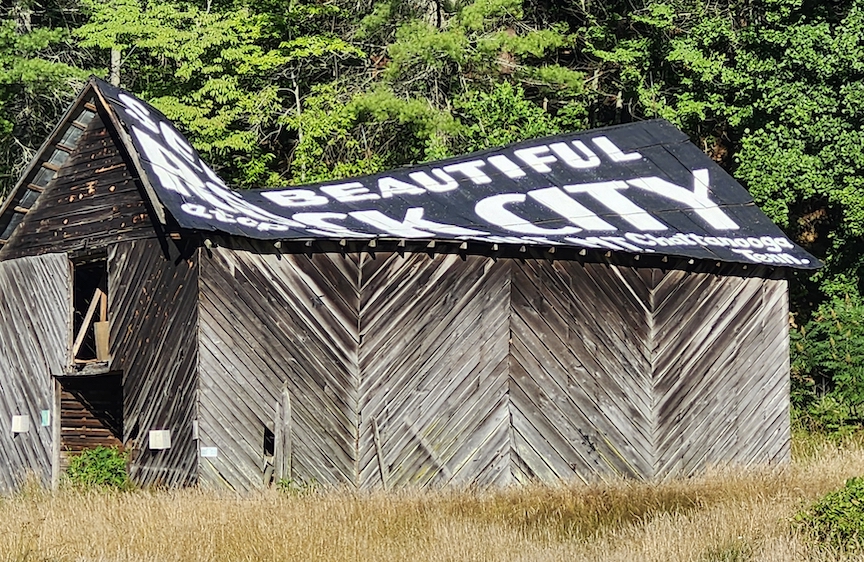
Cherokee County has had a couple, one in Topton that is so faded it is almost impossible to read the lettering. The other is 13 miles west of Murphy on U.S. 64 near Sunny Point Road. That barn was one of only 70 surviving examples that were still maintained by Rock City, but that local landmark may soon join the 800-plus Rock City barns that have succumbed to the years.
Once there were 900 barns in 19 states with roofs proclaiming proudly “See Rock City, Lookout Mtn. TN,” ranging from Michigan to Florida and the Atlantic Ocean to Texas, testaments to marketing genius and pure Americana.
The story of Rock City began when Garnet Carter on Lookout Mountain in Chattanooga had plans to develop a tract of land he owned into a housing development and golf course. The neighborhood was to be called be Fairyland, inspired by Carter’s wife, Frieda’s, love of German Folklore and mythical creatures. Carter laid out plans on 700 acres but his timing was off, as the Great Depression had started. Frieda began devoting time to arranging the nearby rock formations into a rock garden, transplanting wildflowers and laying out trails through the formations with pine straw. She also imported German statues of gnomes and fairytale characters, sprinkling them among the rocks to give the gardens a mystical feel. The gardens would expand to 100 acres and eventually include more than 400 different species of native wildflowers, shrubs and trees.
Carter’s idea to open the garden to the public was launched on May 21,1932, keying on the road improvements that would soon allow Americans easier travel. Rock City Garden’s success did not begin until 1937. Carter had noticed Mail Pouch tobacco ads on barn roofs, and he thought the same approach would work for Rock City. Carter hired a young sign painter named Clark Byers and assigned him to paint “See Rock City, Lookout Mountain TN” on barns across America. While all the Rock City barns bore the basic information, other tag lines varied, including the boast “See Seven States.”
Byers’ work was not always easy. First he had to convince the barn owner to let him paint the barn, bartering with Rock City Gardens passes and Rock City thermometers. For more resistant owners, sometimes a rental fee of $3 to $5 per year was negotiated. Byers received $40 per barn, and with his two helpers could paint as many as three a day – and he did them freehand. The paint used was lampblack and linseed oil.
The 1937 opening of the Great Smoky Mountains National Park put a lot of tourists passing the Rock City Barns, and a great many visitors flocked to Lookout Mountain to see Rock City. While visiting Rock City, they returned to their cars to find a paper sign with metal stays attached to their bumper also with the message “See Rock City.” If a visitor folded their sun visor down it was an indication to the staff to not put a “See Rock City” bumper advertisement on their car. Most often the advertising that drew visitors to Rock City was the painted barns.
From 1927-69, every Rock City barn was painted by Clark Byers and his team, estimated at more than 900 barns at its peak.
In 1969, Byers was injured by a high-voltage line while painting a barn and spent several months recovering. He retired. Later, Byers would own Sequoyah Caverns in Valley Head, Ala., which operated until 2013 – and he saw no need to reinvent the wheel, as the caverns were also advertised on barns.
Part of the marketing plans of Rock City was to paint barns in visible locations on rural two lane roads. With the coming of the interstate highways many of the barns were bypassed, greatly reducing the effectiveness of painted barns. Another blow came with The Highway Beautification Act of 1965, called the “Ladybird Law” passed during President Lyndon Johnson’s administration. Many of the barns in commercial areas were required to be painted over in the interest of highway beautification. Ten years later, the law would be amended to preserve historic “landmark signs,” including barn advertisements.
Tennessee took the banning as a personal affront and passed legislation naming the Rock City Barns as historic landmarks and refused to paint over the barns in Tennessee.
One source said today when a barn falls down it cannot be repainted as it does not meet new standards, so the fate of Cherokee County’s Rock City barn is unknown with the recent roof collapse.
Only 70 barns are maintained today by Rock City Gardens, with Roy Davis of R&R Outdoor doing the barn painting. Occasionally, local volunteers help in order to have a hand in preserving history. A 1994 project commissioned by Bill Chapin, nephew of Garnet Carter and president of Rock City Gardens, resulted in a book by David Jenkins, Rock City Barns: A Passing Era, featuring as many of the surviving barns that the photographer could locate. The records of the barn’s location were maintained in a single metal box of index cards.
The Rock City barns have also been featured in a song by Steve Young, with a chorus: “A man came by this morning, he wanted to paint my barn. He painted ‘See Rock City, US Highway 41.”
Carter’s claim to fame extends beyond Rock City Gardens. When his Fairyland development took longer than planned, to pacify his residents clamoring for the promised golf course, he constructed the nation’s first miniature golf course, later franchising the concept as Tom Thumb Golf. Miniature golf courses soon sprang up nationwide, copying Carter’s innovation.
More than 500,000 people visit Rock City each year, some even using the site as a wedding venue.
At Christmas, Rock City is transformed into the “Enchanted Garden of Light.”
After living in Chattanooga for 34 years before returning home to my mountains, I can attest I have seen Rock City myself – several times.
Bruce Voyles’ local history column runs every other week in the Cherokee Scout. Email him at RoadsLessTraveled@cherokeescout.com.