
 |
In a recent column, we detailed the creation of Old Copper Road in the 1850s along the Ocoee River, and Ocoee No. 1, the first dam built on the river, completed in 1912. Here’s what happened next.
Eastern Tennessee Power Co. started a second dam on the Ocoee in 1910, utilizing many of the same workers who had worked on Ocoee No. 1, and with a lack of creativity, named the new dam Ocoee No. 2. This diversion dam (where the rafters start these days) was built of 10-foot by 10-foot timber cribs, which were then filled with stone, resulting in a 30-foot dam that’s 450 feet wide and 12 miles up from Ocoee No. 1. That location did not have enough drop for the waters to produce the power needed.
Using dynamite, wheelbarrows, picks and shovels, a ledge was cut from the cliff side, running 4.7 miles downstream to Ocoee No. 2 powerhouse. A wood flume line was built on the ledge.
At the terminus of the flume, it empties water 250 feet down to the powerhouse turbines. The flume was completed in 19 months using more than 8 million board feet of lumber. The flume also required iron trestles bridging open spaces.
The dam, flume line and powerhouse were engineering marvels at the time. A town was built by East Tennessee Power to house its workers at Ocoee No. 2 in 1918, across the river from Old Copper Road.
Known as Caney Creek Village, it had treated water, hydrants, streetlights, phones, electricity, tennis courts and a 10-room, two-story hotel. No nearby town could boast such amenities.
What it did not have
was access to a highway. Caney Creek Village was
featured in a “Ripley’s Believe it or Not” column
as a town in which neither an automobile nor horse-drawn wagon ever traveled. Access was across a 150-foot swinging bridge or by boat across Parksville Lake that accessed a dock where a small railroad ran through the village.
The families parked their automobiles alongside U.S. 64 on the opposite side of the river. There was a one-room schoolhouse for the 25 kids who lived there, while the older children rode a bus to Benton, Tenn., for high school.
Among the families to live at Caney Creek was the Price family, who would later live at Hiwassee Dam. Evelyn Price Campbell spoke of it often to her family – and to your author.
In 192, Eastern Tennessee Power, along with others, formed the Tennessee Electric Co., upgrading their dams in the 1930s and adding a new Georgia dam on the Tocca/Ocoee, Blue Ridge Dam. TEPCO also purchased land for a planned Ocoee No. 3.
Despite TEPCO being the largest power company in Tennessee, the coming of the Tennessee Valley Authority in 1933 put a new boss in town. By congressional mandate, TVA was given control of all rivers in the Tennessee River watershed, no matter who owned the dams.
TEPCO’s chief executive officer was Josephus Conn Guild, a Chattanooga, Tenn.-born engineer whose father designed the Lookout Mountain Incline Railway. The father and son put together a deal beginning in 1909 to build the first dam on the main channel of the Tennessee River, Hales Bar Dam. It was in full operation by 1913.
When Guild became president of TEPCO in 1933 the company was facing off with the TVA who threatened to seize TEPCO’s dams under eminent domain.
TVA was challenged in court on the constitutionality of its formation, with Wendell Willkie as the opposing attorney (the same Willkie who would later
run for president). The case went to the U.S. Supreme Court.
TEPCO lost and was forced to sell its assets to TVA for $78 million ($1.3 billion in today’s money). The price for Ocoee Dam No. 1 alone in that payout was $2.68 million (more than $46 million today).
Among the other changes that came with TVA, the families in Caney Creek were forced to leave. TVA policy was not to furnish housing for their employees. An underlying reason, according to some politicians, was they thought the village was “too socialistic.”
With TVA in control, they built the planned Ocoee No. 3 in 1942, with the water diverted through a tunnel to the Ocoee No. 3 powerhouse.
Smaller than surrounding lakes, Ocoee No. 3 is 110 feet high and 612 feet wide, creating a 360-acre lake with 24 miles of shoreline. There is no recreational access.
The dynamic increase demand for electricity in the early 1940s was driven by unpublished reasons at the time, power for Alcoa Aluminum near Knoxville, Tenn., for producing aluminum for airplanes, and the top-secret work at Oak Ridge, Tenn., helping produce the first atomic bomb.
Periodically TVA would upgrade the dams for more efficient power production.
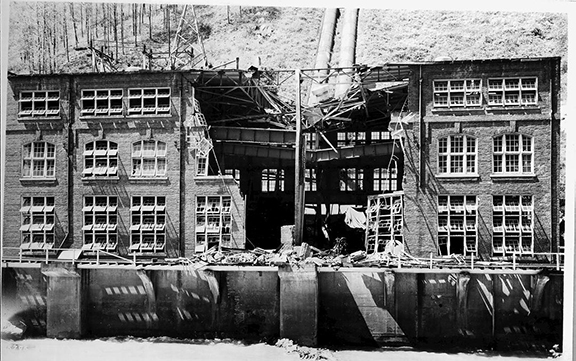
At Ocoee No. 2 in 1949, a governor failed on a generator and the uncontrolled generator exploded, hurling parts through the wall, some of which were found miles away. Several workers were injured, and although repaired and back in operation by 1951, until recently it was still possible to see the different color brick on the wall indicating the 1951 repaired area. Recent repairs replaced that brick.
The history of our local dams and formation of the lakes they created are one of the major attractions for tourists and those considering moving here – not to mention the primary recreation for boaters, fishermen, swimmers or even those who simply enjoy looking out at the calming green waters of a mountain lake.
We enjoy these lakes today thanks to the dams that created them. While TVA manages all the dams and lakes in the Tennessee River watershed, it was others who deserve credit for starting dams on area rivers.
Bruce Voyles’ local history column runs every other week in the Cherokee Scout. Email him at RoadsLessTraveled@cherokeescout.com.