
 |
Most languages, spoken and written, evolve over centuries. The number of writing systems derived from spoken language created by one man can be counted on one hand – since the beginning of time.
All the more shocking when we realize that one of those men who thought the unthinkable and did the undoable was born and lived his early years less than 100 miles from our humble abode.
His name was Sequoyah, born in Monroe County, Tenn., around 1788.
His father or grandfather (depending upon the source) was a white trader who lived among the Cherokee – and as was typical took a Cherokee bride and begat children, both of whom he abandoned at the end of his trading career. Such was the case with Sequoyah’s alleged dad, whose exact name is lost to history but enough historians seem to agree his name was “George Gist.” He was not around to raise Sequoyah, who was raised as an only child by his mother, which was better, as all property passed through the mother’s side of a Cherokee family.
His familial relations were linked to Chiefs Old Tassel and Doublehead.
Gist was lame, again a dozen different versions of why – but whatever the cause he was physically exempted from being a warrior and much work. He became a noted silversmith and blacksmith, with his spurs especially desired from his tendency to inlay silver into the metal of the spur. He did not mark his work, so there are no known examples of his work surviving.
Sequoyah did not attend school, but displayed intelligence when even as a child he designed and built milk troughs and skimmers of his dairy house.
His mother ran a trading post, which he took over upon her death – which was an informal meeting – and drinking place. He was soon neglecting the business and staying drunk, until he began to draw and blacksmith, and then stopped drinking.
Through his contact with the white man he recognized a disadvantage to his people by not having a written language so thoughts could be preserved and communication could be passed back and forth. That realization struck home in the Creek War during the War of 1812 where Sequoyah joined the Cherokee fighting at Horseshoe Bend. Serving for almost a year, he realized the Cherokee did not have “talking leaves” as he called them, and could not write letters home or read military orders. This convinced him of the dire need of his people for a reading and writing system.
Sequoyah was involved in the treaty negotiations for the treaties of 1817 and 1819, and it was in 1821 that he completed his syllabary, affixing a letter for each of the 86 sounds in the Cherokee language. By 1824, three years later, the Cherokee National Council awarded Sequoyah a medal for his work on creating the Cherokee written language.
He moved to Oklahoma far in advance of those in the removal, considered a member of the Old Settlers, the Cherokee who had formed their own government in the 1820s. With the arrival of 13,000 more Cherokee in the Removal, Sequoyah was one of the 16 Old Settlers who combined their government with that of John Ross’s Party, creating a new Cherokee constitution.
His attempt to create a Cherokee written language was resisted, as some Cherokee thought it witchcraft and others thought Sequoyah had lost his mind, as he neglected his crops to work on a written language. He eventually used the Bible as a reference in developing a set of 86 symbols for each consonant-vowel sound in the Cherokee language, with the symbols written in a chart layout.
Sequoyah taught the system to his 6-year-old daughter who was required to demonstrate her ability to read the language, when a local chief needed proof that Sequoyah’s language could be read. The chief gave him something to write, he wrote the symbols in the dirt, and his daughter was brought in and accurately read the words. The entire town was soon learning the new form of communication.
Sequoyah traveled to Arkansas where he invited each leader to say a word aloud, wrote it down, and again his daughter was brought in and read the words. Returning to the Eastern Cherokee, he carried with him a speech from the Arkansas leaders, read in the new written language.
In 1825 the Cherokee Nation officially adopted the writing system, one of the first Native Americans to have their own written language. Soon the Bible and hymns were translated, and copies of Cherokee law were distributed in 1826.
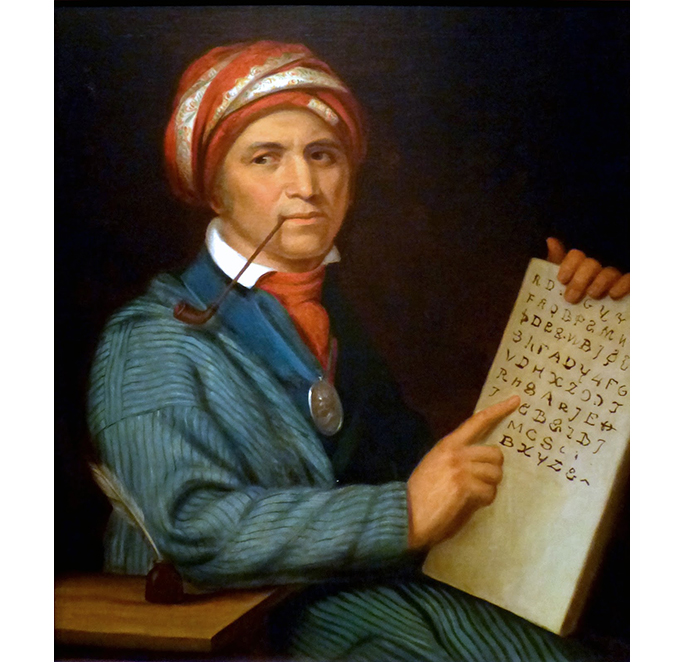
In 1828 Sequoyah was part of a delegation to Washington for a treaty negotiating in Indian Territory where he sat for a portrait, the one accompanying this column.
Convinced his language system would cross tribal lines, he journeyed to Arizona and New Mexico in hopes of teaching Native Americans there his system.
By 1830 90% of the Cherokee were literate in their own language. This was a higher literacy percentage than that of the whites in the Cherokee border country.
Sequoyah dreamed of uniting all scattered Cherokee into a single nation, and hearing there were bands of Cherokee who had moved to Mexico, he mounted a small group to locate them, leaving in the spring of 1842, later accompanied by Comanche warriors he continued into Mexico, pausing for a time to teach the Cherokee language to Mexicans. He was still there in 1843, when he died from a respiratory infection on a trip to Coahuila, Mexico.
The written language created by Sequoyah was one of the few times in history an individual from a pre-literate group created an effective writing system.
It is estimated that 21 writing systems in 65 languages in North America, Asia and Africa stemmed from the language created by the Cherokee man born in Monroe County, Tenn. His historic contribution is honored from naming the giant redwoods after him to a nuclear plant near Chattanooga, Tenn.
The Oklahoma Library Association gives annual book awards to the authors of children’s and high school groups – named appropriately, “The Sequoyah Book Award.”
Bruce Voyles’ local history column runs every other week in the Cherokee Scout. Email him at RoadsLessTraveled@cherokeescout.com.