

What does it take to make a song a classic? There are a hundred definitions. Few can define it. Songwriter Harlan Howard defined a great country song as “three chords and the truth.” Taking that basic definition and turning words and music into a hit are even more elusive.
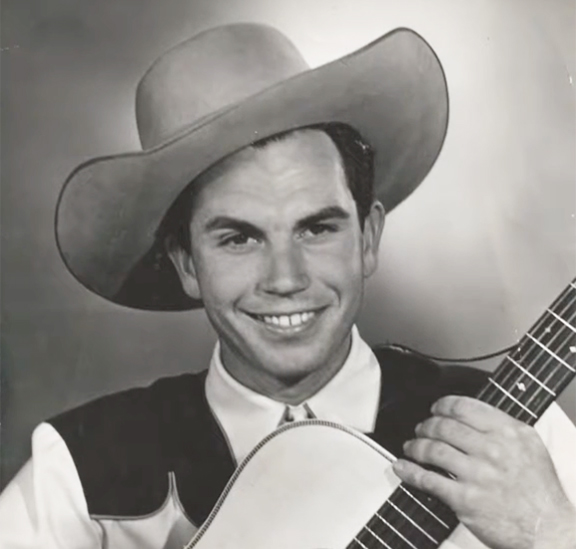
One of those searching for such a song was Paul Westmorland. He was born in Tyler, Texas, in 1916, but as a teenager with his family he moved to California during the Okie Migration brought on by the dust bowl of the Great Depression. “We was starved out in 1929” was how he described it.
During World War II he worked in defense plants but also began song writing and performing as a musician. He became a DJ in the Sacramento area, billing himself as Paul “Okie Paul” Westmorland.
Westmorland began to tour and write songs as he traveled. Among the songs he wrote were “Lordy, Oh Lordy” in 1952, “Save the Pieces” in 1953, and “What’s Another Broken Heart to You” that same year.
In 1954 he began recording with Decca Records. Included in his touring band was “Raymond “Cousin Ray” Woolfenden who would, in 1999, be inducted into the Country Radio DJ Hall of Fame.
But Westmorland is best known for writing the song, “Detour.” Jimmy Walker would record it
first, with Westmorland accompanying him on steel guitar. It was the first of a long list of artists who would record that song and make hits of it. Spade Cooley took the song to No. 2 on the country charts where it remained for 11 weeks in 1946. That same year Wesley Tuttle would
record his version and take it to No. 3, Elton Britt would cover it and take the song to No. 5, and Foy Willing followed suit and took it to No. 6. It was a great year for Westmorland and his song. It was only the beginning.
Patti Page would record “Detour” in 1951 on Mercury Records, peaking at No. 15 and remaining on the charts for 16 weeks. Bill Haley & His Comets added the song to an album in 1960. Hank Thompson included “Detour” on Golden Country Hits in 1964. The next year Dean Martin’s country album Houston had his version of “Detour.”
Instrumental versions were done by Duane Eddy and the Ventures.
The 1979 album One for the Road by Willie Nelson and Leon Russell included the song with the album peaking at No. 3 on the Billboard charts.
Even Cindy Lauper recorded the song accompanied by Emmylou Harris in 2016. The title of the album was Detour.
Westmoreland would die in California in 2005, having witnessed his creation reach classic country status during his lifetime. The lyrics touched generations.
The first stanza and chorus were:
“Detour, there’s a muddy road ahead.
“Detour, paid no mind to what it said.
“Detour, all these bitter things I find.
“Should have read that detour sign.
“Headed down life’s crooked road
“Lots of things I never knowed,
“And because of me not knowin’, I now pine.
“Trouble got in the trail,
“Spent the next five years in jail,
“Should have read that detour sign.”
(chorus).
You might wonder why we are talking about a country song from a Texan via Oakie California in a column with the general objective of Western North Carolina, East Tennessee and North Georgia local history. Here’s the connection.
Westmoreland was touring in 1946, various small towns on many roads that “muddy” was a common description, as were detours. Probably such encounters with the elements are what gave Westmorland that magic spark of creation that turned “Detour” into a classic song.
But when Westmoreland wrote “Detour,” he happened to be traveling to a small town destination in Western North Carolina – Murphy. He wrote the song en route, and the first time it was ever performed in public was the following night – in Hayesville, N.C.
Few in the audience that night in Hayesville knew they were witnessing the birth of one of the true classic country songs. “Detour, there’s a muddy road ahead.”
Radio personality Paul Harvey would have ended what we’ve said here with the simple words, “Now you know the rest of the story.” Indeed now you do.
Bruce Voyles’ local history column runs every other week in the Cherokee Scout. Email him at RoadsLessTraveled@cherokeescout.com.