
 |
Live music in the area is common today. Just about any nice restaurant or bar on weekends will have someone with a guitar in the corner providing music – many of them amazingly good. Spots like Chevelles host a variety of bands regularly, and a few bluegrass groups are often leaving the area for nearby festivals.
As long as people have been willing to listen to music, there have been people eager to play it, but the start of the rock boom was in the early 1960s, shortly after The Beatles appeared on television’s The Ed Sullivan Show and turned the music world upside down. Everyone was soon buying electric guitars, starting a band, and letting their hair grow longer.
It was a movement. West Fannin (Ga.) High School at the time had around 300 students, and 13 different bands practicing in garages and outbuildings, all with dreams of stages, recording contracts, and until that magic day – providing music to high school gyms full of dancing bodies.
Rock radio stations were far away. Daytime for rock music was only WFLI out of Lookout Mountain,
Tenn. At night, we found our music on WLS out of Chicago, WOWO in Fort Wayne and for soul music John R at WLAC from Nashville, Tenn. Eight tracks had yet to be born, let alone cassettes, CDs or digital files.
WFLI sponsored a Battle of the Bands at West Fannin in 1968. Four local bands competed, among them The Crystal Ship and The Uprising. Both lost. Teenage bands break and reform, much like discontented Baptists in a church split.
Members from those bands formed The Other Side in Murphy, bringing in a couple talented singers, and began playing dances, March of Dimes teleramas and even a free dance on Murphy’s graduation night at the softball field.
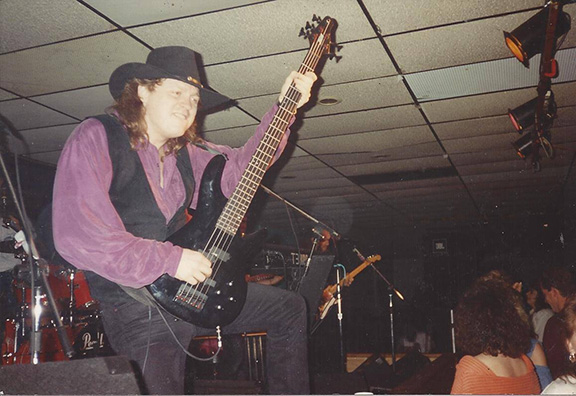
Members of this band were Mike Reese, Ronnie Graves, Jerry Hampton, Chris Smith, Michael Mauldin and your author. Only a handful of years after the passing of the Civil Rights Act, this band was comprised of black and white members – not a common thing in those days, all united by their love of playing music.
We were but only one of a long line of bands and musicians to come from the tri-state area.
Some played because it was a trend, others because girls like boys in the band. Those with talent played because a force inside them required playing. They had to play.
Those with less talent, like myself, became content with guitars around campfires. Those with talent continued and eventually made their marks in the story of music in America.
There was certainly musical talent here. Jan Davidson, longtime director of John C. Campbell Folk School in Brasstown, had a band, The Lonesome Travelers, and would later take an off-Broadway musical, Diamond Studs, to New York and gain network TV appearances and tour the show.
The Fluid Ounces’ organ player was Merle McRae from Murphy – and they would eventually produce an album of their music, touring much of the Southeast, including headlining as The Pier in Daytona Beach.
T.H.E. Beat was one of the first bands of that era: Denny Smith, Brittany Beavers, Jim Lambert and Jimmy Dee Wallace. Drummer Wallace made a career in music; he has accompanied Percy Sledge in concert.
Roscoe Hall and his brother, John, were among the best musicians any of us had ever heard. (The same Roscoe Hall the bridge is named after at the lower end of Murphy.)
Venues included the Blue Ridge (Ga.) Canteen, The Copperhill (Tenn.) Canteen, The Rock Gym, Andrews Community Center, Bill’s Roller Rink, Blairsville (Ga.) Convention Center and any school homecoming, prom, harvest festival or any large gathering.
Bill’s Roller Rink utilized the venue for dancing and rock until midnight every Friday night. On Saturdays, it was live country music. Porter Wagoner and Dolly Parton played there.
The Blue Ridge Canteen hosted Joe Walsh and the James Gang before Walsh joined The Eagles. My band played the following week. It was an impossible act to follow.
The Blazers from Blue Ridge was among the best bands of the time. Their album, On Fire, is sought by European music collectors who pay thousands for a copy, considered one of
the best garage band recordings.
Bazer members included the late Danny Postell of Turtletown, Tenn., and Danny Davenport, who would continue in the music business and later discover a Georgia performer named Travis Tritt.
Other popular bands from that era included The Judge & Co. in Andrews and Dark Lafter (a later band of your author’s).
Ricky Aiken from Ranger chose a musical career and was a mainstay at the Renfroe Kentucky Barn Dance for years.
This time was an amazing era for teenager entrepreneurs. We could rent the Old Rock Gym for a few hundred dollars, create our own posters with construction paper and markers, and with the help of local businesses who allowed posters in their windows, we could host a dance and charge admission, often leaving a sizable profit for boys who would have played for free.
Amazingly in those days, a 16-year-old could rent the Rock Gym in Murphy with just a phone call.
Later local bands would include Burning Desire, featuring Dewayne Cole on bass. He continues supporting local bands with supplies and support through his store, Murphy’s Alpha Music, and is still rocking and playing today.
Others of us gave up. When I sold my M4 Hammond and Rickenbacker, I threw in the microphones, stands, wah-wah pedals and the rest. “You’re crazy,” he told me. “This stuff is worth money.”
“Take it,” I said. “I do not want the temptation.”
I do have something today to show for my years playing that loud music: memories – a 1970s D28 Martin and hearing aids.
Among those mentioned in this column is a man who will make it into the N.C. Music Hall of Fame and become a music legend the world over. Read about him in our next column here in two weeks. His name is Michael Mauldin.
Bruce Voyles’ local history column runs every other week in the Cherokee Scout. Email him at RoadsLessTraveled@cherokeescout.com.