
 |
Once the Cherokee ruled from Nashville, Tenn., to South Carolina, from Atlanta into Kentucky, with constant encroachment into Cherokee lands, usually meaning armed conflict, military retribution, and the Cherokee ends up ceding land to the white man. From the 1600s until 1838, it was a constant refrain.
The Cherokee council enacted a law that denied permission on the penalty of death to cede any more land to the white man. One of the proponents of that law was Major Ridge, a legendary Cherokee leader. When Chief Doublehead was discovered ceding land to white men for bribes, it was Major Ridge who executed him.
Ridge became Major Ridge after being an officer of Cherokee troops in Andrew Jackson’s army that defeated the Redsticks Creek at Horseshoe Bend.
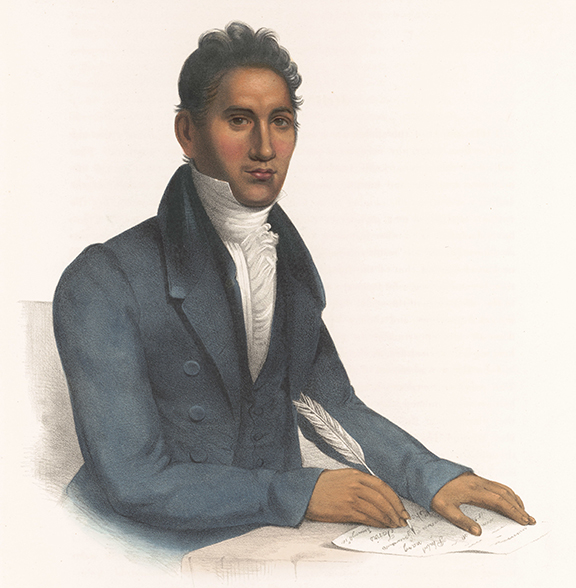
The actions of Major Ridge often overshadow another prominent figure during the Cherokee Removal, his son, John Ridge. It was John who was the spokesman in Washington for much of the Cherokee lobbying efforts to resist removal. Major Ridge could neither read nor write but allowed missionaries to come into Cherokee lands provided they educate his children, and John soon found himself in school in Cornwall, Conn., at the Foreign Mission Board School, a school established to educate minorities.
John was smitten with Sarah Northrop, daughter of a white New Englander, and he requested to pay court, but was denied, the excuse being his health was poor. John returned to Georgia, rebuilt his health, returned to Connecticut in 1824 and married the girl – over the vocal objections of residents of the town, who saw it a scandal that an American Indian would marry a
white girl. (Later his cousin, Elias Boudinot, attending the same school, would also marry a missionary’s daughter).
With local sentiment high against the marriage, John and his new bride moved to Georgia, where with his literate abilities he became a most valuable asset to the Cherokee National and was chosen for the Cherokee National Council.
In 1821, the Creek had signed a treaty ceding land, led by Chief William McIntosh – who was soon murdered for the act (some bribes were paid McIntosh).Later, in 1825, the Creek petitioned Washington to revoke the treaty. As the Creek leaders were not fluent in English, they hired Cherokees John Ridge and David Vann to represent them in front of then-President John Quincy Adams. John was so convincing that the treaty was renegotiated.
John became clerk of the Cherokee National Council and was part of the delegation who went to Washington, lobbying against removal and celebrating when the U.S. Supreme Court ruled in Worchester vs. Georgia that the Cherokee Nation had sovereignty over their lands and Georgia did not, and white Georgians should leave the land on which they were now considered squatters.
The Ridges met again with President Andrew Jackson, and to their dismay learned that Jackson was going to defy the Supreme Court and do nothing to implement their ruling, remarking that perhaps the court should send their own army to enforce their ruling.
John Ridge got the message. Removal was inevitable. The new strategy devised was they should make the best deal possible and take the deal – cash and equal land in Oklahoma. The Cherokee split into two factions, the Treaty Party headed by the Ridges and their cousins, Elias Boudinot and Stand Watie, opposed by Principal Chief John Ross with the National Party.
In 1835, the Treaty Party met with U.S. negotiators and signed the treaty of New Echota, agreeing to a payout and to remove themselves from Eastern lands. Ross opposed with a petition of almost 13,000 Cherokee stating the Treaty Party had no binding authority over the bulk of the nation – but the United States had a signed piece of paper, and that was enough for the Removal Act to clear Congress. They gave the Cherokee two years to get moved.
Ross unrealistically hoped for a deal that would allow the Cherokee to stay, reassuring the Cherokee he had it covered and not to worry about removal. So they did not prepare, believing Ross until 1838, when U.S. troops arrived to enforce the removal.
The Ridges and friends moved to Oklahoma three years before the forced removal began. John Ridge traveled by carriage – through Nashville, where he took the time to visit former President Jackson at The Hermitage. In Oklahoma John began stocking a store, anticipating the needs of the thousands of Cherokee being removed.
Those in the Ross’ National Party considered all Treaty Party proponents as traitors, and Major Ridge had remarked when he signed the New Echota treaty, “I have just signed my death warrant.”
On June 22, 1839, his prophecy came true. Ross’ followers struck at three locations, in parties ranging from 20-30 men, ambushing Major Ridge, Elias Boudinot and dragging John Ridge from his bed into his front yard, where his wife and children witnessed him being stabbed 25 times and a line formed with each assassin stomping his body. John did not die immediately. His family carried him inside his home where he passed. He was 37 years old. Stand Watie had been warned and escaped.
Ross claimed he knew nothing of the assassinations, although the celebration of the murders was at Ross’ house that night. When told surviving treaty party members and Stand Watie had been seen nearby, Ross urged his followers to find and kill them.
Army dragoons were sent to arrest the murderers, but Ross claimed ignorance and no one was ever arrested, even though it was common knowledge among the Cherokee who had committed the murders.
What followed was a Civil War within the Cherokee in Oklahoma lasting two bloody years. John Ross would get a large cash
settlement from the U.S. government as payment for transporting Cherokee during the Removal – building massive mansion with the proceeds.
In the American Civil War with many Cherokee slave owners – they took up the Confederate cause. Stand Watie became a Confederate general – and during that war put John Ross’ mansion into ashes.
Bruce Voyles’ local history column runs every other week in the Cherokee Scout. Email him at RoadsLessTraveled@cherokeescout.com.