
 |
The mid-1830s was when the world turned upside down for the Cherokee living in what is now Cherokee County, N.C.
This land belonged to the Cherokee for centuries, though over the years whittled smaller by treaty after treaty, often secured
by bribing the decision makers among the Cherokee. Then in 1930 the ultimate came – The Indian Removal Act.
Under the guise of “we’re from the government and we know what is best for you,” Washington politicians decreed Southern Native Americans would benefit by being removed from their ancestral homeland to new land west of the Mississippi acquired in the Louisiana Purchase, separating them from potential conflict with the white man.
Creek, Choctaw, Chickasaw and Seminole were under the same umbrella and already in the process of moving. The Creek and Seminole tried armed resistance but to no avail. Then it became Cherokee’s turn.
The Cherokee fought the removal by lobbying in Washington led by English-speaking Cherokee who presented themselves as assimilating into white society, delaying and negotiating.
With the Treaty of New Echota a minority of Cherokee signed the treaty giving up the land. It wasn’t stolen, the government paid a pittance, one-tenth of what the United States would sell the land for a year later.
Two years were allowed for the Cherokee Removal, with no movement made, in part because John Ross was continually coming up with counter-treaties and submitting a petition refuting the treaty of New Echota. The petition delivered by Ross was dismissed, claiming young children and the deceased were represented on the petition. With most of the signers unable to read the legal documents only signed with thousands of unconvincing “X” marks.
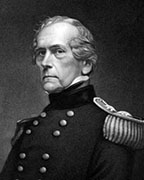
The time came when the Removal was forced bringing here the first of the removal generals, John Ellis Wool.
Raised by his grandfather in Troy, N.Y., Wool was a lawyer until the outbreak of the War of 1812, when he was 28. Enlisting he survived combat, being wounded and was promoted to lieutenant colonel by the war’s end. He was sent to Europe to study their military methods, returning to a new command in 1836 – that of laying the groundwork for the Cherokee Removal. He was chosen
in part for his superior organizational skills, and to provide a military presence to prevent any armed resistance, such as was occurring among the Creek and Seminoles.
Wool established forts and plans throughout the Cherokee land, choosing a central location for Eastern headquarters in western North Carolina at a place where two rivers met and Archibald Hunter had a trading post. Wool named his new fort after the U.S. attorney general, Ben Butler – Fort Butler, in what is today Murphy, N.C.
Wool had a tough job, was understaffed, and allocated limited funds not helped by an economic panic in 1837.
Wool’s next order was for all Cherokee to turn in their firearms. Many Cherokee depended upon hunting to supplement their meager crops, but that did not matter. There was reluctance to turn in firearms, so Wool ordered the Baptist Missionary to the Cherokee, the Rev. Evan Jones, to use in influence to encourage the firearm turn in.
Jones refused, so Wool arrested Jones and his assistants, threatening to take Jones and his assistant, David Foreman, with Wool as he went door to door
confiscating guns. Jones issued the call to the Cherokee, in part thinking they could turn in an old worn-out rifle and keep the better one.
Wool ordered Jones to stop preaching resistance to removal – but Jones moved outside the Cherokee Nation and continued his preaching, continuing a circuit through the Cherokee nation, eluding Wool’s threatened arrest.
Food, clothing and blankets were distributed by Wool to impoverished Cherokee as a part of his duties.
Wool’s tone was sympathetic when he wrote to the secretary of war: “The duty … only made tolerable with the hope that I may stay cruelty and injustice and assisted the wretched and deluded beings called the Cherokee who are only the prey of the most profligate and most vicious of white men.”
In March 1837, Wool addressed the Cherokee Nation urging them to realize that despite Ross’ assurances to the contrary, the treaty would be enforced, with a deadline of May 25, 1838.
He advised: “Take my advice, it is the advice of a friend … who feels deeply interested in your welfare and who will do everything in his power to relieve, protect and secure you the benefits of the treaty. And why not abandon a country no longer yours?”
For the politicians of Georgia and the Indian commissioners eager to gain access to the Cherokee land, the fact Cherokee had not yet vacated became a major annoyance – and with animosity to anyone who gave any sympathy to the Cherokee as Wool did.
When Wool restricted the liquor trade to the Cherokee he was investigated for “interfering with the laws and sovereignty of Alabama.” He was cleared of charges.
Wool chafed under such direction of the non-military authorities and protested to his superiors, but his opposition had done their job in poisoning their opinion of Wool. In 1837 Wool was replaced by Col. William Lindsay, who was less sympathetic to the Cherokee’s plight. Wool had been in the job for 13 months. His compassion for the plight of the Cherokee in comparison to the officers that followed did much to give him the reputation of a humanitarian general.
The new fort at New Echota was named Fort Wool in his honor.
Wool’s career with the Cherokee was over – but not that of his service to the U.S. Army. His bravery and abilities were credited with the victory at Buena Vista during the Mexican War, a victory Zachary Taylor used to put himself in the White House.
Wool would be the oldest general in the American Civil War, commanding Union troops when he was 77 years old. He protested his removal because of age, dying in 1869. He is buried in his hometown of Troy, N.Y.
Bruce Voyles’ local history column runs every other week in the Cherokee Scout. Email him at RoadsLessTraveled@cherokeescout.com.