

 |
Imagine it is 1830 and we are standing where the Hiwassee and Valley rivers unite, a spot that will someday be the Murphy River Walk and a few hundred yards from the future town of Murphy. Is all yet to come. What is here is a trading post by ARS Hunter on the other side of the river, he has ferries to cross the rivers for a fee. This is still the land of the Cherokee.
Nearby is the Unicoi Turnpike. It has coursed through the Cherokee land for 11 years, a road of trade and commerce connecting the white settlements in east Tennessee with the markets and plantations of South Carolina.
It is a road of commerce, and most of the goods traveling the turnpike are not by wagon but on legs, animals carefully herded 10 miles a day. Most of those animals are hogs. Thousands of them each year.
Before refrigeration preservation of meat had its limitations. For those living in the Southern Appalachian Mountains there were few plains for cattle herds, but the terrain was ideal for but free-ranging hogs. Further South that flat land was more profitable utilized for cotton, rice and indigo rather than food crops. The plantations needed herds of pork for food.
Pork on the hoof was nothing new. The Romans had hog herds. The first hogs seen in these mountains were brought by a Spaniard named DeSoto around 1540.
Hogs are intelligent hardy animals, well suited for mountain habitat, and by colonial times most settlers in the mountains would have a number of hogs, fattening themselves on acorns and roots and whatever else the mountains could provide – for an animal that would eat almost anything.
By the early 1800s with Cherokee land whittled away in upper East Tennessee, the settlers along the Watauga and Nolichucky rivers who occupied the land soon had an abundance of hogs fattening in the hollows. Each owner marked their hogs by notching the ears in a distinctive pattern.
(Or sometimes not – it was an argument over both sides claiming notched ear hogs that was a central part of the Hatfield/McCoy feud on the Kentucky-West Virgina border.)
For the plantations of the deep South hogs were a staple food. The rub was how to get hogs from the mountains to the southern markets in a day of bad roads, shallow rivers and no railroads. The solution – hog drives.
Long before the cattle drive of legend where coursing from Texas to the railheads of Kansas, drovers here were directing herds of other animals down the mountain roads, among them occasional small groups of cattle, horses, mules, sheep, goats, ducks, turkeys and geese. But the primary animal trafficked from the mountains to the Southern markets in massive drives was the hog.
One North Carolina tollgate counted 692 sheep in 1847, 898 head of cattle, 1,317 horses, and 51,753 hogs. It was estimated that hogs were five times as many as all other types of livestock combined.
By comparison the western cattle drives lasted 15 years and herded 600,000 head a year. Hog drives were common for nearly a century, with hog drives pushed through Asheville along the French Broad, down the Natchez Trace, and from Knoxville to Georgia through the Unicoi Gap and down the Unicoi Turnpike.
There is even a hog statue in Asheville commemorating the hog drives of the 1800s.
With the coming of the railroads most of the flat land moved livestock by rail, but with the rough terrain of the mountains, hog drives were still the most efficient way to move hogs to market much later.
The path of hog drives through this area began in 1819 when a treaty with the Cherokee included a toll road to be allowed through Cherokee lands. The road had a toll gate at Unicoi Gap and was routed close to what Joe Brown highway is today. An inn or tavern with lodging and corrals was built every 10 miles, originally called wagon stands but soon were simply called “stands.” There were around four stands in Cherokee County during those days – the 10 mile distance between stands determined by the typical distance a hog could be herded in a day without substantial weight loss. Preventing weight loss on the trip was a key concern. That weight loss, referred to as “drift,” was often remedied by the innkeeper who grew corn on the adjoining lands to feed the hogs when they halted for the night.
An injured or lame hog would be traded to the stand owner in exchange for hog forage or the cost of their room and lodging.
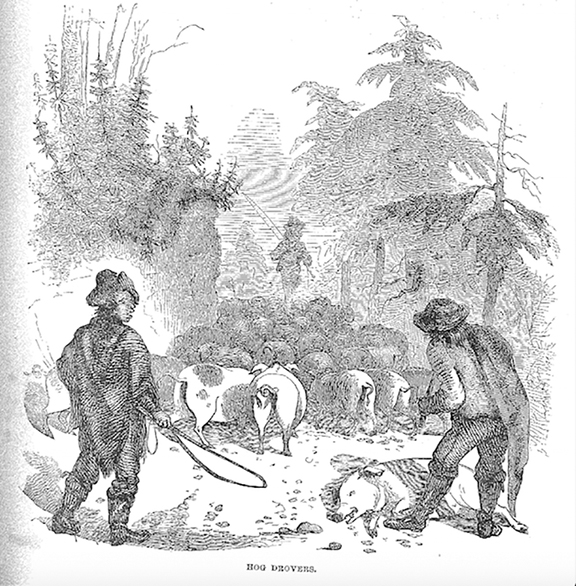
The method of hog driving was refined over the years. Typically the head drover was at the front of the herd road on horseback. Drovers flanking the herd walked behind on foot, allocated as one man per every 100 hogs, shouting “Soo-eey” and “Ho-o-o-yuh” to urge them along. Some herds were said to contain as many as 1,000 hogs.
It wasn’t easy. Most difficult part was the early stages of a hog drive was when the hogs, unaccustomed to being herded, scattered at every new noise and often made their way back to their home farms.
In those pre-PETA days, the drovers came up with the solution. They would sew the hog’s eyelids, and thus blinded the hogs traveled clumped together by feel. Once further along the road with the hogs now used to herding, the stitches would be cut.
Some hog breeds such as the Poland China were especially bred to be better at walking long distances.
Hogs were more suited to mountain drives as the trees provided shade, and the streams provided a steady source of water – and problems. With easy access to water, hogs were prone seek a muddy spot and begin wallowing.
One drover said the solution was “Never let a hog know he was being driven, just let him take his way and keep him going in the right direction.” That advice could apply to a lot of other life situations, too.
Bruce Voyles’ local history column runs every other week in the Cherokee Scout. Email him at RoadsLessTraveled@cherokeescout.com.