
 |
There are few Cherokee battles that are cited as much as the Battle of Horseshoe Bend during the Creek War of 1813-14. It was there Cherokee Leader The Ridge gained fame, and Junaluska is said to have saved the life of Gen. Andrew Jackson.
Before the coming of the white man, Cherokee were in constant conflict with the Indians to their south, the Creeks, their mortal enemies. Creek prisoners captured by the Cherokee who were not kept as slaves were often sold to the British, who in turn sent their newly purchased slaves to work plantations in the
West Indies. (As did the Creek with Cherokee captives.)
There were two factions of Creek, the lower Creek and the upper Creek, also called the Red Sticks, so named because of their war clubs they painted red. The lower Creek wanted to assimilate with the white man following the Cherokee example, while the upper Creek
wanted to stop encroachment of the white man. With the coming of the War of 1812, the British were eagerly arming their Red Stick allies.
When Tecumseh and his brother, Tenskwatawa (the Prophet), went to the Eastern Native Americans calling upon them to unite as a single unit and push the white man from America, the upper Creek Red Sticks joined his cause.
The Cherokee, having been on the receiving end of a white man’s campaign that has destroyed several Cherokee towns turned Tecumseh down and decided to sit this one out.
The Red Sticks under Chief William Weatherford believed that any Indians who allied with the Americans, and that included
the lower Creek who had established plantations
near Ft. Mims in lower Alabama deserved death. The Creeks were in civil war, and as conflicts escalated many fled to the safety of Ft. Mims.
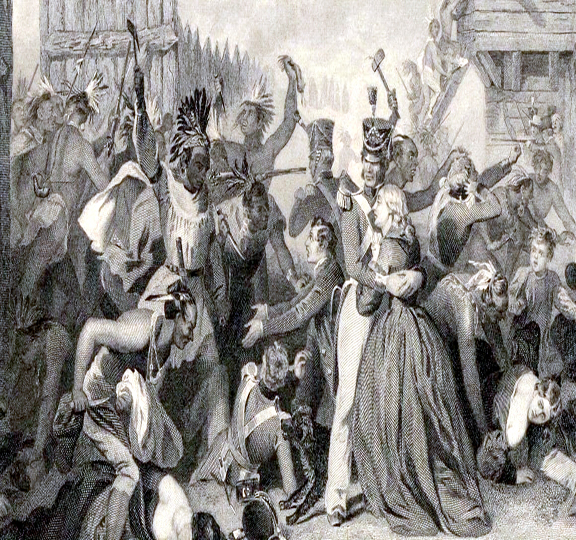
In 1813 when a shipment of munitions from the British were intercepted by troops out of Fort Mims, the Red Sticks attacked the fort in August of 1813, storming the palisades gate which had been left open, and shooting through the fort’s loopholes from the outside, taking the fort by surprise. Before the battle was over, the Red Sticks had killed more than 275 men, women and children, including many lower Creek tribe members. Many were scalped due to an untrue rumor the Brits were paying $5 for every white scalp.
The Red Sticks carried off over 100 captives, many of them slaves, and at the conclusion of the four-hour battle burned the fort to the ground. The cry of “Remember Fort Mims” was soon echoing across the frontier, and justice was demanded.
With Federal armies occupied fighting Brits in the War of 1812, the job fell to local militias. Three thousand Tennessee, Georgia and Mississippi Territory Militia were sent to destroy the Red Sticks under the command of Jackson, including a contingent of lower Creek and over 300 Cherokee.
Cherokee leader The Ridge was awarded the rank of Major and from that point forward he was known as Major Ridge, and would play a key role in Cherokee leadership for years to come. Junaluska would stand
out among the Cherokee troops.
When a Red Stick captive was brought to Jackson for questioning, the prisoner seized a knife and leapt for Jackson. He might have succeeded had not Junaluska intervened and thus saved the life of the future president who would be instrumental in the forced removal of the Cherokee from their native lands to Oklahoma.
Among the scouts for Jackson’s army was Tennessean Davy Crockett.
As the preparation for the campaign against the Red Sticks continued, Jackson was losing men to desertion with the onset of winter, forcing Jackson to depend more on his reliable Cherokee troops, who were soon taking a role beyond that of just interpreters, guides and scouts.
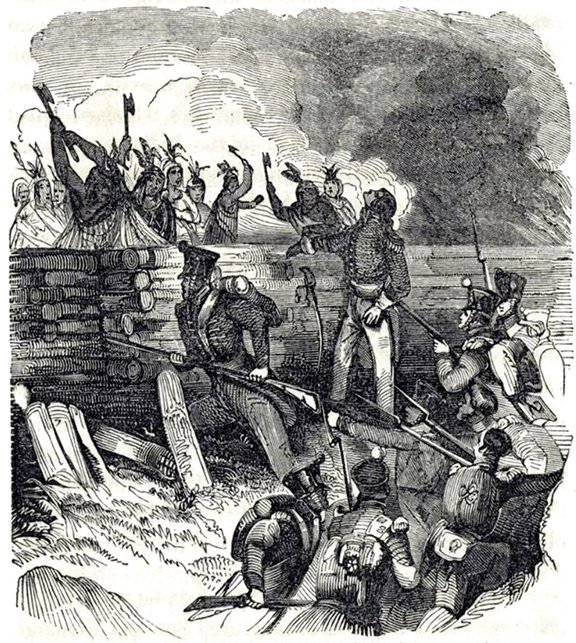
The Red Stick Creek stronghold was Tohopeka in eastern Alabama, on a peninsula of the Tallapoosa River, protected on the landward side by a massive elaborate breastworks that resisted the cannon fire from Jackson’s command, and made a frontal assault suicidal.
Jackson began the battle on March 27, 1814. The turning point in the battle came when Junaluska and other Cherokee swam the river to the Creek side, stole the Red Sticks’ canoes, and in turn used the canoes to ferry 200 Cherokee across the river and attack the Red Sticks from the river side of their encampment.
With Red Stick warriors leaving the barricade to defend against the Cherokee attack from their rear, it allowed Jackson’s troops to attack the weakened breastworks, and they breached the barricade and destroyed the Red Sticks. Sam Houston was wounded in storming the barrier.
Around 1,000 Red Sticks were killed, including several hundred shot while attempting the swim the river, since the canoes on which they had planned an escape had been captured by Junaluska’s group.
The victorious Cherokee’s spoils of battle included their returning with Red Stick women and children as captives.
The surviving Red Sticks were forced to surrender more than 20 million acres in the Treaty of Fort Jackson. (One-half of what is Alabama today.)
The site of the Battle of Horseshoe Bend is a national military park near Alexander City, Ala.
The Battle of Horseshoe Bend’s importance to history is more than the amount
of territory the United
States gained, but also because it thrust Jackson into national prominence –
a role he would carry to victory at the Battle of
New Orleans against the British and on to the White House.
The battle is also important as increasing the prominence of Ridge and Junaluska, and detrimental to the Cherokee, who were lulled into believing the Cherokee’s service to Jackson, including saving his life, would affect Jackson’s decisions in favor of the Cherokee in the future.
Jackson is reported to have told Junaluska, “As long as the sun shines and the grass grows, there shall be friendship between us, and the feet of the Cherokee shall be toward the East.”
Those of us in Cherokee County know how that ended up.
Bruce Voyles’ local history column runs every other week in the Cherokee Scout. Email him at RoadsLessTraveled@cherokeescout.com.