
 |
It was at Georgia State University where history of American journalism professor Chad Skaggs passed out a small piece of metal type, the kind they hand-set in trays for printing presses in the old days. We each touched it before he placed it back in a small box and began his story.
He had been invited to a marker dedication at New Echota, Ga., home of the Cherokee Phoenix, a newspaper that was printed in the Cherokee language prior to the removal, and in 1835 the newspaper’s presses were destroyed and type scattered by a Georgia mob. As Skaggs walked around the grounds, he looked down and had kicked up a piece of metal type, with a Cherokee symbol. He had a relic of true journalism history.
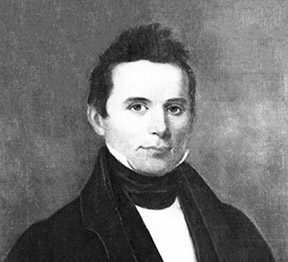
The founding editor of the Cherokee Phoenix was a Cherokee known as Buck Watie, Gallegina in Cherokee. He was born in 1802 and attended a Moravian missionary school near Spring Place, Ga. A standout student, in 1818 he was invited to further his education at the American Board of Commissioners Foreign Missions School in Cornwall, Conn., a school established to educate promising young men from foreign and Native American cultures.
Buck Watie was introduced to Elias Boudinot, a prominent statesman of the time who had presided over the Second Continental Congress, a New Jersey congressman, president of the American Bible Society and a patron of Boudinot’s school. The statesman so impressed Buck Watie that he asked Elias Boudinot if
he could change his own name to Elias Boudinot in tribute.
Buck Watie, now known as Elias Boudinot, converted to Christianity, attended Andover Theological Seminary and became engaged to a white woman, Harriett Ruggles Gold, igniting a storm of prejudice. They were burned in effigy and, with this being the second Indian-white marriage at the school (Boudinot’s cousin, John Ridge, had married a white woman earlier), the school was forced to close, termed “a breeding ground for mixed couples.” In 1824, Boudinot was translating the New Testament into Cherokee.
Boudinot went on a speaking tour in 1826, publishing a pamphlet “An Address to the Whites” and raising enough funds to enable The General Council of the Cherokee Nation to purchase a printing press and type of their own. He began publishing the Cherokee Phoenix on Feb. 21, 1828, serving as editor. It was the first newspaper published by a Native American nation.
The newspaper’s title came from a line from Boudinot’s speaking tour, “the Indian must rise like the Phoenix, after having wallowed for ages in ignorance and barbarity.”
The goal of the Cherokee Phoenix was to demonstrate to the lawmakers in Washington the advanced Cherokee society with its own government, language, literacy and now newspaper.
Many Cherokee read the paper (literacy was estimated at 50-90%) but the target was more Washington lawmakers and to draw support to fight removal. The Phoenix was exchanged with over 100 other newspapers. It was written in both English and Cherokee.
With the passing of the Indian Removal Act in 1830, Boudinot recognized the futility of resisting removal and began publishing editorials urging the Cherokee to remove themselves voluntarily, which was against the wishes of the Cherokee Council, causing Boudinot to resign his editorship in August 1832.
In a letter to Principal Chief John Ross, he said, “I cannot tell them that we will be reinstated in our rights, which I have no such hope, and after our leading, active and true friends in Congress and elsewhere have signified to us they can do us no good.”
After leaving the editorship Boudinot published a pamphlet attacking Principal Chief John Ross who continued to resist removal.
Ross installed his brother-in-law, Elijah Hicks, as editor, but in 1836 the Georgia Guard seized and destroyed the press and equipment.
Boudinot remained active as a member of the Treaty Party, endorsing the voluntary removal to Oklahoma. He practiced what he preached – and when it came time to put his name on the Treaty of New Echota, he did not hesitate, adding his name to that of his uncle, Major Ridge, his first cousin, John Ridge, and his brother, Stand Watie.
The goal of the Treaty Party was to reach favorable terms through a negotiated settlement, insuring compensation for lost lands and preservation of Cherokee rights in Oklahoma. They feared that resistance would result in removal by force with no rights guaranteed.
The Treaty of New Echota achieved their goals, despite most of the Cherokee still in favor of resisting removal to the last.
In 1836, after the death of his wife in Georgia, he moved West with the other Treaty party signers before the forced removal began. He sent his children to the Brained Mission school in what is Chattanooga today. He married a second time, this time to a white teacher he met at New Echota.
After the U.S. Army forced the thousands of Cherokee to Oklahoma, for many of the Ross supporters who had fought removal it was now was time for retribution.
In groups of 25-30 men on a single day – June 22, 1839 – they set out to punish the violators of the Cherokee law (originally drafted by Major Ridge) that forbid, on the penalty of death, any Cherokee who ceded land to the white man. Major Ridge and John Ridge were killed by the large groups.
Boudinot was building a house and was approached by three men asking he take them to missionary Samuel Worchester for medicine. On the trail, the three men turned on Boudinot and killed him. His killers were never found.
His orphaned children were sent to Cornwall, Conn., to be raised by their grandparents there. One
of his sons, E.C., became an attorney and became active and prominent in tribal Democratic Party politics.
In 1959, Boudinot was inducted into the Georgia Newspaper Hall of Fame, and in 2005, Elias Boudinot was inducted into the Georgia Writers Hall of Fame.
Bruce Voyles’ local history column runs every other week in the Cherokee Scout. Email him at RoadsLessTraveled@cherokeescout.com.