
 |
Harry Nelson Atwood lived in Hanging Dog in a plastic house, and while it was indeed a novelty, few here knew the man who lived there and designed that house was, in fact, famous aviation pioneer Harry Atwood.
Atwood was born in 1883 in Boston, the son of a coal dealer. He attended the Massachusetts Institute of Technology studying electrical engineering but dropped out, re-enrolled and dropped out a second time. He had learned enough to put his inventor skills into patented electric meter designs he sold to General Electric.
The die was set for his fame earlier, when the Wright brothers flew their first flight at Kitty Hawk in 1903. The brothers subsequently monetized their aviation innovations by making and designing airplanes and also training pilots. They started Wright Flying School in their hometown of Dayton, Ohio.
Atwood was determined to learn to fly and utilized the funds from the sale of his invention he enrolled in the Wright Flying School. He was 24 years old.
Among the men who would train in the same 1911 class was Henry (Hap) Arnold, who would command the U.S. Air Force in World War II. Atwood finished the school in May 1911, after only two weeks of training, 18 lessons, and a flying time of one hour and 55 minutes.
With that as his background, he became the flight instructor for the Burgess Co., which was manufacturing airplanes under a license from the Wright brothers.
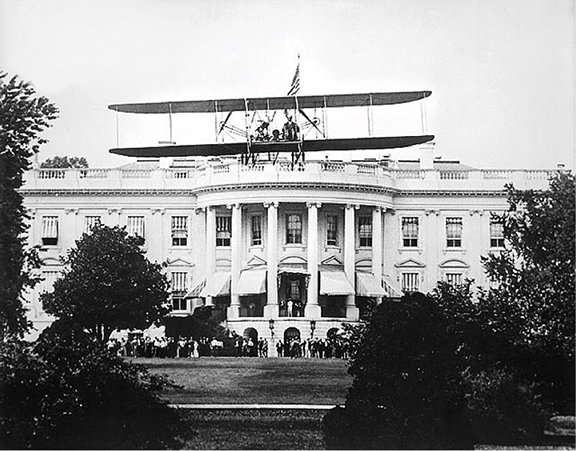
Within three months from his first lesson, Atwood was the first person to fly a plane over New York City, and he set a world record by flying 576 miles from Boston to Washington, culminating with a national headline-making landing on the White House lawn in front of President William Howard Taft.
His airplane was A Burgess Wright Model F, of which there are only three in existence today. It had a 39-foot wingspan, weighed 800 pounds and was powered by an engine that would put out between 28- to 40-horsepower.
Taft would give Atwood an aviation medal. The Burgess Co. converted a horse race track into a landing strip in Saugus, Mass., and named the field after Atwood. In the first four months of flying, he flew 1,600 miles, and became known as a leading aviator.
In those early days, aviation prizes were offered for record making flights, and Atwood won $10,000 for flying between Chicago and Milwaukee. That would be $319,000 in 2025 dollars.
Atwood made national newspapers again when he flew 107 miles to fly over the Harvard-Yale rowing regatta, with the newspaper hailing his speed.
“With weather conditions ideal all the way, he covered the 107 miles in 125 minutes, an average of a fraction over 51.56 miles an hour.” Once there, he flew over the racing boats “at a speed which the waiting oarsmen at Red Top And Gales Ferry envied,” adding, “He’d used 12 gallons of gasoline during his flight and by the time he’d landed the tank was nearly empty.”
In 1912, Atwood made the first air mail delivery in New England by dropping a sack of mail to a field in Lynn, Mass. That same year he was declared the “Undisputed Air King” with a fan base following his exploits as he flew exhibitions to raise money for a planned transatlantic flight attempt.
Those plans were never fulfilled, as he began to concentrate on his inventive pursuits. Atwood invented a flying boat and attempted to go into production of the planes, constantly reviving and improving the design but never going into full production, forced to make another career move when his factory burned in 1922.
Atwood began research into developing a plastic airplane, and is called by MIT “The Father of Plastic Planes.” He experimented with taking thin panels of wood at cross grain angles united with a bonding agent, then molded into shape. He flew his first design in 1912, but the glues of the time were prone to come apart in rain.
Atwood devoted eight years into his plastic plane. The processes he envisioned would eventually be perfected by others by placing wood in a vacuum and injecting it with epoxy. While this process did not work well for airplanes, it was ideal for sturdy airplane propellers as World War II would prove.
Atwood was a test pilot for the Wright brothers before forming a company to produce what he called “Rubwood” wheels, marketed primarily to baby buggies, shoe heels and kiddie car wheels. That company failed in 1927.
His company’s failure and the Great Depression prevented Atwood from finding other investors and at age 46 in 1930 he was forced to declare bankruptcy. That did not stop him.
Atwood built a small plane out of birch veneer strips and a new plastic he developed called Duply. The plane was called “the Model T of the air,” and with the help of a failing furniture company their first plane flew in 1935, declared by the press to be “the plane for the multitudes,” but that business also failed.
In 1939, Atwood sold his Duply designs for $10,000 – then others took his process and made millions.
With the coming of World War II, he became involved in trying to develop a plastic airplane financed by Andrew Jackson Higgins, the designer of the World War II landing craft utilized in Pacific landings and D-Day. This company failed as well, as did his later work on a milk purifier.
He remained in the aviation industry as an inventor and research scientist.
Atwood moved to the North Carolina mountains, building his house of what was locally called “plastic,” but were actually processes he had invented. The home boasted a plastic-covered swimming pool.
Atwood married four times before marrying Nellie Pickens, and they had a daughter, Nelda Atwood Stiles.
Atwood died in 1967 at age 83 in Murphy – 56 years to the day he landed at the White House. He is buried in the Hanging Dog Baptist Church cemetery.
Bruce Voyles’ local history column runs every other week in the Cherokee Scout. Email him at RoadsLessTraveled@cherokeescout.com.