
 |
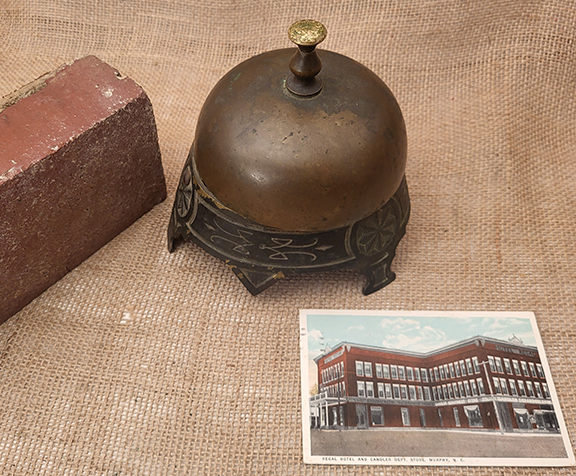
If one ventured into downtown Murphy anytime from 1910-78, there was one massive red brick building impossible to miss, boasting 50 rooms, three stories high, on the corner of Peachtree and Hiwassee streets. Its name described it well – The Regal Hotel.
For decades, the hotel was the central lodging for anyone visiting Murphy, impressing guests a with large wide staircase, elegant surroundings and amenities that were state of the art for the time, including steam heat, an electric elevator, electric lights, a brick building with a fire escape. A surviving advertising card lists rooms for $1, a room with a bath was 50 cents more. Dinner was 75 cents; breakfast was 50 cents.
The idea for a hotel was the project of J. L. Smathers, who found much success in Murphy as both a wholesale grocer and a tanning bark dealer. He announced the hotel plans in 1908, and it was in 1910 that the hotel opened, with a construction cost of $75,000 (2.5 million in today’s dollars).
The ground floor was occupied by G. W. Candler’s department store. When Candler announced his opening at The Regal, he announced a stocking inventory of $25,000 ($800,000 today).
The plans were originally for a fourth story, but instead the building material was used to construct another Murphy building, three stories high, at the corner of Tennessee street and Valley River Avenue, known as the Coward building to older residents.
In 1920, an ad in the Asheville Citizen announced that The Regal Hotel would be sold at auction. In 1921, a Mr. Meroney owned The Regal briefly before selling it to family that would become synonymous with Murphy hoteliers, brothers Columbus (Lum) Savage and younger brother William Anderson (Will) Savage.
The brothers had been involved in a real estate transaction for the sale of 8,859 acres in 1918 representing Lily Lumber Co. of West Virginia, leading to a lawsuit resulting in a settlement of $16,000 for the Savages, giving them the resources to purchase The Regal Hotel. The family moved to the third floor of the hotel.
In May 1928, the brothers leased the hotel to B. G. Gregory and P. C. Clark for 10 years, but in February 1929, W. M. Chester obtained that lease for $500 per month, plus $5,000 for the linen and supplies, including an option to buy The Regal for $90,000 within five years. However, the Great Depression canceled the plan.
The Savage brothers’ father, E. A. Savage, returned to Murphy from Florida in 1928. The 91-year-old told his family that he felt as if the sun was setting on his life, and he wanted to return home to die. The Civil War veteran who had survived combat at Bull Run, Gettysburg and was captured by the Union troops at Petersburg obtained his goal, and passed at The Regal Hotel only three weeks after his return. He is buried in Sunset Cemetery.
In the succeeding years, the Savage brothers would run the hotel between leases to other managers, with management of The Regal seeming to revert back to the Savages regularly. In 1942, the Savages sold The Regal to Howard Dayton, and Lum Savage opened the Savage Hotel across the street from The Regal. That upstairs location entered to the left of what is ShoeBooties Cafe today.
Dayton sold to a corporate syndicate that hired Thelma Dickey Phillips as manager. Tenants leasing the property continued, with Harry M. Seamon purchasing the lease and took over in 1949, and was eventually owned by Saul Schulman of Sylva, who owned it in 1978.
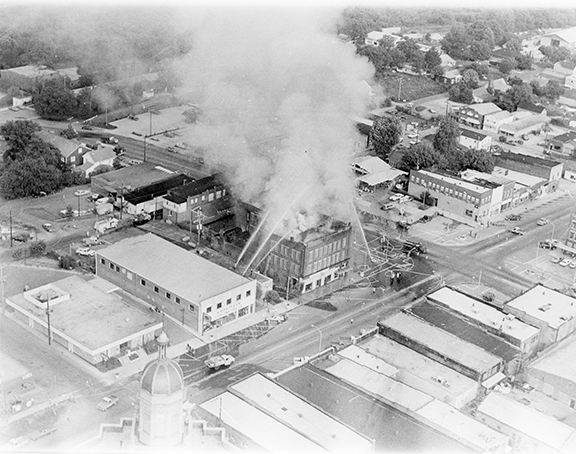
In July 1978, a fire originating in Maddox Hardware engulfed The Regal. Wally Avett, editor of the Cherokee Scout at the time, secured a plane to do aerial shots of the burning building. A door on the plane was removed, and Wally recalls that as they circled and flew through the smoke of the burning building, the smell of the burning hotel infiltrated the cabin. He says the odor was almost unbearable.
That was not yet the end of The Regal Hotel story. Demolition was handled by Wells & West, who were taking down the burned-out walls with a large wrecking ball – that somehow came loose and instead of hitting the wall destroyed a popular ladies dress shop next door to The Regal. The owner of the damaged building lived in Sylva, and the following morning a representative of Wells & West was waiting when the owner arrived with intentions of buying the crushed property before the owner learned of the destruction. The owner smiled when he saw him since he had already heard about what had happened. There is no public record of the settlement.
In my travels, I often find myself seeking old classic hotels: The Roosevelt and Waldorf Astoria in New York; The Peabody in Memphis, Tenn.; The General Francis Marion in Virginia; the Bentley in Alexandria, La.; and the Grove Park Inn in Asheville.
I suspect my fascination with vintage hotels began with The Regal Hotel. My grandmother brought me to Murphy for an overnight adventure – to see the wagon train in Murphy. The first year, we stayed at The Savage Hotel due to her friendship with Mrs. Savage. I was 6. The next year, at 7 years old, our hotel for that weekend was the red brick colossus that was Murphy’s finest – The Regal Hotel.
Much of this column was based on the original research of Cameron Killian. Our thanks to him for the assistance. There is a Facebook page, “Regal Hotel Memories,” for those who enjoy the classic old hotel.
Bruce Voyles’ local history column runs every other week in the Cherokee Scout. Email him at RoadsLess-Traveled@cherokeescout.com.