
 |
When pioneers came to tame a wilderness, they needed more than what could be tied to the back of a pack animal. They needed wagons to carry their staples and, if they produced sellable crops or heavy items, they needed those wagons to take their trade goods out. Those wagons rolled on wrought-iron outer wheels.
In Cherokee County in the 1830s, there was already a well-traveled, wagon-worthy trail running through the county, the Unicoi Turnpike, connecting the Tennessee Overhill settlements of Tenase and Tellico to Augusta, Ga., and points beyond. Iron was a necessity to conquer a frontier. A plow needed iron where the plow met ground. While pegs and leather would work for nails and door hinges on a rustic cabin, a wrought iron door hinge and iron nails were more effective.
That was probably not on the mind of George Washington Lovinggood when he came into Cherokee County in 1830 to minister to the Cherokee. During those times supposedly one could fence in acreage and file for a homestead. Lovinggood, in company with his brother, Harmon, started to do just that, with plans to fence in 1,500 acres in Valleytown.
The story goes that a Cherokee competitor began fencing in some of the same prime bottom land, and a race ensued. However, the Cherokee had an advantage, carrying the fencing rails in a wood wheeled cart and were obtaining more of the prime land than the slower Lovinggood brothers.
That is, until the morning they found their cart missing a wheel. Tensions were raised when the wheel was found on Lovinggood property. It was clear their future did not lie in Valleytown.
The Lovinggood brothers went to Plan B. They went into the most remote part of Cherokee County, a place known as Hanging Dog. There they made history by creating the first bloomery forge in Cherokee County.
Utilizing the brown hematite ores found around Marble, they were hauling ore via ox cart to their forge, where they had dammed up Davis Creek to create a water powered stamping press, bellows and drop hammer forge. It was 1837.
The State of North Carolina recognized the need for iron on the frontier and offered a gift of 3,000 acres of land for anyone who would establish a bloomery forge. The Lovinggood brothers took the state up on its offer, building the dam and two iron-making fires.
The bloomery process of creating iron was labor intensive, first requiring huge amounts of charcoal, obtained by digging large pits, into which 20 or more cords of chestnut would be dumped, ignited and skillfully smothered to create the charcoal.
The iron ore would be crushed into a fine powder with the stamping press. A forging fire was built with the charcoal, while the water wheel powered a bellows forcing air to the fire, making it much hotter. On to this fire a layer of fine iron ore would be ladled, and more charcoal added. Then more ore.
This became a days-long process of layers of iron and charcoal. The impurities would burn, leaving a rough piece of unworked iron. The fire burned out and the remains, called a bloom, was removed. Because of the porous nature of the bloom it was called sponge ore, as it resembled a sponge.
This bloom was heated, placed under the water powered drop hammer, reheated and hammered time and again, with the result wrought (worked) iron. This workable steel was suitable for wagon wheels, hinges, plows and legal tender.
Many workers preferred to be paid in the high demand iron, which would fetch four cents in trade. The men worked for 50 cents a day.
While the steel was in demand locally, the output was such that there was still enough iron to sell into Tennessee, carried down the Unicoi Turnpike as the Lovinggood’s was the closest forge. Other forges would soon follow, with forges in Hanging Dog and forges on Persimmon Creek and Shoal Creek.
Lovinggood continued his gospel mission as well, organizing Hanging Dog Missionary Baptist Church and becoming its pastor. He would die in 1862.
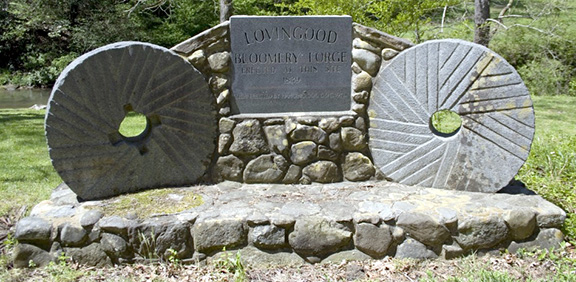
There is a monument to the Lovinggood forge in Hanging Dog, and the hammer used at the forge is displayed in front of the Cherokee County Historical Museum in Murphy.
Bruce Voyles’ local history column runs every other week in the Cherokee Scout. Email him at RoadsLessTraveled@cherokeescout.com.