
By Ann Miller Woodford, Guest Columnist
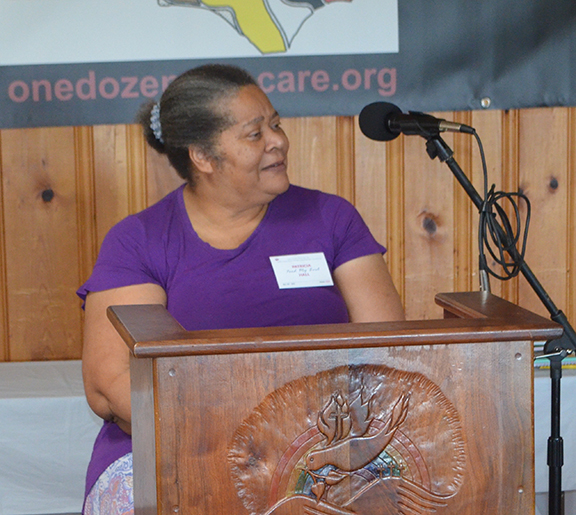
With much gratitude, I thank the Cherokee Scout and Abigail Blythe Batton for her remarkable article with photos in the April 26 publication about the 2023 One Dozen Who Care Inc. Multicultural Women’s Development Conference, which was held at the picturesque Hinton Rural Life Center in Hayesville.
The major goal of this conference is to tear down the barriers of age, race and religion as we lift each other up.
We honor the example of a returning keynote speaker, Kichung Lizee, a U.S. citizen originally from South Korea and a Buddhist priest, who drove to the conference from Maine with her husband to participate with us this year. ODWC is also grateful to all the wonderful speakers and participants who joined us for this very special event themed “Feed My Soul.”
Because ODWC, the first tax-exempt 501(c)3 nonprofit community development organization initially led by African-American women, looks forward to a big celebration of 25 years of service to the communities in far-western North Carolina next year, I would like to illuminate some points from the article.
ODWC was envisioned during a meeting on April 26, 1998, when 22 leading African-American women from Cherokee and Clay counties met as a collective group. This was the first time a forum of this type had sought the opinions and legitimate concerns of people of color who lived and worked in our communities. Subsequent to that meeting, and giving honor where honor is due, the founding board members of ODWC were Annie Jean Bennett, Brenda Blount, Kimberly Boykin, Jean Busch, Betty Jean Dorsey, Patricia Hall, Elyse Kelly, the Rev. Constance Mary Lang, Betty Smith Nicely, Angie Oliver, Mary Edna Pickens and myself.
Understanding that, as Nelson Mandela said, “Education is the most powerful weapon which you can use to change the world,” ODWC set out to let the world know that together we could help build a more positive world, one step at a time by starting in our own areas. We believed that we could become successful because we were passionately dedicated to our communities through faith, and the knowledge that we were strong and not afraid to try.
This group wanted to develop ways to strengthen our own leadership abilities and create community bonds through common cultural situations, increase leadership, assure the well being of our children and youth, and bring honor to our elders by investing in human resources from within our immediate region and to support viable community organizations with similar goals.
The mission has evolved, but the vision from that first meeting has stood firm. Our new more concise mission follows through on the original plan created by the initial group of amazing black women leaders. It states, “With a vision of a unified community that honors and respects racial and cultural diversity, ODWC Empowers, Educates and Encourages economic development for women, youth and elders in far Western North Carolina, in order to bridge cultures and create community bonds.”
It is always perilous to begin to name people for fear of leaving someone out. But I must mention Judith Alvarado and Mary Ricketson, who have been volunteers with ODWC from its inception. The group has held its annual conference since 2000, when they – along with Robin Mauney, who drove to Knoxville, Tenn., to get programs printed – were joined by a group of other community leaders who initiated the first conference.
Pamela Carmen was the first white woman to step up to join a group led by black women. We appreciate that our community works together for the good of all of us.
It is important to clarify from the article that many of the African-American people who live in Andrews attended the Andrews Colored/Negro Elementary School near Mount Zion Missionary Baptist Church on Collett Street in Happy Top. It was a one-room,
one-teacher, very small building. The Andrews school system did not provide living space for the teachers, so all of the teachers were forced to stay with African-American neighbors in Happy Top. Ms. Ida Mae Logan lived with the family of Helen Jones, across the street from the school building.
We have many challenges in our region. But another quote from Mandela says, “Everyone can rise above their circumstances and achieve success if they are dedicated to and passionate about what they do.”
Let us all continue to work together to see that our living shall not be in vain.
The writer is a resident of Cherokee County and one of the founding board members of One Dozen Who Care Inc.