
 |
Legends are unprovable good stories, void of historical fact or relics – but still capturing the imagination with “it could have happened that way.” To support that premise, we often find ourselves looking for other legends to back up the story, such as in the stories of the moon-eyed people.
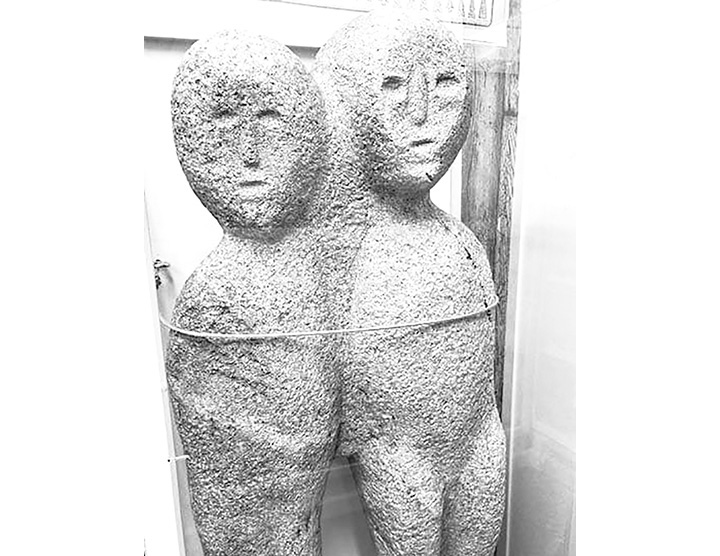
In Cherokee County, that story is especially treasured after an 1840s farmer excavated a stone sculpture of two figures with large eyes that some say fits into the legend.
That legend begins in 1170, when a Welsh prince was coming out on the short end of a battle for the throne after his father, Owain Gwynedd, passed. This prince – Madoc ab Owain Gwynedd, called Madoc – took to sea to flee the violence. Legend says Madoc sailed west, landing in Alabama. He supposedly returned to Wales, loaded up 11 ships with more men, women and children – and sailed away, never to be seen again.
From the 13th century, stories and poems abounded about Madoc, the prince who discovered a paradise in the New World and established a colony.
In the late 1500s, such stories were encouraged and promoted by Queen Elizabeth as proof Welshman Madoc had landed in the New World some 300 years before Columbus, giving England clear title and a priority claim to America.
Over the centuries, Madoc’s Welsh were said to have spread with settlements and forts up the Southern rivers, intermarrying with Native Americans, evolving into what were called Welsh Indians.
Morgan Jones, a minister, claimed he had been captured in 1669 by the Doeg tribe in North Carolina, and was spared when the chief heard Jones speaking Welsh, as the chief understood the language. Jones claimed he lived among them for months preaching the gospel, and 23 years later, in 1686, published his story, although dismissed at the time as a hoax.
The stories persisted. When Thomas Jefferson sent the Lewis & Clark’s Corps of Discovery up the Missouri, he wrote to Lewis in 1804 to look out for Welsh Indians. They did not find proof, but noted the unique Mandan tribe’s round skin-covered boats – bull boats – were similar to the Welsh coracle. The Mandan language was said to have many Welsh sounds and words, but unverified as the tribe was all but wiped out by a smallpox epidemic in 1837.
In 1810, John Sevier recalled a 1782 conversation with Cherokee chief Oconostota, during which he inquired about fortifications along the Alabama river. Sevier was told the forts were built by white people called “Welsh” before the Cherokee drove them away. Sevier also claimed discovery of six skeletons in brass armor with Welsh coats-of-arms engraved in the armor – a claim duplicated by Thomas Hinde in 1824.
Mormon leader Bringham Young sent a Welshman to the Hopi tribe to speak Welsh and hopefully identify them as Madoc descendants but failed. Welsh-born Mormon missionary Llewelyn Harris visited the Zuni tribe in 1878, and wrote that the tribe had many Welsh words in their language and claimed to descend from white men who had come there 300 years before Columbus.
Overall, 13 real tribes and five unidentified tribes have been put forth as possibly having connections as Welsh Indians.
The rock formations at Fort Mountain State Park in Georgia have been suggested as Madoc built. The 850-foot stone structure was once 12-feet thick and seven feet high and resembled European style battlements, although some suggest it was a village wind break rather than a fortification.
Daughters of the American Revolution erected a plaque at Fort Morgan in Mobile, Ala., in 1953 that read, “In memory of Prince Madoc, a Welsh explorer who landed on the shores of Mobile Bay in 1170 and left behind with the Indians the Welsh language.” The plaque was later removed by the Alabama Parks Service and is on display at DAR headquarters in Mobile.
This is all fodder for moon-eyed people supporters, who attribute the name moon-eyed people because they supposedly could see better at night. Could the moon-eyed people be so called because with their pale white skin and blue eyes, the Cherokee thought they were untanned and did not go out in daylight?
In James Mooney’s 1902 book, Myths of the Cherokee he links the moon-eyed people story to an 1823 book, The Natural and Aboriginal History of Tennessee who claimed the moon-eyed people were driven from Kentucky and west Tennessee. Mooney has two other mentions from the Cherokee he interviewed, who described a people who lived north of the Hiwassee River when the Cherokee arrived who were “very small people, perfectly white.”
The Town of Murphy was sold in 6-acre lots, and in 1841 Felix Ashely while plowing unearthed the two-person effigy housed today in the Cherokee County Historical Museum. He placed it on a sledge, drug it back to his house and leaned it against his well house for years. Prior to its unearthing, the effigy had reportedly been in a place of honor in the Cherokee Meeting House in the village along the Valley River near the Murphy River Walk today.
The effigy appears more of a representation of the moon-eyed people, not necessarily life size considering the work was produced by pegged stone, chipping another stone into another. If it was only a representation there was no need to make it full size. It is thought that the moon-eyed people’s settlement prior to being chased away by the Cherokee was on the opposite side of the Valley River near the Leech place.
Historians require proof of fact. The “might-have-been” and “makes-sense” deductions do not count. So the story of Madoc, Welsh Indians and the moon-eyed people, while linked by hope and logical deduction, has only a single artifact to bolster the story – a talc and sandstone effigy in the Cherokee County Historical Museum.
Bruce Voyles’ local history column runs every other week in the Cherokee Scout. Email him at RoadsLessTraveled@cherokeescout.com.