
 |
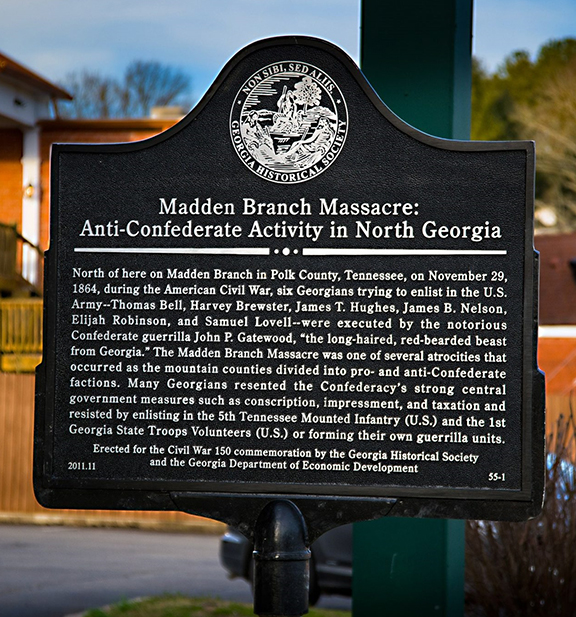
The story of John Gatewood and the Madden’s Branch Massacre is not a new one to longtime Cherokee Scout readers. Wally Avett dealt with the subject in a prior Hillbilly Ranger column and built his novel Rebel Bushwhacker around a character based on Gatewood, who was called “The Red-Bearded Red-Headed Devil From Georgia.”
There is more to the man and his story than the cold blooded murder of six men on the road between Copperhill and Cleveland, Tenn. Gatewood killed 12 others on that day.
Gatewood was 21 when the war began, and along with three brothers enlisted in the Confederate army in Fentress County, Tenn. After action around the Cumberland Gap and Perryville, Pemberton returned home to find his 15-year-old sister murdered by Union bushwhackers. His mother soon passed from the grief. These deaths instilled an intense hatred for all things Union.
The army did not provide enough opportunities to extract his revenge, so Gatewood joined Champ Ferguson’s Confederate guerillas. Today, Gatewood would be diagnosed with extreme post-traumatic stress disorder. He beat three captured prisoners to death with a river rock, saying he wanted to “save ammunition.”
Ferguson shared Gatewood’s detestation of Yankees. Ferguson would be one of only three Confederates hung for war crimes post war, specifically for murdering hospitalized wounded Union soldiers.
As the Confederate defeats mounted, Gatewood formed his own band of between 50 and 100 men, with the expressed goal – kill Yankees.
Gatewood was detached from Gen. Joe Wheeler’s command and ordered to Georgia to harass Sherman’s supply line from Chattanooga to Atlanta as the battles of Resaca, Kennesaw Mountain and Atlanta were fought – and lost. Sherman left Atlanta on his march to the sea toward Savannah, living off the land. The Confederate army turned North, but the Chattanooga area was now in Union control.
With no supply lines to attack, Gatewood and his command moved their base to McLemore’s Cove south of Chattanooga and planned a raid – with little strategic intent except to provide Gatewood the opportunity to kill more Lincolnites, as he called them. His raid would course from Georgia into Polk County, Tenn., an area where his family members lived. Splitting his riders into three columns, they made their way into the no-man’s land outside Cleveland, Tenn.
Cleveland was the recruiting location for a new Union regiment, the 5th Tennessee Mounted Infantry. There were not enough troops to organize the regiment, so recruiters and Union sympathizers were sent to recruit into east Tennessee, western North Carolina and north Georgia, where many Confederate deserters fled.
The deserters felt the Confederacy had violated their agreement by extending their enlistments without consent, instituted conscription and extended the draft age to 45. The area was ripe for recruiting Union enlistees, especially in areas only a two days walk from Cleveland, like Fannin and Union counties in Georgia.
William Lillard was sent from Cleveland, and he recruited Peter Parris to organize a group to come to Cleveland and join the 5th Tennessee.
Lillard was a Confederate deserter, as was Parris who had deserted the 65th Georgia. It is estimated more than 40% of enlistees deserted their Georgia regiments. Paris added to his group Samuel Lovell, who had a brother in the 5th Tennessee. Parris led his group of Fannin County men down the Ocoee toward Cleveland.
The Gatewood raid and the Fannin County recruits were on a collision course.
Gatewood began his raid on Nov. 28, 1864, with one column going through Bradley County and two into Polk, seeking and murdering known Union sympathizers along the way.
Gatewood rode in the center column, distinguished by his long red hair to his shoulders and a bushy red beard, with six Navy Colt .36 caliber revolvers: two in his waistband, two in his boots and two in saddle holsters. He soon engaged a known Union man in casual conversation before drawing a pistol and shooting the man through the head in front of his family.
Further on, Gatewood found four men he thought were Confederate deserters, as they ran when he approached. One escaped. The three were lined up and shot by Gatewood, again in the head. Two survived, though injured for life. Three more men were shot at a Unionist home, one killed in sight of his mother.
Gatewood told his men they must be on the move, for more work of that kind remained. Two more men were shot at Benton, Tenn., and a 15-year-old boy was killed as they approached the Ducktown road.
Four miles from there Gatewood ran into the Fannin County group, who scattered up the bluff upon seeing the coming troops. Gatewood’s men carried Union overcoats, and Gatewood posed as Union men, convinced the fleeing men to come out of hiding, where he lined them up and began shooting. Parris ran, escaping with six wounds. Jasper Parton jumped into the river and escaped despite being shot through the eye. Six men did not escape.
Gatewood killed 18 men that single day, spending the night near the state line before crossing back into Georgia the next day.
The Union authorities in Cleveland sent out a small column, but Gatewood was long gone. In the totality of the war at this time, Gatewood’s raid was noted and soon forgotten. It was not his last such raid, but the Maddens Branch Massacre of six men at the spot where Madden’s branch crosses U.S. 64 on Ocoee is not forgotten in local history.
Post war Gatewood would go to Texas, where some say he faked his death and changed his name. There is no positive proof of his eventual end.
Bruce Voyles’ local history column runs every other week in the Cherokee Scout. Email him at RoadsLessTraveled@cherokeescout.com.