
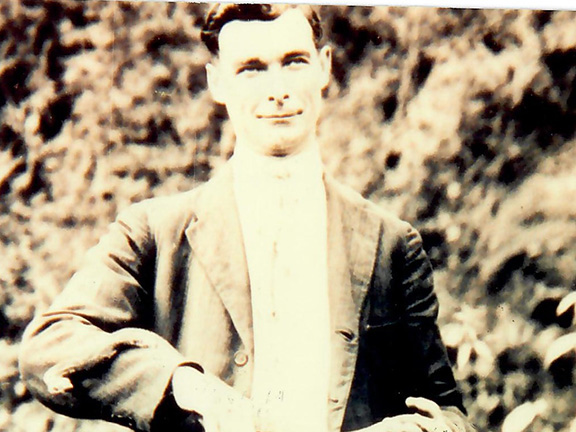
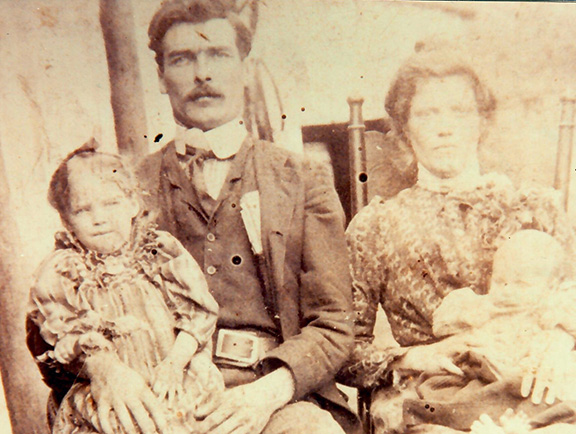
Jim Rose was a legend. Born in Violet, as detailed in our previous column, Rose was accused of killing a Unaka man for his rifle at 16, spent time in jail at 18 for shooting a man in the mouth during a fight, reportedly assassinated badman Buster Duggan from ambush, and dispatching Duggan’s sidekick Joe McCully. A “dead or alive” reward was offered for him in the shooting of Abner Wilson.
When we left the Jim Rose story, he was dying in the Murphy jail after a gun battle with Federal officers. Legends often end that way – but not for Jim Rose. And despite the rumors and accusations, Rose’s only conviction was the shooting at 18.
When murderer and draft dodger George Crawly fled Blairsville, Ga., into North Carolina, pursers assumed Crawly was seeking to join Rose hiding in the mountains around Unaka. Crawley was elsewhere, but the posse stealthily approached the home where Rose was staying. They were seen, and a gunfight erupted.
Rose had been wounded and Cherokee County sheriff’s Deputy Julis McClure has lost his arm in the battle, and Violet born Rose was branded an outlaw by the press in accounts that went nationwide.
After recovering from his wounds Rose was placed on trial in Asheville in 1920, where he faced trial for draft dodging and assaulting an officer. Rose was acquitted of not registering for the draft, arguing he was at the limit of age for registration (46) and was told by his employer that he need not register. He testified he was willing to serve, citing his enlistment in the Spanish-American War and veteran status.
He had enlisted in the Second North Carolina Infantry Regiment for the Spanish-American War, but when assembled for training the officers declared the recruits “untrainable” and the regiment was disbanded and the volunteers sent home.
The jury acquitted Rose after five minutes of deliberation. He also claimed federal officers had not identified themselves as officers and were not in uniform, and he thought he was being assaulted by robbers, not officers, and thus forced to defend himself. Again he was acquitted of all charges.
Despite his acquittal, federal lawman Glen Young in his memoirs would claim the high point of his long career was taking down the Jim Rose Gang, and the “baddest man I ever met was bad Jim Rose.”
And aside note: The Crawlys were never in contact with Rose, but Young would later arrest the two brothers single handedly.
Rose had been in the mountains eluding a murder charge in the death of Wilson, and he stood trial on that charge in Murphy, claiming he said hid out because two of his defense witnesses were in the Army and would not be able to testify on his behalf – so his solution was to hide out until they returned.
Rose’s alibi was he had been in Monroe County working – with Bart Boring, whose family confirmed Rose’s claim. Rose was acquitted despite Wilson’s wife and daughter’s eyewitness testimony to the contrary.
After his acquittal, Rose stayed away from Cherokee County, helping guard the Moore hunting lodge grounds on Hopper Bald. Cotton McGuire hired him because with Rose’s reputation he felt no one would be crazy enough risk poaching the reserve’s game animals.
Things changed in 1923 when his Unaka neighbor, Big Ben Morrow, was elected sheriff. Being on the practical side, Big Ben surmised that it would be better if he enlisted Rose to be on the side of the law rather than opposite, and again Rose was hired as a Cherokee County deputy, a position he would hold for the remainder of his life.
That same year, he was in the newspapers for busting a still in Tomotla. Under Sheriff D.M. Burchfield in 1927, Rose raided a still in Unaka and destroyed 1,800 gallons of beer.
In 1930, he served as the night police officer of Murphy.
As a law enforcement officer Rose spent much of his time raiding stills, until one night in 1932, when word came to his Unaka home of a man drinking and disrupting a church prayer meeting near Copper Creek. Rose investigated and found Bass Dockery the offender.
The two began to fight and drew pistols. Rose was shot in the thigh, and the pistol shots fired by Rose glanced off Dockery’s self-made bulletproof vest comprised of three overlapping pieces of crosscut saw blades laced together under his shirt. One of Rose’s bullets ricocheted into Dockery’s arm, and like Julis McClure 11 years before, the ricochet would result in Dockery losing his arm.
Both men were loaded into a single vehicle and driven to Murphy for medical treatment. Again Rose recovered. Dockery received a nine-month suspended sentence.
Rose was enlisted by Polk County (Tenn.) Sheriff Birch Biggs to intimidate voters in the election of 1936 at the Turtletown precinct. When questioned why a North Carolina man was brandishing weapons at a Tennessee poll, he said, “I am over here for what money I get out of it, and I am well paid.”
Rose would die in Culberson in 1938, having survived being shot twice, tried for murder, assaulting federal officers, and shooting the arm off one man as an outlaw and another as a deputy. He died in bed. The unproven list of his alleged victims includes John Thompson, Wilson, Doc Allen, Duggan and McCully.
Rose’s dying moments became something of legend too, witnessed by some who say in his dying moments he exclaimed that his feet were already on fire in hell, and he asked the window curtains to be drawn because he could see the faces of all the men he had killed looking in on him. As he died the witnesses claimed there was the smell of sulfur in the air. He was 65 years old.
While he was never convicted of killing anyone, the mix of rumors, truth and accusations can make a legend – such as the legend of Jim Rose.
Bruce Voyles’ local history column runs every other week in the Cherokee Scout. Email him at RoadsLessTraveled@cherokeescout.com.