
 |
In the January 2013 Washington Post, Valerie Strauss published the “Top 10 Skills Children Learn from the Arts.” Her list included abilities such as Problem Solving, Confidence and Perseverance. Number one on her list was “Creativity.”
If you are making art, you are obviously being creative. But what actually happens as we are taught is that we learn to develop rather amazing creative habits to use all our lives. We learn to take risks, trying something to delight us (and others) without knowing if we will succeed. We learn to see a task with a different perspective, for after all, our art doesn’t rely on 2 + 2 = 4, nor require that the sky be blue. As we try art we start learning to innovate, to use our own thoughts on a subject – we learn to be original.
In the New York Times, Aug. 4, 2010, Pulitzer Prize winner Thomas Friedman said, “We live in an age when the most valuable asset any economy can have is the ability to be creative – to spark and imagine new ideas, be they Broadway tunes, great books, iPads or new cancer drugs.”
In Cherokee County we have great teachers who are helping to make our future creators and innovators. They are creating future assets to our economy as their students acquire those qualities that add creativity and passion to the math and science and language know-how.
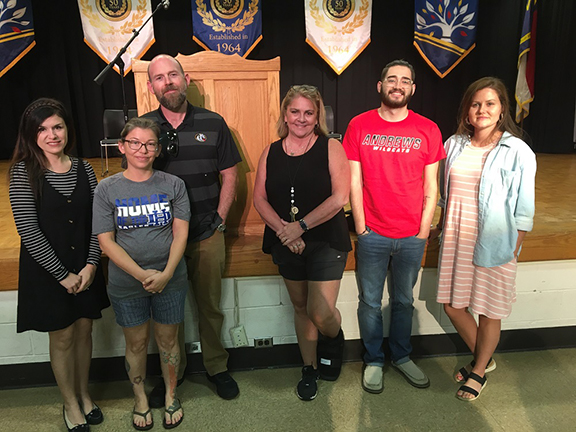
Cicely Cable, Cristen Clounts, Brandon Clonts, Sandy Faggard, Paris Annas and Talon Stiles cover as many of our schools as practical for six teachers. Others pitch in, I know, but this group is specifically charged with instruction in the visual arts. We’ll talk about music, drama and writing in a future column, but today let’s recognize our teachers of visual arts.
Strauss’s 10 skills, and Friedman’s highly valued abilities such as imagining new ideas – those gifts are being given to our students every day by our art teachers. While they have N.C. Department of Public Instruction standards that are followed, the public should know how the Department recognizes the importance of art. This can be seen in the three elements of N.C. DPI’s Comprehensive Art Education Plan: 1) Art Education, taught by qualified staff in the classroom, 2) Art Integration – art as a catalyst for learning across the curriculum, and 3) Art Experiences – exposure to a variety of art.
Art experiences are where organizations and businesses can help, with varieties of exhibits, music, dance, theater performances, poetry and storytelling events. Art integration happens in class as students and teachers in math, science, social studies and other core subjects, use creative methods to solve problems or illustrate concepts. Art education, with the arts as a core academic subject – that’s done through the school year by the Cherokee County art teachers.
This comment from Brandon Clounts at Murphy High echoes the thoughts of educators, economists and corporate CEO’s around the country: “I try to stress that the visual arts are the culmination of the other subjects. To be an artist requires knowledge of history, math, science, reading and writing, methodology, material use, business and marketing. I help my students recognize those connections, and to use their time in class to put things into practice, explore possibilities. I want them to learn to be curious and persistent when faced with a problem, including developing multiple solutions to any given problem. I hope they are able to extend these practices beyond art, that they are able to apply these practices to whatever they pursue.”
With these ideas in mind, it is not hard to see that art is essential, regardless of one’s future endeavors.
David Vowell is director of Visual and Literary Arts with the Cherokee County Arts Council.