
 |
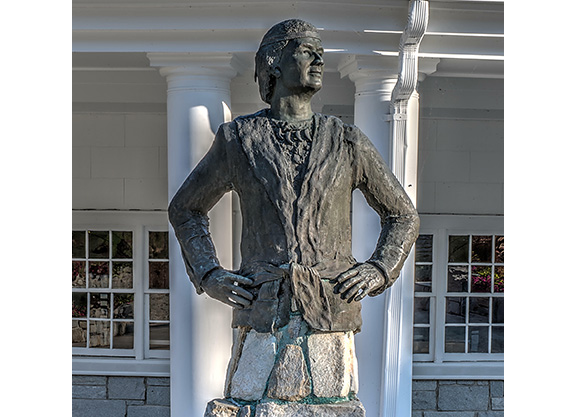
Ask someone to name a Cherokee chief, and the most likely response will be Junaluska. Even though he was not actually a chief, Junaluska remains a legendary figure in both local and Cherokee history.
As a young warrior, Junaluska declared he would kill all the Creek in a battle, but despite the victory he failed in the total annihilation of the foe. From that point forward, the young Cherokee warrior changed his name to “Tsu-na-la-hun-ski,” meaning “one who tries but fails.” Over time, that name evolved into Junaluska in the white man’s tongue.
Junaluska was born around 1779, but it was not until the arrival of Tecumseh’s visit to the Cherokee at Soco Gap that he became known. Shawnee Tecumseh came south attempting to unite all Native American tribes for a concentrated resistance to white incursion. Although not a chief, Junaluska still spoke eloquently in opposition, and the Cherokee turned down Tecumseh and avoided involvement.
After the Cherokee’s longtime enemies, the Creek, massacred a garrison at Fort Mims, Ala., Andrew Jackson raised a militia army from the surrounding states. In 1813, Junaluska recruited 100 Cherokee locally to unite with another 400 Cherokee and join Jackson’s militia in war against the Northern Creek, also called the Red Sticks. These Northern Creeks had aligned themselves with the British in the War of 1812.
One undocumented story is Junaluska stopped a Creek prisoner from killing Jackson. A group of captured Creek warriors were being questioned by the future president when one snatched a knife and lunged for a defenseless Jackson. Junaluska responded by tripping the Creek warrior, saving Jackson’s life. A differing account has Junaluska killing the attacker with a tomahawk.
While that instance may not be documented, the Battle of Horseshoe Bend and the events there are well recorded history. The Creek had fortified a peninsula on the Tallapoosa River – about 12 miles from what is Alexander City, Ala., today – with barricades on the land side, creating an unassailable position surrounded by water on three sides. But the Creek warriors did not put all their faith in the strength of their barricades. They assembled a flotilla of canoes to make there escape should their barricades be breached.
Junaluska and others swam across the Tallapoosa River and stole the Creek canoes, which were then used to ferry the Cherokee force across the river to outflank the Creek, a turning point in the battle. During this effort, Junaluska was wounded in the shoulder, and he was recognized for his bravery in combat on behalf of the United States.
Eighteen Cherokee died in the battle and 32 were wounded. The Cherokee who witnessed the battle credited Junaluska’s act for winning the victory.
Winning the battle meant the Creek Nation ceded 23 million acres to the U.S. government, roughly one half of what is Alabama today, including 1.9 million acres claimed by Jackson’s allies, the Cherokee.
Returning to North Carolina Junaluska claimed 640 acres under the provisions of the 1819 treaty, near Franklin, but soon moved into the Cherokee Nation after conflicts with local whites threatened his land ownership. His new cabin was reportedly along the creek above Andrews that bears his name.
When the Cherokee Removal was still being resisted through political means, Chief John Ross arranged for a meeting between Junaluska and the man whose life he had saved at Horseshoe Bend, President Andrew Jackson. The president listened to Junaluska’s plea and ended the meeting by saying, “Sir, your audience is ended. There is nothing I can do for you.”
Legend has it Junaluska later said had he known how Andrew Jackson would pursue the Cherokee Removal, he would not have gone to the trouble to save his life.
Junaluska accompanied John Welch from Valleytown to Fort Cass to protest government overreach during the removal. Instead of hearing their complaints, Junaluska and Welch confined in the stockade, and Junaluska was not released until forced to go to Oklahoma on the Trail of Tears in the Jesse Bushyhead detachment. His wife and two children died on the trail.
He lasted in Oklahoma until 1843, when Junaluska decided to come back to his homeland, walking to North Carolina. Once here, he discovered he was without legal status and land.
That changed in 1847 when, with a push from W.H. Thomas, a special act of the N.C. Legislature awarded Junaluska citizenship and 337 acres for his bravery at Horseshoe Bend.
One provision of the grant was the land was not to be sold, but in 1850 Junaluska sold the grant to George W. Hayes for $1,000, while at the same time leaving the same property for the support of his wife. The resulting confusion was a controversy not resolved until 1872 when a northern businessman, George Smythe, bought the grant. Part of that grant was the land on which Robbinsville sits today.
By most accounts, Junaluska was en route to Citico, Tenn., for the benefits of the healing springs there when he collapsed on the trip. He is buried in Robbinsville.
At first, his grave was a pile of stones in the Cherokee tradition, but in 1910 the Daughters of the America Revolution erected a monument over Junaluska’s grave. The moment remains there.
He is honored by many locations named for him: Junaluska Creek, Junaluska Gap, Lake Junaluska and a salamander, the Junaluska Salamander. He is honored with a giant sculpture in Metro-Kiwanis Park in Johnson City, Tenn., called “Trail of the Whispering Giants.” When the slave-holding Cherokee aligned with the Confederacy during the Civil War. A Confederate ship was even named for him, the CSS Junaluska, operating off the North Carolina coast until it was dismantled in 1862.
Bruce Voyles’ local history column runs every other week in the Cherokee Scout. Email him at RoadsLessTraveled@cherokeescout.com.