
 |
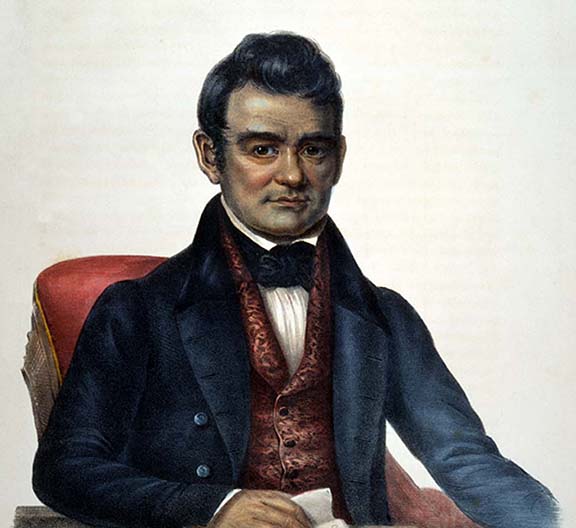
The story of the Cherokee in Western North Carolina, the people from whom our county takes its name, cannot be told without John Ross.
Ross was one-eighth Cherokee by modern standards, a descendant of Cherokee traders from both sides of the family but was raised to identify as Cherokee. He was formally educated, and bilingual and bicultural. In 1809, he was sent to meet with Cherokee who had immigrated to Arkansas as a deputy of U.S. Commissioner of Indian Affairs, Return Meigs.
At age 20 in 1811, Ross was appointed a U.S. Indian agent, served as an adjutant to the Cherokee regiment fighting under Andrew Jackson during the Red Stick War, and in 1815 he built a warehouse, trading post, and ferry north of the mouth of Chattanooga Creek, a place known as Ross’s Landing (Chattanooga, Tenn., today). His partner was Meig’s brother, Timothy.
In 1816, Ross went to Washington as part of a Cherokee delegation to discuss white land encroachment and boundaries. He was the only delegate fluent in English, which propelled him to National Council president by 1818.
Ross was on hand for two important Cherokee treaties, the Treaty of the Cherokee Agency in 1817, which provided benefits for Cherokee who would move west, but also offered 640-acre reserves for those who chose to stay and with the possibility of state citizenship. The Qualla Cherokee under Yonaguska took the acreage. Their foresight allowed the existence of the Eastern Band of Cherokee today, rights confirmed in 1824.
In 1819, a second treaty reaffirmed the 1817 treaty and added the rights for a turnpike through what is Cherokee County today, a road that would link the Overhill Cherokee settlements and the Watauga white settlements with Augusta, Ga., and low country markets. This treaty would allow the Unicoi Turnpike.
By modern terms, the turnpike meant an interstate highway was now running through the Cherokee nation with an exit every 10 miles. They called the stops every 10 miles “stands,” which boasted a tavern, lodging and corrals for the livestock being herded to market. The 10-mile interval was considered as a normal day’s walking distance for a herd.
Stands were usually manned by whites, and each would produce crops to sustain the stand. Things spread from there. By the Cherokee Removal’s beginning, there were as many whites as Cherokee living on Cherokee lands.
John Ross was named president of the National Committee in 1827, with Major Ridge as speaker. The following year, Ross would be named principal chief – a position he would hold until his death in 1866.
With the Indian Removal Act of 1830, the Cherokee began a lobbying effort in Washington led by John Ridge (Major Ridge’s son) and William Shorey Coody (John Ross’ nephew) among others.
Tensions ran high over the Removal. Ross survived an assassination attempt in 1831 by a white supporter of Cherokee Removal.
In 1832, the Cherokee won the legal battle in the U.S. Supreme Court with Worcester vs. Georgia, that ruled that the Cherokee Nation East had the protection of the U.S. government against the states seizure of their lands. President Andrew Jackson refused to enforce the ruling. After Jackson’s meeting with John Ridge, many Cherokee realized the futility of resistance and changed from opposing the removal to that of getting the best price they could for the land. Ross opposed and turned down a $3 million offer for the Cherokee lands.
The Cherokee split into two parties, the Treaty Party led by Major Ridge, Andrew Ross, John Ridge and Cherokee Phoenix editor Elias Boudinot versus Ross, who wanted to resist removal until the bitter end. Over the next two years an average of one death a week would occur in this internal feud.
In December 1835, the Treaty Party met with Jackson’s envoy John Schermerhorn and Commissioner for Indian Affairs Return Meigs and others to finalize what would be known as the Treaty of New Echota, in which the Cherokee received $5 million to be dispersed per capita, a half-million dollars for education ($182 million in 2023 monies, or $11,000 per person), title to the equal amount of land in Oklahoma and full compensation for all improved property left behind (barns, livestock and crops). The meeting had been open to all Cherokee but was stated that if they were not attending they were by their absence giving those attending their proxy to vote for them.
John Ross refused to sign and led the protest, obtaining petitions signed by over 13,000 Cherokee stating the Treaty Party did not have the authority to vote for them and protesting the treaty. It did not work. Two months later, in May 1836, the U.S. Senate ratified the New Echota treaty, passing by a single vote.
One month later, Gen. John Wool arrived in Cherokee County to “prevent disorder,” but in reality to locate and build forts, explore for natural resources (led by looking for gold deposits which they knew were in Valleytown). With the resistance of the Seminole and Creeks still present in their mind, Wool also had a more devious mission – to disarm the Cherokee. He held missionary Evan Jones in detention until Jones agreed to assist Jones in the disarmament.
Ross still traveled among the Cherokee insisting that they should ignore removal demands, follow him and everything would be OK. In September 1837, he was sent as an intermediary to help convince the remaining Seminole to stop resisting removal, but once there he and his companions became even more convinced that passive resistance to removal was the correct course.
Ross played a losing hand.
In May 1838, Maj. Gen. Winfield Scott arrived in Charleston, Tenn., to oversee removal. Eighteen days later, troops began rounding up Cherokee families and taking them to the closest fort. Fort Butler in Murphy was one central holding point.
The first Cherokee Removal detachment would depart a month later. The Trail of Tears had begun, but the John Ross story was only getting started.
More next time.
Bruce Voyles was born and raised in Cherokee County. He has completed two novels under the J.J. Bruce pen name, both set in a rural mountain western North Carolina town in Oconluftee County. The Carolyn Factor and Vengeance Creek are available through most traditional outlets, including local book stores. Voyles’ local history column runs every other week in the Cherokee Scout. Email him at RoadsLessTraveled@cherokeescout.com.