
 |
“The mountains are calling, and I must go,” is a phrase from John Muir’s letter to his sister, Sarah Muir Galloway, in 1873. He wrote “the mountains are calling as well as I should go and I will certainly work on as I can, studying incessantly.”
We find that phrase today in advertising for Gatlinburg, Tenn., and on tee shirts in gift shops from Grandfather Mountain to Murphy. For anyone raised in these mountains, or newcomers captured by the lure of majestic mountaintops and hollows, Muir captured those magic feelings in a succinct sentence.
Muir was a naturalist, botanist and environmental philosopher. He is considered the patron saint of the American Wilderness, and he authored over 300 articles and 12 books, most about the outdoors, many about Yosemite Valley.
As the co-founder of the Sierra Club and its president for 22 years, his influence was instrumental in creation of Yosemite National Park, which was created in 1890.
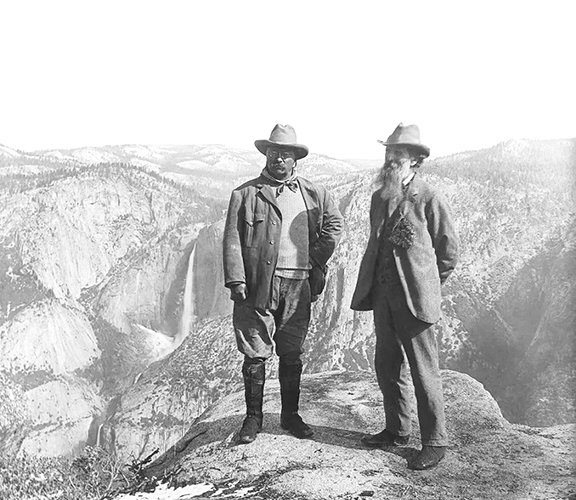
In 1903, he guided President Theodore Roosevelt through Yosemite, with the two leaving their entourage behind and going into back country overnight.
Muir has been commemorated on two stamps and his image is on the back side of the California quarter in the U. S. Mint’s state series. His impact on preservation of our outdoor heritage continues today.
Muir gave in to the lure of outdoors after almost losing his sight when a slipped file cut the cornea of his right eye. He was working in a wagon wheel factory. Muir spent the next six weeks in a dark room recovering and emerged determined to follow his dream of walking from Indianapolis to Florida, finding “the wildest, leafiest and least trodden way I could find.” A book resulted, A Thousand Mile Walk to the Gulf.
Following is a quote from that book:
September 19, 1867
“As I was leaving, he repeated the warnings of danger ahead, saying that there were a good many people living like wild beasts on whatever they could steal, and that murders were sometimes committed for four or five dollars, and even less.”
My path all to-day led me along the leafy banks of the Hiwassee, a most impressive mountain river. Its channel is very rough, as it crosses the edges of upturned rock strata, some of them standing at right angles, or glancing off obliquely to right and left. Thus a multitude of short, resounding cataracts are produced, and the river is restrained from the headlong speed due to its volume and inclination of its bed.
All the larger streams of uncultivated countries are mysteriously charming and beautiful, whether flowing in mountains or through swamps and plains. Their channels are interestingly sculptured, far more so than the grandest architectural works of man. The finest of the forests are usually found along their banks, and in the multitude of falls and rapids the wilderness finds a voice. Such a river is the Hiwassee, with its surface broken to a thousand sparkling gems, and its forest walls vine-draped and flowery as Eden. And how fine the songs it sings.
In Murphy [North Carolina] I was hailed by the sheriff who could not determine by my colors and rigging to what country or craft I belonged. Since the war, every other stranger in these lonely parts is supposed to be a criminal, and all are objects of curiosity or apprehensive concern. After a few minutes’ conversation with this chief man of Murphy I was pronounced harmless, and invited to his house, where for the first time since leaving home I found a house decked with flowers and vines, clean within and without, and stamped with the comforts of culture and refinement in all its arrangements. Striking contrast to the uncouth transitionist establishments from the wigwams of savages to the clumsy but clean log castle of the thrifty pioneer.
September 20.
All day among the groves and gorges of Murphy with Mr. Beale. Was shown the site of Camp Butler where General Scott had his headquarters when he removed the Cherokee Indians to a new home in the West. Found a number of rare and strange plants on the rocky banks of the river Hiwassee. In the afternoon, from the summit of a commanding ridge, I obtained a magnificent view of blue, softly curved mountain scenery. Among the trees I saw Ilex [Holly] for the first time. Mr. Beale informed me that the paleness of most of the women in his neighborhood, and the mountains in general hereabouts, was caused chiefly by smoking and by what is called “dipping.” I had never even heard of dipping. The term simply describes the application of snuff to the gum by means of a small swab.
September 21.
Most luxuriant forest. Many brooks running across the road. Blairsville [Georgia], which I passed in the forenoon, seems a shapeless and insignificant village, but grandly encircled with banded hills.
John Muir is only one of the fascinating and important figures who have passed through our home’s less traveled roads.
Bruce Voyles’ local history column runs every other week in the Cherokee Scout. Email RoadsLessTraveled@cherokeescout.com.