
 |
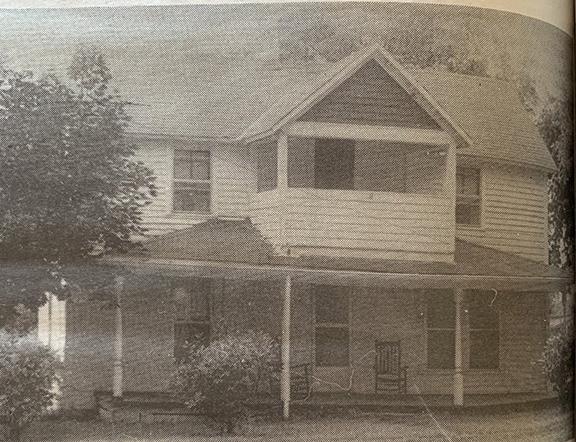
On a beautiful summer day in June of 1990, I stopped by to visit with “Pete” McJunkin, who moved to Happy Top over 70 years ago, and she still lived in the same two-story farmhouse that she grew up in. We sat out in the shade of the grapevine shed and talked about old times. A time when life was simple, and altogether different than the way we see it today.
Allie Blanche Fisher, or “Pete” as everyone called her, was one of eight children born to Lucrecia Tidwell and Allen Isaac Fisher. Her parents met and married in Alabama and later moved to Oklahoma. However, her father was a native of this area and brought his young family back home to the mountains.
In those days everyone had to help with the canning, Pete explained, and prepare for the winter. “We all helped,” she said. “I had to chop all the kraut. and everyone had their job to do. But the whole family worked in the garden, and everyone had to gather the crops.”
Years later, though unbeknown to her at the time, Pete met her would be husband, when she was a young teenager. “He was from Murphy and the hatefullest little boy I had ever seen, we fought every time we met,” laughed Pete. She explained that the Murphy boys came to Andrews to court and the Andrews boys went to Murphy.”
Time worked out their differences because Pete married Clyde McJunkin in the 1930s, and their marriage span over 60 years. Pete went to nursing school and worked as a Licensed Practical Nurse at the Rodda-VanGorder Clinic, on the corner of Locust and Main.
She moved with Dr. Charles VanGorder and Dr. John Rodda and the rest of the medical staff into the newly constructed District Memorial Hospital, which was built on Whitaker Street. She worked there until sometime in the 1970s when she decided to retire. Anyone who worked with Pete was quick to confirm her dedication and professionalism as a nurse.
Clyde McJunkin worked as a construction blacksmith in tunnels and dams throughout the United States, and was accompanied by his bride. “I worked on the Nantahala Dam for the Utah Construction Company for 12 months.”
He remembered a “people’s strike” organized to render pressure on the company to hire local folks. It went on for several weeks, but they finally won out, and sometime later the construction company hired 300 people in the area to work on Nantahala Dam. “I know them all,” Clyde said, “they are a breed of their own.”
After Pete and Clyde retired, they kept busy around the house and yard. Clyde always grew a beautiful garden, grapevines and a garlic patch. He laughed and said, “I didn’t get any volunteers to help plant the garden, but we did have some help from a couple of youngsters in the neighborhood. We just loved for them to come over.”
While we were sitting in the shade watching the squirrels and hearing the birds sing, Pete said, “The Wagon Train is gearing up, and it makes me think of my brother Buck (who also lived in the homeplace). Anyone who was associated with the Western North Carolina Wagon Train, years back, knew Buck Fisher.” He was certainly a colorful character and was the epitome of a western cowboy. There was not a little boy in town who did not love Buck Fisher.
The old Fisher Homeplace was very special to Pete, as she had many precious memories growing up there, she said, “I just wish people could keep a lot more of the old homes.”
My eyes teared up as I drove by the homeplace, now devoid of life and abandoned. The grounds that were once kept immaculate are now overgrown with weeds and saplings. There was no trace of the grapevine shed or the stacks of Clyde’s firewood. The rocking chairs that graced the front porch was now only a memory in my mind.
Although the house is still standing, Clyde and Pete, and Cowboy Buck Fisher have all passed away, but those of us who knew them will keep their memory embedded in our hearts forever.
Kandy Barnard is a columnist for the Cherokee Scout. To talk about the Andrews Valley, call her at 361-3268 or email kandybarnard@gmail.com.