
 |
Few places in America can lay claim to being the birthplace of two branches of the Protestant faith, but Cherokee County, North Carolina, can.
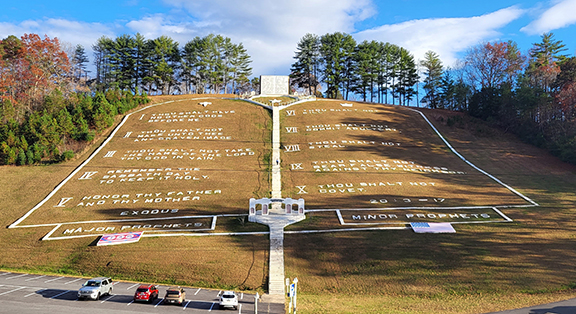
Fields of the Wood near Hiwassee Dam on N.C. 294 bills itself as a “Biblical Park,” but it is more, as it marks the founding location of the Church of God of Prophecy and the Church of God, both now based in Cleveland, Tenn.
Founder A.J. Tomlinson became associated with the Holiness Church at Camp Creek, and on June 13, 1903, walked to the top of Burger Mountain to pray, seeking God’s direction. From the revelation he received there, he started a worldwide movement that today boasts millions of members in more than 130 nations.
In 1940, Tomlinson returned to the exact spot where he had prayed 37 years earlier, and erected wood markers for the historic site, taking the name for the park from Psalm 132:6: “Lo we heard of it at Ephratah: we found it
in the fields of the wood.” The Fields of the Wood biblical park remains there today.
The roots to the Church of God of Prophecy dated back to 1886, when Elder Richard Spurling, a Baptist minister, rejected traditional views and organized a group in Monroe County, Tenn., and Cherokee County, N.C., calling itself the Christian Union.
Spurling’s son, R.G. Spurling, was ordained by the Christian Union, and in 1902 along with W.F. Bryant formed the Holiness Church at Camp Creek, N.C. Spurling was pastor.
Among those joining the new congregation the following year was A.J. Tomlinson, a former Quaker who had come to the mountains as a missionary to distribute Bibles for the American Bible Society. He was soon a leader of the Camp Creek church, and the church grew after his 1903 revelation. New churches were soon formed in North Carolina, Tennessee and Georgia.
In 1906, the first annual meeting of these churches was held in Cherokee County, and in 1907 the name, “Church of God” was adopted. The following year, Tomlinson professed a baptism of the Holy Ghost, aligning his church with the Pentecostal movement. In 1909, Tomlinson was elected General Overseer of the Church of God, where he would remain until his death in 1943.
In 1923, there was a division in the church, one group wanting a 12-man “upper room” group in charge rather than Tomlinson as the lone General Overseer. The 12-man leader group split to become the Church of God in Cleveland, Tenn., while Tomlinson’s group would eventually become known as the Church of God of Prophecy.
From those humble beginnings in the western part of this county, the Church of God of Prophecy boasts a membership of 1,500,000 worldwide today. In 2006, the U.S. membership was 84,762 in 1,871 churches.
The ministry includes homes for children, Bible training institutes, youth camps and a seminary.
In the early formation days of the church, a group of skeptics – including ministers of other churches, deacons, a justice and a sheriff – formed a group of 100 men who tore down and burned the old schoolhouse in which the early church was meeting. A monument stands today where that occurred on River Hill Road.
Growing up a few miles from Fields of the Wood and friends with many members of the home church congregation, it was not uncommon for a Baptist such as myself to sometimes attend.
For many years, a massive event occurred every Easter at Fields of the Wood with a sunrise service drama precluded by all night preaching and singing, drawing top gospel groups like Wendy Bagwell and the Sunlighters.
For the less faithful, the all-night event became a social event rather than a religious service, requiring a police presence to be sure everyone stayed within social boundaries. Over the years, the all-night service was phased out.
In the early days of the service to replicate the thunder after the crucifixion, dynamite would be exploded before the sound effect was moved to more traditional loudspeakers.
For a child growing up in the Hiwassee Dam community, there was no other way to hear dynamite being exploded, so it became a must-go event if one could convince their parents to get them up in the wee hours of the morning to attend. Yes, my parents did indulge me.
In my early teens, the Fields of the Wood church, pastored by Fred Montgomery, offered free guitar lessons, which was the spark that would allow me to play music gigs in the area throughout high school and college.
Fields of the Wood Biblical Park is best known for the Ten Commandments in 6-foot-high letters covering the side of the mountain, with a set of more than 300 steps that run from the parking lot to the top of the hill. The park is open to the public, and even has a small cafe named after park’s geographic name, The Burger Mountain Cafe. In addition to viewing the park, you can get a good burger there, too.
Bruce Voyles’ local history column runs every other week in the Cherokee Scout. Email him at RoadsLessTraveled@cherokeescout.com.