
Wally Avett: Hillbilly Ranger
Willie Nelson said it best in his song “My Heroes Have Always Been Cowboys …” Mine, too, since the days my playmates and I listened to the afternoon’s installment of The Lone Ranger on the radio, and then raced outside to re-create the episode.
My lifelong Wild West interest included artwork from Frederic Remington and Charlie Russell, who today still cast long shadows in the world of Western art.
So a small back hallway in our house is my mini-museum, with six of their prints hanging there in barn-wood frames. In some cases the frames probably cost me more than the prints but I’m satisfied.
On the road again
Like Willie, we spent some time on the nation’s highways during the first decade of the 2000s. Worked down to a formula whether we headed West or North. Ended up setting foot in 44 states, driving rental cars from Chattanooga or Asheville, unlimited mileage, senior rates.
Never had any trouble on the road but were prepared if we did. Planned to call the 800 number of Avis and say, “This horse has died … time’s a-wasting … bring me a fresh horse.” Thankfully it never happened.
Planned the routes well in advance, got to see what we wanted of the major stuff. Stayed in bed and breakfasts in Amish country of Pennsylvania and eastern Ohio, regular motels elsewhere. Gettysburg, Hershey, L.L. Bean, Niagara, Bar Harbor, Lake Placid, etc. Ditto Santa Fe, Grand Canyon, Navajo land, Taos, Yellowstone, Old Sacramento, Dodge City, Denver, etc. But as driver and chief navigator, I made sure on a Northern trip we went to Ogdensburg, N.Y., and on a trip to Montana we went to Great Falls.
Frederic Remington
(1861-1909)
Remington was born the year the Civil War started and his father was a Union officer. From a well-to-do family, he was a cousin to the founders of the Remington Arms Co., America’s oldest gun-makers.
He was a painter, sculptor and writer, having written stories and novels but probably best known for his bronze statues and his paintings. His subjects were cowboys, Indians and U.S. Cavalry at a time when America was becoming increasingly fascinated by the so-called Wild West.
Remington received formal art training at Yale, then later in New York City. His routine was to go out West, making sketches of all sorts of people and situations, and selling some of his work to magazines and newspapers. On the way he also collected all sorts of props for later artwork, such as tools, weapons, clothing, gear, etc.
He made friends early with Teddy Roosevelt and did the illustrations for Roosevelt’s book. Then he got interested in sculpture.
We entered the Remington museum complex in Ogdensburg and there by the front door was a large-scale statue of his Broncho Buster, perhaps his best-known piece. He accompanied the Rough Riders on their expedition into Cuba during the Spanish-American War and the men afterward bought a copy of the Broncho Buster and gave it to Roosevelt, their commander.
Nowadays you can buy that same statue, in several sizes, from the museum or you can often find copies made in China, poor quality but much cheaper. His museum has a wide array of his sculpture and paintings.
Charlie Russell
(1864-1926)
Russell, often called “the cowboy artist,” was also a painter and gifted sculptor. At age 16 he left his native Missouri and went to Montana, working as a cowboy and becoming a self-taught artist. In his mid-20s he lived for a year with Indians and his natural subjects became the cowboys and Indians.
At 32, he married a 19-year-old girl with a gift for business. She managed his talent, booked his gallery shows and pushed him for success. Today his legacy is some 4,000 works of art and a large, very active museum complex in Great Falls, Mont., where his work is displayed.
We enjoyed Great Falls for several reasons. The Lewis & Clark exploring expedition had to haul their river boats out of the water and portage for about 18 miles here to get around rock bars (very visible) in the Missouri River. So the feds have a large interpretive center here.
Had dinner with friends here, their home just outside Great Falls overlooks the river. He also is a sculptor, modern-day, who does pricey bronzes of turkey and wildfowl hunters for the sporting class.
Russell’s log cabin studio, where he did much of his later works, has been preserved. And he is locally very popular, a life-size statue of Charlie and his horse, Monte, on a downtown street.
Charlie’s paintings will cost you. Small pencil drawings bring $25,000 and up. Large paintings sell for millions.
You can also view a number of Russell works at the historic center at Cody, Wyo., on your way to Yellowstone.
Be sure to eat in downtown Cody at the Irma Hotel, which Buffalo Bill built in 1903 and named for his daughter. We thought the lasagna made with buffalo meat was good.
Similar Carolina story
In the mid-1960s, I worked as a rookie reporter for a daily paper in far-eastern North Carolina and heard good stories, especially from deputy sheriffs in Nash County.
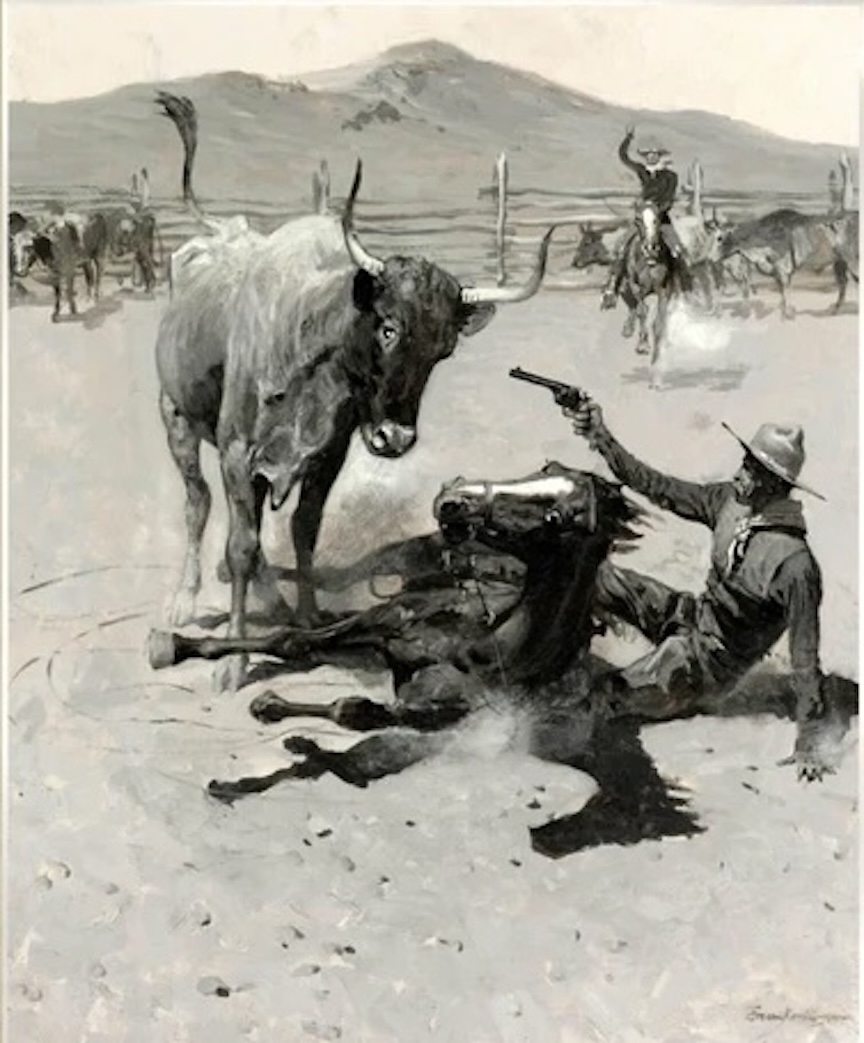
One of them had been tossed rudely by his bull over the fence and clean out of the barnyard. In uniform and armed, only his dignity wounded, he lay on the ground looking at the snorting animal still trying to attack him through the fence.
Saying aloud, “I won’t have something like that on my farm,” he drew his regular snub nose .38 Special and shot the beast between the eyes.
So when I recently saw this 1902 Remington print for sale on the Internet, titled “A critical moment,” just had to have it. Bull puts man on ground … man then puts bull “In Ground.”
Wally Avett first wrote for the Cherokee Scout as editor in 1969. His books are available as signed copies at the Scout office in Murphy. Call him at 828-837-5531 or email wallyavett@gmail.com.