
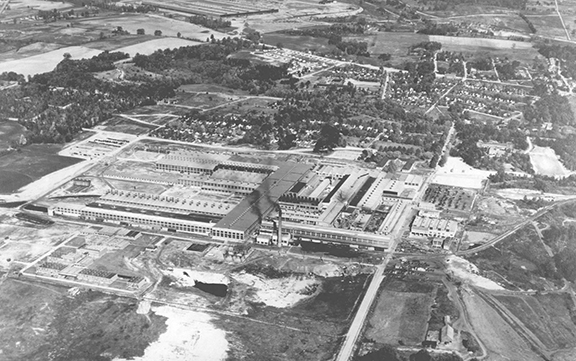

Looking through old newspapers recently, found an interesting story. “The erection of a large plant for the manufacture of aluminum … airplane parts on a 1,200-acre tract two miles west of Andrews in Cherokee County …” –Waynesville Mountaineer.
Some 500 men would be given work when the aluminum plant opened, the Haywood County weekly newspaper’s editor wrote, adding that aerial photos had been made of the property in the Konaheeta Valley, almost level, “among the finest farming lands in western North Carolina.”
Options are being taken on the land involved, attorneys are clearing titles for purchase, engineers are presently surveying and marking construction sites.
Having been involved in real estate here in Murphy, I read this and became excited some myself, even though this action was a full year before I was born and World War II started.
Local news coverage
Thank goodness for the Cherokee Scout files, which go back to the mid-1920s, and I knew would have full account. Was not disappointed.
Opened the 1940 bound book, crumbling paper copies in a year’s worth of local history. The Scout issue of Oct. 3 predated the Waynesville story by a week, and I would guess that the Haywood editor exchanged papers with ours here in Murphy and there’s where he got his story.
Our weekly paper here did a top-notch job:
The headline said it would be eventually a 5,000-man job, initially hiring 500 men and expected to expand quickly. Three shifts would work at the Aluminum Company of America plant. Construction would take several years to complete and cost estimated tens of millions of dollars.
Our front-page local story gushed that options had been taken in about 1,500 acres total, including a large part of the Ed Woods dairy farm (where our airport is located today). Some land owners got cash money to sign the ALCOA options, some signed freely without money involved.
ALCOA engineers roamed daily over the optioned lands, plans in hand, driving wooden stakes into the ground to mark where buildings would be placed.
The Scout’s news writers did not miss critical details in this story. For sake of accuracy, it was noted that “two truckloads of pegs were used.” However, the number of planned buildings for the new aluminum plant was not given by ALCOA engineers.
Disaster project dead
But just as quickly as it was announced and started, the big beautiful dream died. It was not announced why suddenly it was gone.
ALCOA headquarters in Pittsburgh made the final decision and locally it was believed to be “because the engineers had found too great a danger of the land being flooded.”
Part of the announced plan had included an expensive “re-route” of the Valley River, to protect the ALCOA plant as it punched out airplane parts from its aluminum around-the-clock.
The Nov. 7 issue of the Scout told the sad story. Murphy attorney C.E. Hyde represented ALCOA in quashing all the options to purchase land here.
“The plan to build in this section has been abandoned,” came the announcement. The wooden stakes that marked where buildings were planned were all removed.
Big plant for Maryville
Three weeks later, front page announcement of Nov. 28,1940, Scout told the sad news here that a huge aluminum plant would be constructed near Maryville, Tenn. In a town called Alcoa and making aluminum airplane parts within a year’s time. The local news story quoted Cherokee County folks as believing this “took the place of the Andrews project of ALCOA.”
Said it was “cruel and unfair to western North Carolina” because ALCOA was also planning to build Nantahala and Fontana dams, to tie into its electricity network with generating facilities of Santeetlah, Cheoah and Calderwood.
All the electric power our river energy produces will be going to Tennessee, they said. We can never attract a big industry that depends on it because ALCOA has dammed all our big streams.
ALCOA said simply that its dams and power they produce were vital to the defense and security of America. World War II would start about a year later.
Over the years, the plant at Alcoa, Tenn., would grow to a peak employment of 11,000. Currently there are about 1,000 workers there, employed by Arconic, a branch of ALCOA, whose smelter closed in 2012.
Wally Avett first wrote for the Cherokee Scout as editor in 1969. His books are available as signed copies at the Scout office in downtown Murphy. Call him at 828-837-5531 or email wallyavett@gmail.com.