
 |
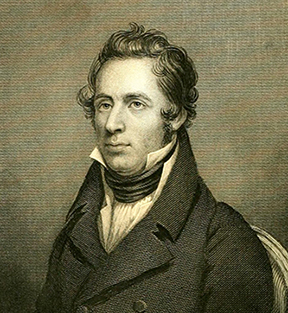
The tale of one of the rarest wildflowers in North America begins with a French botanist who explored our Carolina mountains 12 years after William Bartram made his excursion into what was then Cherokee lands. His name was Andre Michaux.
In a presentation, Charles Kuralt said of Michaux, “His name was Andre Michaux, and we should all remember his name, for he was one of the most remarkable human beings of the 18th century or of any century.”
Michaux was trained to follow his father’s footsteps of maintaining the gardens of Versailles. When his wife died after an 11-month marriage, he left to study botany and horticulture, where his plant collecting travels took him to England, the Pyrenees and Persia.
In 1785 France sent Michaux to America to study trees, with the goal of sending back specimens to replace the denuded forests of France. In conflict with England, France was in need of trees for shipbuilding and tall straight trees for masts, having cut down most of their own forests in their shipbuilding efforts.
With a base in New York, he gathered on trips into Pennsylvania, Maryland and New Jersey, sending back plants, wildflowers and occasionally live game birds. In 1787, he found Charleston’s climate better for his collection and shipping, bought a plantation, and from there began the first of what would be many trips exploring the North Carolina mountains. In both Charleston and New York, he would replant his discoveries and in addition to plants, send the seeds to France.
In the mountains he discovered a rare species of yellow locust whose inner bark made a common dye for the mountaineers, and he introduced the mountaineers to the commercial value of ginseng, which was sold to the Chinese for its medicinal purposes even then. Hundreds of plants first came to public awareness through his discovery. He also introduced new plants to America, including the mimosa tree and the crape myrtle.
Michaux was fearless, often traveling alone in rugged hostile territory by canoe, on horseback, and on foot, driven by the constant need to examine all the plants he found in his travels, and noting the plants new to science. A friend of William Bartram, he said of Michaux that he could find new plants in areas Bartram and his father had already searched.
Michaux wrote two books based on his American travels, The History of North American Oaks and Flora of North America. He recorded seven journeys into North Carolina for his botanical explorations.
In 1792, Michaux proposed an exploration to study the sources of the Missouri River and the rivers that flowed to the Pacific, soliciting Thomas Jefferson’s support to finance the exploration through the American Philosophical Society. The attempt failed and Michaux was sent on a diplomatic mission to deliver messages for the new French Minister of the United States. Jefferson would use much of the proposal he helped compose for Michaux in his instructions to Lewis & Clark.
With the coming of the French revolution, Michaux lost his royal financial backing, and upon returning to France discovered many of the plants and trees he had sent to France had been neglected or destroyed, and with the revolutionary counsels refusing to honor his salary guaranteed by the royal predecessors he found himself penniless.
When the opportunity came for Michaux to travel to Australia to gather plants, he took it, visiting several islands until he fell ill on Madagascar and died.
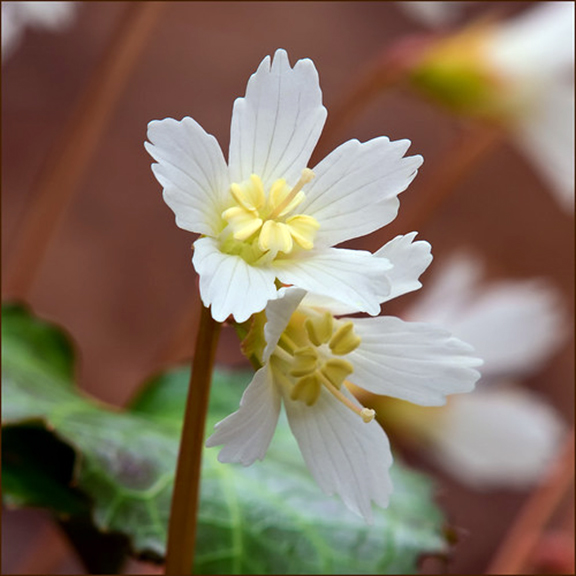
During his explorations in the Cherokee country, he would discover a plant known today as Shortia galacifolia, the Oconee Bell.
Michaux’s pressed sample he took to France was unnamed until noticed by Dr. Asa Gray in 1839, who recognized it as a new genus. He named it for Kentucky botanist Charles Short.
Gray immediately set out to find this rare flower in the wild, and from his position as professor of Natural History at Harvard, he made many trips to the North Carolina mountains searching for the elusive Shortia.
Gray searched for the plant unsuccessfully for 38 years. Then in 1877, while fishing on the Catawba River, George Hyams, son of a Statesville botanist who collected plants for pharmaceutical purposes, noticed a charming, bell-shaped, waxy white flower on slender stems with irregular-toothed petals, growing from a rosette of wavy margined, roundish, shiny evergreen leaves similar to the mountain galax. He found the wildflower interesting and took it home to his father, who could not identify the wildflower and sent it to Doctor Asa Gray at Harvard for help in identifying the wildflower. Gray’s 38-year search had ended.
Gray replied to Hyams, “You have stumbled on what for many years I have tried so hard to find.”
In his lifetime, Gray would classify 25,000 botanical specimens. But he left instructions for his grave in Cambridge, Mass., to be covered with the plant he had sought for so many years, the Shortia galacifolia.
It was botanist Charles Sprague Sargent who took Michaux’s journals and carefully followed the directions and discovered a large colony of the wildflower.
The site was flooded by a hydroelectric dam in 1973, but not before many of the plants were rescued and relocated.
The low-growing evergreen perennial enjoys the deep shade of moist well-drained slopes, banks and rock outcrops. Delicate pink or white bell-shaped flowers bloom in early spring. Glossy round leaves stay on the plant all year but turn from green to deep reddish-bronze in the winter.
While protected and not available for gathering in the wild, and on a list for potential federal protection in the future, you may see the wildflower at several botanical gardens, where you will find the wildflower identified as Shortia galacifolia, or the more common name, Oconee Bell.
Gillian Welch immortalized the wildflower in her 1996 album Revival: “The fairest bloom the mountain knows is … the brave Oconee Bell.”
Bruce Voyles’ local history column runs every other week in the Cherokee Scout. Email him at RoadsLessTraveled@cherokeescout.com.