
 |
Back in my younger years, when I was more lost than found, I worked as a receptionist for a spirited, busy office. Because there were so many departments and people, the company allowed me to hire a temp to help connect the callers to the called.
It was in this metropolis that I met Dearest. She showed up that first day wearing a short skirt, a red cardigan and black stockings with tiny polka dots, which matched the ones I was wearing. It was kismet.
Together, we mastered the switchboard, ate snacks, and, crucially, shared stories that made us laugh and envious. In short, we became best friends. Eventually, we rented the same house, and later, when we both married, she moved into the downstairs apartment, and I rented the upstairs.
And so it went through the decades of our 20s and 30s. Our kids played together, and when our marriages ended, we cried on each other’s sofas with snacks and vodka.
Once, Dearest had to be hospitalized for exhaustion. Her diagnosis was unsurprising because she is one of those people who lives out loud. Her bite of life has teeth, possibly fangs. “I’m kind, Abigail,” she told me once, “but I’m not good.”
She loved being in the hospital. “Everybody treats me so well,” she said, but mainly, she wanted the dinner cart. “I love the food here.” And she meant it.
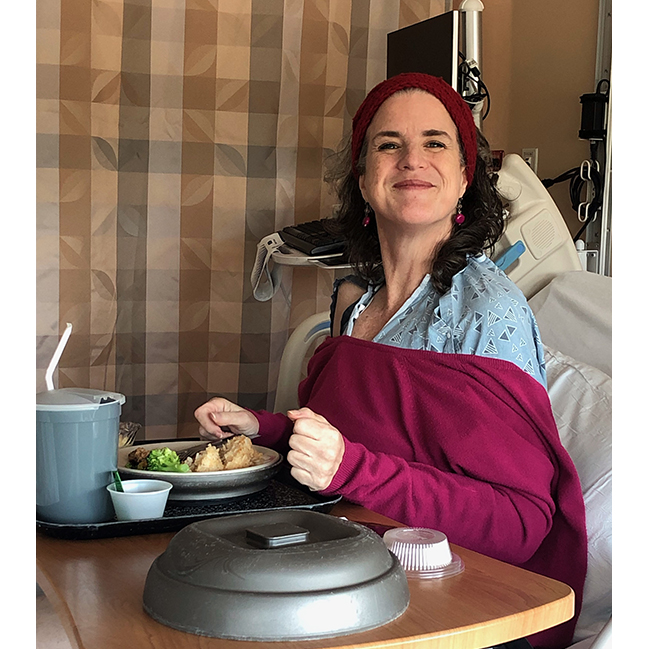
Years and distance separated us, but we managed to stay in touch tangentially until last month when she sent me a picture of her sitting in a hospital bed, happily preparing to eat the lunch set before her. I called her, congratulating her for landing in the hospital for whatever reason.
“I see your luck continues to hold,” I told her.
Except that she wasn’t lucky this time. She had Stage 4 metastatic ovarian cancer. I stared at her happy, gorgeous face while we spoke.
Dearest looks a lot like the old-fashioned, black-haired girl in those antique Coca-Cola posters. In fact, she has a collection of them in her home. “I don’t mind looking at myself,” she used to laugh.
We aren’t emotional gals, and so the conversation, while passionate, wasn’t desperate. We didn’t cry or anything like that. She explained the diagnosis pretty thoroughly, but neither of us ventured more deeply into those waters. We weren’t going to swim around for the prognosis.
“Look,” I told her, “we are all dying. Life is terminal.”
I don’t know why I said that. It was a stupid thing to say. I wanted to tell her that she’s been an outlier her whole life, so maybe she would be the one to beat this monster.
We didn’t speak for long. She was very tired, something I’d never known her to be. When we hung up, I sent her a gift box of biscotti, but that was stupid, too. She told me she had lost her appetite and had to make herself eat. We talk on the phone all the time now, discussing all the unnoticed things in life that, when collected, become the meaningful bits.
I told her about a minor social problem I was having. “Tim Gunn it,” she said. “Make it work, designers,” she added in Tim Gunn’s voice. “I carry him around with me in my head,” she ended with a laugh.
It’s been a month since she was diagnosed, and she still hasn’t seen an oncologist because her insurance isn’t the fancy kind. But she bears this sort of outrage in her typical, Dearest way. She’s been researching doctors who take her insurance, listing them in order of their smiles.
“She looks really friendly,” she said of one of them. But can she kick cancer’s ass? I wanted to know.
Dearest has been dragging herself out of bed and driving to these offices, trying to get a receptionist to put her on the books. No luck so far, but Dearest won’t stop fighting for the right to live.
And she won’t be one of those honorable cancer people. She’s going to wrestle this disease to the mat, and it will involve bruises and snot and sweat. And, when she is up for it, snacks.
She sent me her mantra a couple of days ago. It’s a section of prose written by Marita Golden. “I am a stranger to half measures. With life I am on the attack, restlessly ferreting out each pleasure, foraging for answers, wringing from it even the pain.
I ransack life; hunt it down. I am the hungry peasant storming the palace gates. I will have my share no matter how it tastes.”
At the end, Dearest repeated “no matter how it tastes” for emphasis.
Dearest’s share tastes bitter, no doubt. But in my mind, she is holding her goblet high and drinking the stuff of her life with a growl and a smile that’s only slightly more friendly than wicked.
And if she ever heard me say that, she would double over in laughter, not stopping until tears were running out of both our eyes.
Abigail Blythe Batton is a staff correspondent for the Cherokee Scout. Her column runs every other week. Email her at ablythebatton@gmail.com or leave a message at 837-5122.