
 |
As a child, I was classified as an “airhead.”
It was a popular term in the olden days, meaning lacking focus or possibly even intelligence. It was an insult. But such is the power of a name that I spent most of my early adulthood believing I lacked focus, or possibly even intelligence.
Even after graduating college and then graduate school as a Dean’s List scholar, I identified myself as unfocused and kind of a dumb-dumb. My aunt told me, “Degrees just mean you’re good at school; they don’t say anything about your intelligence.”
I slowly outgrew this classification like a snake wrestling loose from its skin. The name began to feel restrictive. I had outgrown it.
When I dropped that classifier, airhead, I think my IQ raised a few points. When I left the name behind, I had no attachment to its meaning at all.
This experience taught me the importance of names. How we name something influences our behaviors and beliefs surrounding it.
For example, a military liberator is a very different story to a military occupier. Being unemployed rather than between jobs may produce different outcomes. Names such as patriot, liberal, immigrant, fetus and even democracy have such power they’ve started an ideological civil war.
Names can sometimes mean the difference between life and death. A tangential friend of a friend’s mother and father were decapitated in their Atlanta garage because the hit man misread their street name.
They must have been so confused at the time of their murder. They died because somebody confused a street name.
What’s the first thing you do in witness protection? You change your name.
Your old name is powerful enough to cause you harm. A new name becomes synonymous with a new identity. Our names both define and become our identities.
In Appalachia, the name “redneck” means something entirely separate from “hillbilly.” To call oneself a Cherokee County part-timer may evoke opinions from the natives.
Look at county names. The difference between one or the other can affect your millage rate, if you have sidewalks or if you’ll be charged for a 911 call. All that, just in a name.
When I meet someone new, the first thing I ask, of course, is “What is your name?” They answer, and at the exact same moment I forget it. I’m too busy looking for other classifiers to help me understand who this person is.
Are they homeless, in which case I might recoil? Are they a brainiac, in which case I might behave like a sycophant? My behaviors are attached to their classifications. But had I simply listened to their name, their actual personal identifier, I might have a chance to understand the human before placing judgments on their social capital.
People are picky about their names. “It’s Robert, not Robbie” or, “owner not manager.” When we are called by our childhood nicknames, we feel safe and known.
Our name becomes synonymous with our personhood. Lewis Carroll called it “muchness,” and when the Mad Hatter told Alice she had lost hers, he meant she was less of herself, that she was missing something.
I lost my muchness two years ago, when my husband left me. I wandered around with a name that no longer belonged to me. Abigail Hickman was the gal who fell in love with the guy in her happily ever after.
So when the ever after turned decidedly unhappy, the name no longer fit. The Hickman name belonged to a former life, a different Abigail.
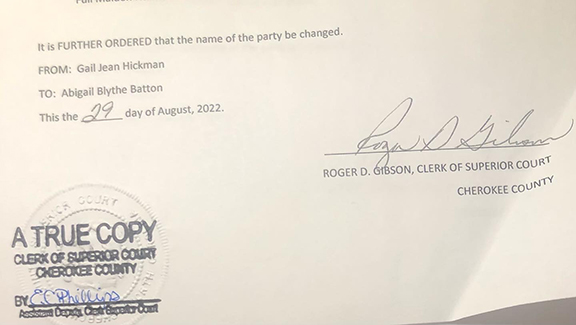
Because names are so important, I recently asked the Cherokee County Clerk of Court’s Office to strip me of my current name, the one that no longer identified who I really am, and restore a name that has always belonged to me – Abigail Blythe Batton.
The clerk, a person who deals with names all day, understood the importance of the occasion.
“Congratulations,” he told me, and shook my hand like he meant it.
I think I floated out of the courthouse. I felt the way one feels after taking the first bite of an iced chocolate cream-filled donut. Such pleasure, and I knew there was so much more to come.
Now the world will call me Abigail Blythe Batton. The new name has helped me restore my muchness. I’m no longer attached to a name that implies wretchedness and loss. I’m no longer living life with an imposter’s name.
I like the way my new name sounds coming out of my mouth, “Abigail Batton.” I like that it’s untainted, full of possibilities. And even if Alan Watts was right when he said, “The menu is not the meal,” to me, Abigail Batton feels like a feast.
Abigail Blythe Batton is a staff correspondent for the Cherokee Scout. Her column runs every other week. Email her at abigailhickman44@gmail.com or leave a message at 837-5122.