
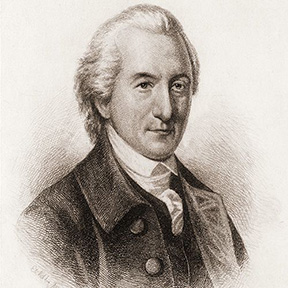
John Dickinson
 |
This vignette is an educational moment in American history. It is about those who made a difference during the Revolutionary War era and how they served our country.
On Nov. 13, 1732, John Dickinson was born at Crosiadore, Talbot County, Md. Historical sources indicate that when John was born, his vagitus cry was “for freedom … heard throughout Colonial America.” John’s mother was Agnes Metzelar. Limited history information suggests that Agnes died when John was an infant.
John’s father, Samuel, and his new wife, Mary, moved to Kent County, Del. Samuel was a farmer and a judge in the Maryland Court of Pleas.
During his youth, Dickinson received his primary and secondary education from private tutors. In 1750, he started reading law under John Moland. In 1753, Dickinson continued his legal education in London. Studying law at Inns of Court, Middle Temple, allowed him “the opportunity to hear the leading legal minds of the day argue the fine points of Enlightenment philosophy and the rights of English citizens.”
Returning to America in 1757, Dickinson gained admittance to the Philadelphia Bar. Earning the “reputation as one of America’s finest lawyers,” along with his challenging British inequities, propelled Dickinson into politics. He acquired international fame by speaking and writing about colonialists’ rights. His publications included Letters of a Pennsylvania Farmer, adding to his popularity.
Dickinson attended the first Continental Congress in 1774. The following year, he helped Thomas Jefferson write a Declaration of the Causes and Necessity of Taking Up Arms. Dickinson exerted much effort to subdue Congressional hostility toward King George and Great Britain, hoping to create reconciliation and prevent future conflicts.
Ironically, Dickinson did not vote for independence nor sign the Declaration of Independence. Not because of supporting Britain – Dickinson “refused to vote for or sign the Declaration of Independence, as the emerging nation was not ready for [an] open revolt against the most powerful empire on Earth.” Dickinson recused himself from the congressional vote for independence, so the official record reflected it was unanimous.
When the Revolutionary War began, Dickinson demonstrated his patriotic colors: He joined the Continental Army, became an abolitionist, served in the Confederation Congress, and was governor of Delaware and Pennsylvania, respectively. He served in the militia as a brigadier general and then, subsequently and ironically, as a private. Dickinson went on to “found Dickinson College, chaired the Annapolis Convention, and was central in drafting and ratification of the [U.S.] Constitution.” Just as important, Dickinson developed the Great Compromise that solved the issue of states’ representation in the new government.
Upon learning of Dickinson’s death, Jefferson wrote, “[A]mong the first of the advocates for the rights of his country when assailed by Great Britain, he continued to the last the orthodox advocate of the true principles of our new government, and his name will be consecrated in history as one of the great worthies of the revolution.”
This great Founding Father, statesman, and
patriot died on Feb. 14, 1808. Dickinson was buried in an unassuming marked grave in Wilmington, Del., at the Friends Meeting Burial Ground. Dickinson’s legal arguments, public speaking and commentaries earned him the title of The Penman of the Revolution.
Visit the local Charters of Freedom setting at Konehete Veterans Park, 699 Connahetta St. in Murphy. A Charters of Freedom setting consists of the Declaration of Independence, U.S. Constitution and Bill of Rights. They are on permanent display analogous to the Charters of Freedom in the National Archives in Washington.
Visit FoundationForward.com to learn more. Email david.streater@mymail.barry.edu for paired educational materials.
Dr. David Streater is the director of education for Foundation Forward, 501(c)(3). He is a retired college instructor/administrator and a retired probation and parole officer/administrator. In addition, David is a criminologist with an acute interest in history, served in the Navy, and is a resident of Burke County.