
 |
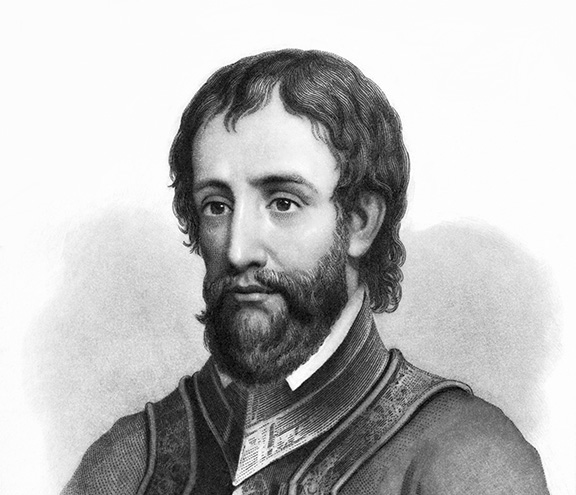
In 1540, Hernando DeSoto may not have been the first European to come through our area, but he is the first white man to pass through accompanied by four men who would chronicle the expedition, ensuring his place in history as the first documented white man to explore here. This was less than 50 years after Christopher Columbus landed.
DeSoto came to the New World from Spain accompanying the first governor of Panama. As a soldier, he was a part of the conquering army of Nicaragua in 1524. His bravery and loyalty gained him fame before joining Francisco Pizarro to Peru. He was made a captain.
The Inca head, Atahualpa, was invited to a meeting with the Spanish, and DeSoto was in the troops that kidnapped the Inca leader, holding him for a ransom, demanding the Inca’s fill a room with gold and silver objects. The Spanish killed Atahualpa and then turned to attack the Inca capital, Cuzco, with DeSoto leading the advance guard. Inside the capital huge amounts of gold and silver were looted, with DeSoto’s share making him a wealthy man.
Desoto served as lieutenant governor of Cuzco before returning to Spain in 1536. He was granted the position of governor of Cuba, with the directive to colonize North America for Spain within four years. His position allowed him to partake in any exploration he desired and allowed him to possess any new lands he might discover, along with whatever wealth he might find there, hopefully gold.
DeSoto selected 620 Spanish and Portuguese volunteers who left Havana on seven Spanish ships and DeSoto’s two caravels. They brought along 237 horses and 200 pigs. The expedition was expected to take four years.
Starting in Florida in 1539, DeSoto’s explored Florida, wintering in the panhandle near what today is Tallahassee.
Along the way, DeSoto recruited local guides as interpreters. If he was in Florida among the Timucua, he would find a Timucua who lived near the Choctaw and spoke both languages. The Timucua would recruit a Choctaw who spoke both Choctaw and Cherokee, and thus DeSoto would leapfrog through the frontier with someone always at his side who could speak the local dialect.
DeSoto soon added 300 captured Indians to his entourage, who served as bearers of his supplies.
As he explored, Desoto would commandeer supplies from the local Indian tribes, and demand women as companions for his soldiers. Any resistance was quickly crushed. After a battle with the Timucuan in which he captured 200, he had the prisoners slain, the brutal act considered to be the first large-scale massacre of Indians by Europeans. Unfortunately, it would not be the last.
Hearing of gold “toward the sun’s rising” DeSoto left Florida and turned northeast through Georgia and into South Carolina. From there, he turned into the Appalachians, stopping for a month to rest his horses and allow his men to fan out in their search for gold, which they failed to find.
The exact route has never been 100 percent proved, but many believe that trail lead through what his chroniclers described a long, beautiful valley and a large Cherokee town the Spanish called Guasili, thought to be the site of the Peachtree Mound. The English version of that word we know today as Hiwassee.
The territory around Guasili was controlled by a tribe the Spanish scribes wrote as “Chalaque.” Later the French wrote the word as “Cherauqi,” and the English later translated that into “Cherokee.”
Frustrated in not finding gold, DeSoto pushed into Alabama where he encountered Tuskaloosa, a chief of the Mobilian tribe. When confronted with DeSoto’s demand for women and servants, Tuskaloosa refused and was promptly taken hostage. Tuskaloosa quickly changed his mind, provided bearers, and told DeSoto they must go to the fortified town of Mabila for the women.
On the way, Tuskaloosa’s warriors ambushed DeSoto’s troops, killing 200 and wounding another 150.
Tuskaloosa lost between 2000 and 6,000 men. In the battle, DeSoto lost most of his supplies and 25 percent of his horses. The Spanish quickly made their way into Mississippi in the spring of 1541.
When DeSoto made his usual demand of women and porters to the Chickasaw, they, too, refused and attacked the Spanish. Escaping to the Mississippi River, the Spanish built flatboats and crossed into Arkansas, exploring into Oklahoma and Texas, wintering on the Arkansas River before returning to the Mississippi.
There, on May 21, 1542, DeSoto succumbed to a fever and died. His body was hidden in weighted blankets and sunk into the Mississippi river at night, due to DeSoto wanting the Indians to believe he was an immortal son of the sun.
At the time of his death, he owned four Indian slaves, three horses and 700 hogs.
His expedition members voted to go home, eventually building boats and floating down the Mississippi, skirting the gulf shore until they at last reached a coastal Spanish town, then to Mexico City where the Viceroy immediately wanted another gold-seeking expedition.
Of 700 men who started with DeSoto, only 311 survived. Few volunteered for the Viceroy’s new mission. They had their fill of exploring the New World.
The lasting effect of DeSoto’s expedition is the razorback hogs in the Southeast, descendants of the hogs that escaped DeSoto’s expedition.
DeSoto’s failure to find gold caused the Spanish to concentrate future expansion of their empire in other directions, with Florida as the upper limit, never knowing they had missed the gold they sought in Coker Creek and Dahlonega, Ga.
Twenty-seven years later, Juan Pardo followed the same track seeking gold, finding small amounts, plus copper, suspected to have come from the area around Copperhill, Tenn.
For western North Carolina and the Cherokee, DeSoto was one of many who would pass through their homeland. With the Spanish stopping in Florida, the South was now open for settlement by another group of Europeans who would come and stay – the English.
Bruce Voyles’ local history column runs every other week in the Cherokee Scout. Email him at RoadsLessTraveled@cherokeescout.com.