
 |
One of the jewels of Cherokee County is Lake Hiwassee. The lake is serene, 180 miles of postcard shoreline, much of it unspoiled by summer homes, save for isolated long-term leases and a section sold for private ownership in the 1960s. The rest is saved from private development by the Tennessee Valley Authority and U.S. Forest Service, unlike other nearby TVA reservoirs.
While in mid-lake looking toward the shore, one might easily imagine this scene of mountains meeting water has been here through the ages. That is not the reality. The river has been here forever, the meeting of the Valley and Hiwassee rivers, joined by the Nottley River further down.
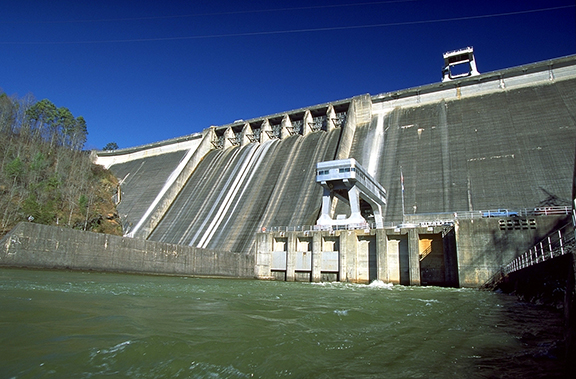
The lake is new in geological terms, formed by a man-made massive chunk of concrete finished in 1940, and since 2017 listed on the National Register of Historic Places. The reason we have Lake Hiwassee is because there is Hiwassee Dam.
Hiwassee Dam’s name comes from the river it impounds to create the lake. That was not the first choice of a name. The location of the dam was on the Fowler Bend of the Hiwassee River, and there was some discussion of calling the dam Fowler Bend Dam.
Hiwassee won out, the name taken from the Cherokee name of large meadow. The Muskogee Indian translation of the same word, Hiwassee, is copperhead, many of which can be found around Lake Hiwassee today.
For almost 100 years, the small communities (and post offices) in the western reaches of Cherokee County were known as Vests and Oak Park, small farming communities more than 20 miles from the Cherokee County seat of Murphy. TVA changed that.
Prior to the coming of the TVA, Chattanooga, Tenn., was seasonally inundated by the Tennessee River’s flood waters. With the coming of President Franklin D. Roosevelt’s New Deal, and a goal of government-financing jobs to work our way out of a Great Depression, the TVA began building hydroelectric dams, citing the need to control flooding and as a by-product provide electricity to millions, with the side benefit of putting thousands of Depression-era unemployed to work.
Just as important but not in the public eye of the explanation for the creation of TVA was that power generated by the dams would be needed in the buildup to World War II. World War II-era airplanes boasted aluminum skins. Alcoa Aluminum near Knoxville needed electricity to make that aluminum and – top secret at the time – massive amounts of power were demanded to enrich uranium for the creation of the atomic bomb at Oak Ridge.
Hiwassee Dam started construction in 1936 and only four years later in 1940 was generating electricity. A U.S. Navy base was created at Hiwassee Dam, the deep mountain lake providing an ideal testing area for depth charges. Hiwassee Dam and the power it generated played a vital role in our country’s victory in World War II.
The new dam was not as well received by those whose riverfront farms the lake submerged. By the time the first generator started turning in May 1940, 3,336 acres were cleared, 261 families and 462 graves were relocated. The price tag for the 307-foot concrete behemoth was more than $24 million. It is the third-highest dam in the TVA system.
Houses were built nearby by TVA to house workers during the dam’s construction. A school was started, and the communities received a new name, Hiwassee Dam. High school students were bussed to Murphy for classes, one of the reasons why those who had ridden those buses then vehemently opposed consolidation during their lifetimes, among them my father, Euclid Voyles.
In the 1950s, a second turbine was added to the dam, featuring a first-of-its kind pump turbine, generating electricity with the water flow from the reservoir, but in non-peak hours having the ability to pump water back into the reservoir and reflow during high power demand times.
For that, Hiwassee Dam is also designated as a National Historic Mechanical Engineering Landmark by the American Society of Mechanical Engineers.
Many of the surviving worker houses and the nearby administration buildings would be refurbished in the 1960s by investors who created Hiwassee Dam Resort Village and purchased adjoining lakefront from TVA. The concept imitated the successful Fontana Village Resort, which repurposed older TVA worker houses there. The lakefront lots some of the few not owned by TVA and U.S. Forest Service, make up the Bear Paw community today.
The communities surrounding the dam, school (K-12) and fire department are united under a single name – Hiwassee Dam. You will hear those who live or were raised there sometimes referred to as Dammers. Your author is one of those.
Bruce Voyles’ local history column runs every other week in the Cherokee Scout. Email him at RoadsLessTraveled@cherokeescout.com.