
 |
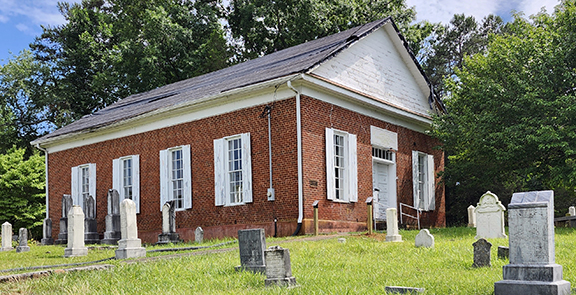
At first glance, Harshaw Chapel is a rather plain, minimalist building, but the reality of what this nondescript building represents is much more. It is well located on top of a high hill on Church Street overlooking all downtown Murphy’s younger buildings.
Harshaw Chapel’s uniqueness combines the chapel’s survival, with roots that go back to the earliest days of this town we call home. It is the oldest building still standing in Murphy, the oldest church building in the county, and the only surviving example of its style of brick exterior. Harshaw Chapel is built of red brick, uncommon in the old days, with the additional cachet of those brick being made locally.
The building is a simple rectangle with unadorned walls. Most historians agree that religious gatherings were held at this location long before Harshaw Chapel was built, with grounds used for burial years before the chapel came along. The style is described as Greek revival, and in addition to the uncommon brick exterior it also boasted a pine wood floor.
There would not be a Harshaw Chapel had it not been for Joshua Harshaw, who arrived in Cherokee County from Burke County immediately upon the Cherokee Removal, taking advantage of good bottom land and farming ability. He purchased his properties at the land sale in 1838.
Accompanying him was his brother, Abram, who established his farm on the Hiwassee River and that property remained in the family until recent times when it was broken up as a real estate development. Joshua’s farm was downriver near Brasstown.
The year after the Harshaws’ arrival, in 1839, Nancy Crump Hayes was the first person interred into what would become the Harshaw Chapel Cemetery. Her husband, George Washington Hayes, knew the Cherokee language and came here from Georgia as an interpreter during the Cherokee Removal.
He was given 700 acres as a grant in thanks for his service during the removal and was later elected to the N.C. General Assembly for several years. During his time in the legislature he would introduce legislation to break Clay County off from Cherokee County. Hayesville, the county seat of Clay, is named for George Washington Hayes.
Harshaw deeded six acres of his Murphy land to trustees of the Methodist church in 1844 for a proposed church.
Joshua and his brother prospered, with the demands of their farms requiring intensive labor, which in those days meant slaves. In a small mountain county with few large farms lending themselves to slave labor, the Harshaws were the exceptions, and quickly became the largest slave holders in the area. With the coming of the Civil War, the slave-owning Harshaws naturally took a Confederate stand.
Harshaw Chapel construction began in 1857 when the first cornerstone was laid, but the building was not completed on May 1, 1869. Construction was interrupted by the Civil War.
The Murphy Methodist congregation was meeting prior to the dedication of the Harshaw Chapel as indicated by the Methodist’s Holston Annual Convention in 1858, when members were estimated to number more than 450.
Joshua Harshaw’s life here was not without tragedies. His wife died in 1863 at age 35, and his only child following in death the next year.
In 1876, Harshaw again donated land to the Methodist church, this time a half-acre lot for a parsonage. Harshaw died that same year– and is buried close to the chapel and in the cemetery that bears his name.
A marble dedication was enshrined over the door reading “Harshaw Chapel. I Joshua Harshaw Do make a free will gift of this house to the Methodist Episcopal Church South At Murphy, NC This May 1, 1869.”
Electric lights would be added in the early 20th century, but by 1924 the congregation had grown and Murphy First United Methodist Church was built downtown. It is still home to the local Methodist congregation today.
The older Harshaw Chapel was leased to Murphy Free Methodists until the 1940s, after which the chapel fell into disuse, with little changes save a new roof in 1965.
Most of the interior furnishings were moved to the new building, but eventually six of the original handmade pews were returned to the church with four other newer ones added.
In 1965, the building was deeded to the Archibald D. Murphey Chapter of the Daughters of the American Revolution with the stipulation they restore and maintain the structure. With the help of a Richardson Foundation grant the church was restored. In 2013, First United Methodist Church again took ownership for the building and historic grounds.
The cemetery is the final resting place of many of Murphy’s early settlers, of Civil War soldiers, and along the back side of the cemetery are the graves of slaves, all buried together in a single graveyard.
One of the most visited graves in the cemetery is that of Abram Enloe. Several legends claim that Enloe employed a young girl, Nancy Hanks, as a servant around 1801-06. When the single woman became pregnant with Enloe’s child the story goes that Enloe paid $500 to a man in Hodgenville, Ky., to marry Hanks and give the child his name.
The taker of the money was allegedly Tom Lincoln, and Nancy named her child Abraham, thus making Enloe the biological father of Abraham Lincoln.
While this varies from most historical accounts, there are existing photos of Enloe’s other son, and there is a striking resemblance to the Civil War president. Like all legends, it is a good story but unprovable.
Enloe did not live here but apparently passed away while visiting friends and thus was buried in the Harshaw Chapel Cemetery.
On April 5, 1984, Harshaw Chapel & Cemetery was recognized as historically significant, being entered into the National Registry of Historic Places by the Department of the Interior, a designation only bestowed on seven other places within Cherokee County, with two of those seven being Tennessee Valley Authority hydroelectric dams.
Bruce Voyles’ local history column runs every other week in the Cherokee Scout. Email him at RoadsLessTraveled@cherokeescout.com.