
This vignette is an educational moment in American history. It is about those who made a difference during the Revolutionary War era and how they served our country.
 |
During the fall and winter of 1777-78, the British military brought the Continental Army to its knees.
In September 1777, British Army Commander Gen. William Howe triumphed over Gen. George Washington at the Battle of Brandywine. With more than 1,000 patriot losses, they retreated. This situation allowed the British to occupy Philadelphia.
A month later, on Oct. 4, 1777, Washington and Howe faced off again at Germantown, Penn. The patriots became disoriented in a thick fog, leading to substantial friendly fire injuries and deaths.
This dire situation again resulted in a “general retreat” by Washington’s soldiers.
After considering several locations, Washington chose Valley Forge for his army to take refuge in and recuperate during the winter. This settlement, close to Philadelphia, prevented the British from invading the interior of Pennsylvania.
Valley Forge was also “far enough away to halt the threat of British surprise attacks.” Further, the Schuylkill River’s geography and banks enabled sentries to see if any Redcoats were advancing.
The wintertime of 1777-78 in Valley Forge was brutally cold, along with snow, ice and wind. The frigid weather made getting essential supplies to the troops almost impossible. The American troops needed clothing, medical care and food. They were distressed, freezing and starving.
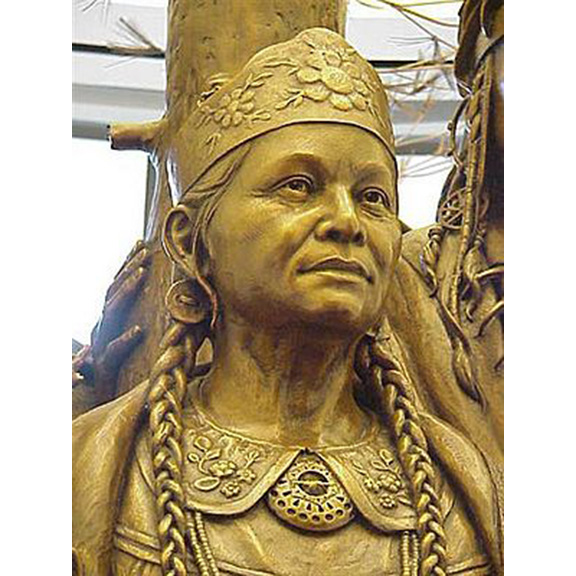
Enter Polly Cooper of the Oneida Indian Nation.
A select group of Oneida, including Cooper, made the grueling journey, bringing food and supplies “boosting the morale of the hungry soldiers at a critical time during the war.”
The Oneida had trekked several hundred miles from central New York. However, the hundreds of bushels of white corn the Oneida brought with them required a unique cooking process.
Upon the Oneida’s arrival, some starving soldiers immediately grabbed and started to eat the raw corn. Polly stopped them, explaining that if consumed uncooked, this corn would kill them by bloating their stomachs.
Polly volunteered to make the journey to Valley Forge to help the soldiers. Her motivation “was freedom in thought to develop principles for the good of all living and the coming generations.” When it was time for the Oneidas to leave, Polly stayed to cook, feed and care for the troops. She refused any pay for her help.
Discovering that Polly was interested in a particular bonnet and shawl, army officers and the federal government raised money for this gift. For her heroic service, Martha Washington presented the bonnet and shawl to her. Polly treasured her beloved garments, and her descendants have continued to value and preserve them.
Over the years, Polly has been honored in several ways. Her shawl is occasionally exhibited to the public, and the Polly Cooper Chapter of the Daughters of the American Revolution keeps her legacy alive.
A sculpture featuring Cooper is permanently displayed in the Smithsonian’s National Museum of the American Indian. This exhibition commemorates the alliance between the Oneida Nation and the United States.
Also, the Oneida County Historical Society, N.Y., inducted her into their Hall of Fame.
Historians have noted that without the help of the Oneida, especially Polly, “Washington’s army might never have lived through the winter, let alone march south to victory at Yorktown and eventually independence.” Polly Cooper is a highly regarded and benevolent patriot who never knew her birthday nor age.
Visit your local Charters of Freedom setting at Konehete Veterans Park, 699 Connahetta St. in Murphy. A Charters of Freedom setting consists of the Declaration of Independence, U.S. Constitution and Bill of Rights. They are on permanent display analogous to the Charters of Freedom in the National Archives, Washington.
Visit FoundationForward.com to learn more about our existing settings.
Email david.streater@mymail.barry.edu for paired educational materials.
Dr. David Streater is the director of education for Foundation Forward, 501(c)(3). He is a retired college instructor/administrator and a retired probation and parole officer/administrator. In addition, David is a criminologist with an acute interest in history, served in the Navy and is a resident of Burke County.