
 |
Growing up here, the Civil War seemed as simple as gray and blue. We were in the South. North Carolina was called the lifeline of the Confederacy. In those days, before political correctness forced Civil War history buffs into hushed silence, we young Southerners were all Rebels. The Yankees were strangers who came with different accents in sharp clipped tones, brusque manners and talked too loud in restaurants. Confederate flags were commonly waved.
The facts differ from the perception. Confederate battle flags were square, not rectangular. For companies making rectangular American flags it was easier to utilize the same-size cloth, thus altering history for convenience. And, similarly, this area was heavily against secession.
One Voyles ancestor started out as a 3rd lieutenant in the 39th North Carolina Infantry (Confederate) but resigned his commission eventually become a captain in the 3rd Tennessee Mounted Infantry (Union).
That was a rude shock to this Southern boy. I stopped assuming and started researching for the truth. In 1861, the states began seceding from the “United” states. Much like today, when the larger population of the Eastern part of the state makes rules the Western region opposes, the East wins.
So it was with secession. There were few slaveholders here. Locals saw the Civil War as a rich man’s war and a poor man’s fight.
With the coming of war, a leader, often a politician with influence with the governor, would ask for a commission to raise a regiment. If he could enlist 1,000 men, he would be the colonel in charge, and the men would often elect the rest of their officers.
For Cherokee County, the war fever hit hard, with two politicians seeing this area as a prime source for fodder to fill out their regimental rolls. One was W.H. Thomas, who enrolled soldiers for his Thomas Legion, later designated the 69th North Carolina Regiment. Another regiment was recruited here by state Senator David Coleman, who would lead the 39th North Carolina Regiment.
Coleman was born in Buncombe County and attended the U.S. Naval Academy before becoming a lawyer in Asheville. He would serve two terms as a state senator, one in which he defeated future governor Zebulon B. Vance. That race was so bitterly contested the two candidates were on the verge of a duel.
The 39th originated as Coleman’s Battalion, so named because he initially failed to get the 1,000 men for the regimental level. When he did hit that number, the group became the 39th North Carolina Infantry.
The 39th included several 100-man companies of Cherokee County soldiers, including William Stiles. In 1862, he was captured by Union Mounted Infantry that included his own son, Benjiman. William was sent to a Yankee prison camp, where he died of pneumonia in 1862.
The 39th saw some of the worst of combat in the Western theater of war, joining Kirby Smith’s invasion of Kentucky in 1862 after guarding the Cumberland Gap. The regiment was engaged in the Battle of Perryville and at Stones River near Murfreesboro, Tenn. There Coleman was wounded and the 39th suffered 42 casualties in taking Union cannon, a feat that allowed the regiment the right to add cannon emblems to their battle flags.
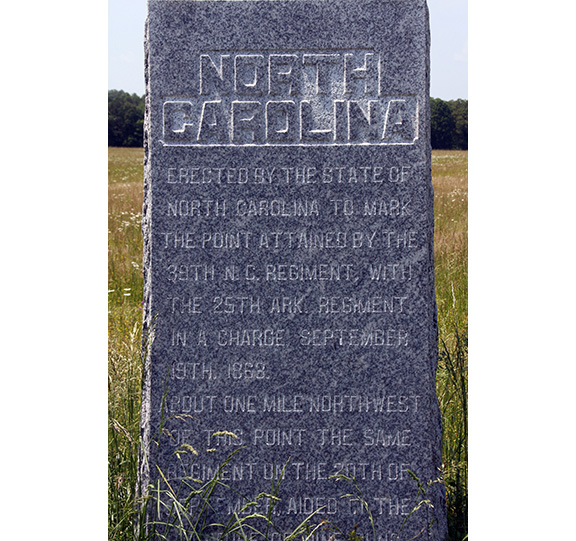
At Chickamauga on the end of the first day of battle, Sept. 19, the 39th found itself in the vanguard of a near-dark charge that would lock the lines in place for final day of the battle. The 39th charged headlong into Wilder’s Lightning Brigade, so named because commander John Wilder had secured a loan from his Northern bank to purchase Spencer repeating rifles for his entire command.
Those rifles fired seven rounds without reloading, while the 39th Confederates carried single-shot muzzle loaders. It was a bloodbath. By this stage in the war, the 39th had dwindled to 247 men, of which 103 became casualties that day. Of those 103, 85 men were killed outright. The following day, 39th survivors helped captured nine Union cannon, a rare feat.
After Chickamauga, the remainder of the regiment was detailed to Mississippi until called back to Georgia for the battle of Resaca, followed by the Battles of New Hope Church and Peachtree Creek in Atlanta.
At Nashville, Tenn., in December 1864, Coleman would command the 39th and 29th N.C. regiments, plus the entire Texas Brigade of Matthew Ector. That defeat destroyed the Army of the Tennessee under John Bell Hood.
The retreating troops added a new chorus to “The Yellow Rose of Texas” as they marched. “Now I’m going Southward, my heart is full of woe, I’m going back to Georgia to find my Uncle Joe, you may talk about your Beauregard and sing of General Lee, but the gallant Hood of Texas he played hell in Tennessee.”
During the war in addition to the combat wounded, 180 of the 39th would die of disease, and 212 would end up in Yankee prison camps.
In Historic Oakland Cemetery in Atlanta, tours are conducted for those visiting the graves of governors, mayors and celebrities like Margret Mitchell, author of Gone With the Wind. In a quiet corner of this final resting place are the graves of Civil War soldiers. Several of those buried there are from the 39th North Carolina Infantry.
In the 1890s, when the Chickamauga National Battlefield was dedicated, veterans were invited back to the ground to determine the accurate locations for the markers, cannon and of the monuments representing their regiments. The size of the monuments at Chickamauga has little to do with the regiment’s roles in the battle – it only means their survivors and states could raise more money for a larger monument.
And on that bloody Chickamauga battlefield, the deadliest two-day battle of the Civil War, there is a 6-foot marble monument standing honoring a regiment comprised of a great many men from Cherokee County, N.C., the 39th North Carolina Infantry.
The 39th’s commander, David Coleman, would die in Asheville in 1883.
Bruce Voyles’ local history column runs every other week in the Cherokee Scout. Email him at RoadsLessTraveled@cherokeescout.com.