
 |
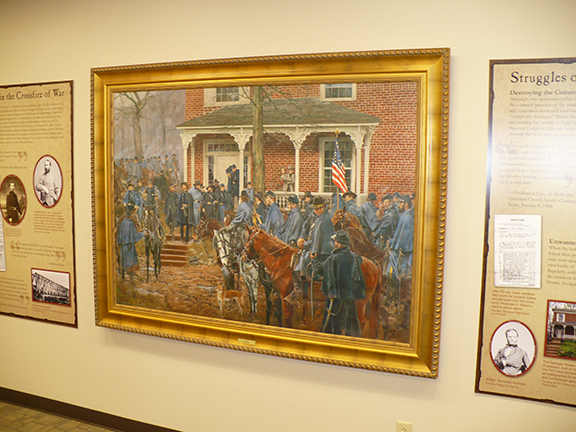
Earlier this month, my wife and I enjoyed lunch at the Cracker Barrel in Cleveland, Tenn., then visited a small, relatively new museum about 10 miles north of the city.
Charleston is the town, and the modest museum called the Hiwassee River Heritage Center, which is housed in a repurposed bank building right on the main highway.
Local folks have banded together to form the center and are rightfully proud of it. Donations are welcome but no admission is charged, only closed on Sunday and Monday, opens at 11 o’clock.
There are a few Cherokee smoking pipes, bowls and other domestic utensils on display. Also professionally done storyboards and photos, produced at Middle Tennessee State University.
There are Civil War bayonets, belt buckles, lead bullets and other souvenirs of activity here. Both Union and Confederate forces passed through Charleston at various times, occupied homes here and stripped building materials out of local churches.
Charleston was the jumping-off place, Fort Cass, for the infamous Trail of Tears, 1838 removal of the Cherokee Indians.
Trail of Tears departure
“They were brought here from all over and camped in an area about 12 miles long and four miles wide,” said Darlene Goins, manager of the center. “Most of the North Carolina Cherokee stayed on Little Mouse Creek. They put them anywhere there was a little space and some water.”
About 16,000 Cherokee were forced to trek to Oklahoma and 4,000 of them died along the trail. Some 9,000 were processed through Fort Cass.
Fort Butler in Murphy was the gathering point for North Carolina Indians. About 3,000 were gathered at Fort Butler here and then sent to Charleston.
Thousands of Indians gathered in a small area beckoned merchants for the captive audience. Including Hunter, here in Murphy, who reportedly loaded his store goods into wagons and went there, too.
As the summer of 1838 passed, large parties of the Cherokee would leave Charleston, either walking or on wagons or horseback. They went up across Tennessee and Kentucky, crossing major rivers including the Ohio, then west and finally south to Oklahoma.
Winter death camp
Some years ago on a hunting trip north of Paducah, Ky., we encountered a grim tale of the Trail of Tears at a little town called Smithland on the big Ohio river and all night long we could hear the boats pushing barges upriver.
Eleven different parties left Charleston, and one of the last to leave departed on Oct. 23, 1838, winter approaching, and they usually made just 10 miles a day.
At the ferry crossing above Smithland there was ice floating in the river. The ferry captain refused to operate in such dangerous conditions but told it was a government operation did raise his passenger rate from 10 cents each to $1.
Forced to camp in snow and ice before the ferry ran again, 250 of the very old and the very young died right there. Records show they left Charleston with 1,766 and arrived in Oklahoma with only 1,311.
White soldiers stationed here in Murphy regretted participating in the Removal. One wrote in his diary about seizing the entire Indian congregation their Brasstown church, calling it “a night of moral darkness.”
Another said “some fearful retribution” may come from God for what the whites did.
Happy New Year!
Wally Avett first wrote for the Cherokee Scout as editor in 1969. His books are available as signed copies at the Scout office in Murphy. Call him at 837-5531 or email wallyavett@gmail.com.