
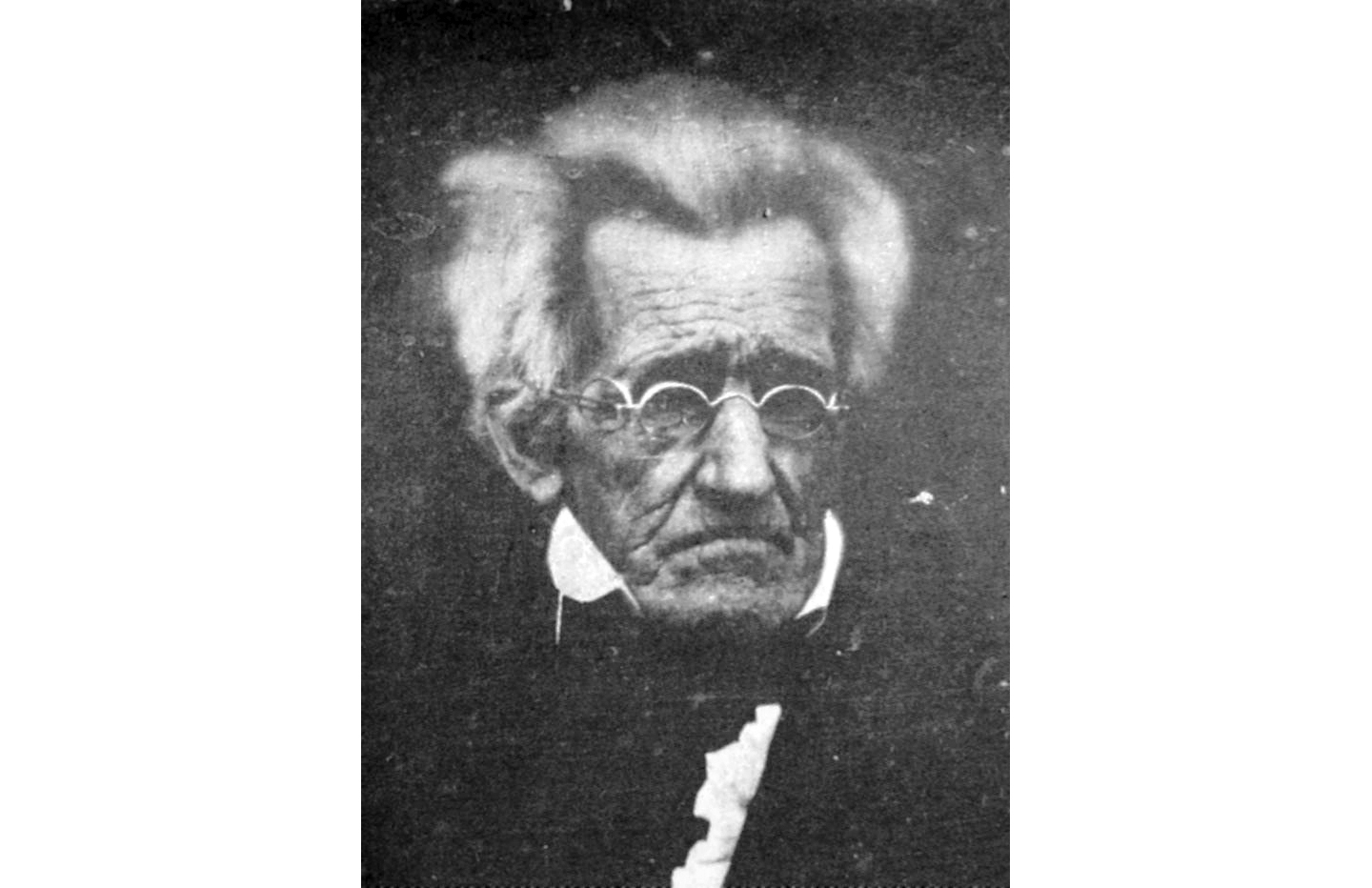

Let’s deal with the murky photo that accompanies this piece – sorry about the quality, but it was poor to start with and went downhill from there.
But it’s very important because it is an actual photograph, a closeup of the wrinkled face of Andrew Jackson made not long before he died in 1845.
Not a hand-drawn painting done by an artist, which tend to be glorified images.
But the truth, a photo made with an all-seeing glass lens and film of some sort, probably a glass plate coated with a layer of light-sensitive chemicals.
Which preserved all the creases and receding hair and weak eyes (note the early glasses) of an aging white man at that moment in time.
He had fought Indians and British forces, been president of these United States and sent the Cherokee on the Trail of Tears.
Born near the North Carolina/South Carolina border, both states claimed him. In the mid-1840s when this photo was made, Andy Jackson sent word
to South Carolina urging leaders there not to destroy the Union, but to preserve it.
He died before the war began in 1861 with the attack on a U.S. fort in Charleston’s harbor but would have been saddened at the news. Photography had made great advances by then and we have lots of photos of Lincoln, Lee, Grant, etc.
Military man
Jackson liked to be addressed as general and had many victories, although supposedly trained as a lawyer and not an officer.
Captured by the British in South Carolina during the Revolution, as a youth Andy was abused by an arrogant English officer who struck him a glancing blow with a sword, scarring him for life.
In a militia role he fought Indians, and some tribes sided with the British. He found English proof-marks on captured Indian rifles and despised them all from then on.
Whipped the British at New Orleans to end the War of 1812, went down into Alabama to whip the Creeks with assistance from Junaluska and the Cherokee. Exiled both Creek and Cherokee to Oklahoma.
All about land ownership
It was all about the land, who owned it, who claimed it and how to get it.
North Carolina claimed land then far beyond its western borders, which complicated early Tennessee settlers.
Andy Jackson came up from South Carolina and lived at Salisbury, N.C., edge of the frontier then. Supposedly read lawbooks with a local attorney there, which passed for a formal education in the law.
I went to high school just across the Yadkin River from Salisbury, near the caves where Daniel Boone’s large family had camped when they arrived from Pennsylvania.
Both Boone and Jackson would soon be aligned with the high rollers in Salisbury who were financing illegal private treaties with Indian tribes, grabbing land and moving settlers westward.
As a teenager I knew Salisbury as the home of Jimmy Blackwelder’s famous barbecue and a square dance joint we enjoyed called Roy’s Rhythm Ranch.
Jackson in his day was much wilder – duels, cock fighting, horse racing, gambling, and reputedly had a string of mulatto mistresses.
A black slave woman who worked at the hotel where Andy lived was asked years later if she ever saw him reading law books.
“All I ever saw him do,” said Mama Judie, “was clean his pistols, fight cocks and chase yellow women.”
His Tennessee plantation, the Hermitage, is not far out of the way and when we went to the Opry years ago we had to stop there. You’ll enjoy it.
Wally Avett first wrote for the Cherokee Scout as editor in 1969. His books are available as signed copies at the Scout office in Murphy. Call him at 837-5531 or email wallyavett@gmail.com.