
 |
First were these mountains, older, worn and wooded, unlike the younger Rockies. Home to native Americans, but dominated by the Cherokee centuries before the white man.
Colony traders made first contact with the Cherokee. There was European demand for animal skins – efficient for clothing more than hand woven cloth in Europe. Captives of other tribes were a secondary item of trade, sold to the Brits for plantations in the West Indies.
The goods exchanged were transported on narrow footpaths, later by horse train, and soon white traders would live among the Cherokee for extended times, often taking Cherokee wives with children who remained after the traders returned home.
White encroachment on their lands occurred whenever the Cherokee would take the wrong side in a conflict – which they often did. In the French & Indian War they backed the French, in the Revolutionary War they backed the British, and in the Civil War, as some prosperous Cherokee owned slaves, they backed the South.
After every conflict Cherokee ceded more land to the whites. In 1819, the Cherokee allowed a road to connect the east Tennessee settlements to Augusta, Ga., allowing the Unicoi Turnpike to be built giving the white man a reason to set up a small station every 10 miles throughout the Cherokee land.
A large Baptist mission was established to the Cherokee shortly thereafter alongside the Hiwassee River.
Along the Unicoi Turnpike, where the Hiwassee and Valley Rivers merge, Archibald Hunter established a trading post and ferry in the 1820s. The post office he named Huntington. Centrally located, his trading post soon found itself alongside an army fort, Fort Butler, built to enforce the Cherokee Removal. By 1838, the year of the removal, there were as many white people within Cherokee lands as there was Cherokee.
With most of the Cherokee removed, the land for which the Cherokee was paid 60 cents an acre was resold in Franklin, N.C., for prices ranging from 50 cents to $5 per acre, based on the quality of the land. There was a land rush – often for the tilled fields, barns and homes still standing and left behind by the Cherokee.
Cherokee County was created, with a county seat on a hill above Hunter’s post, named for a N.C. politician who had never been here, Archibald D. Murphey. An uncorrected clerical error gave the official name of the town as Murphy.
When the Civil War came to these mountains, the majority opposed secession. Union and Confederate units of local men were recruited, resulting in notable skirmishes and atrocities committed that would be termed war crimes today – by both sides.
Following the Civil War the natural resources of the county were monetized, marble for monuments, iron ore turned into iron through local bloomery forges, a talc mine began, copper mines nearby, and on the rich bottom land the once Cherokee farms were expanded and developed.
Timber companies followed the railroads arriving in the 1890s, making inroads into our isolated mountain community primarily for transporting tanning bark and virgin timber to market. In western Cherokee County many found employment in the copper mines and smelting operations in Ducktown and Copperhill, Tenn.
Highways improved. U.S. highways running east and west came through Murphy (US 64/74). Gravel roads became paved, and the population improved, the increased numbers of schools and churches reflecting this growth.
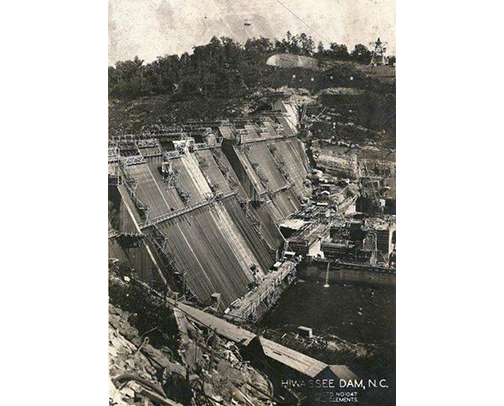
In the 1930s, the Tennessee Valley Authority brought electricity. With control of the entire Tennessee River, existing dams were taken via imminent domain and new dams were started, among them Hiwassee Dam. The power from nearby dams like Hiwassee, Nottley, Chatuge, Appalachia, Blue Ridge and the Ocoees was needed to power war industries like Alcoa Aluminum and the secret atomic bomb facilities at Oak Ridge, Tenn. The depth of Hiwassee Lake was utilized by the U.S. Navy during World War II for torpedo and depth charge detonator research.
After World War II, other manufacturers found their way here, capitalizing on inexpensive mountain labor. Furniture companies, clothing manufacturers and others built facilities and employed many starting at minimum wage – until finding still cheaper labor in other countries and relocating their manufacturing there.
In the 1990s, our county became the focus of national publicity as the hideout of Olympic Park bomber Eric Rudolph, and his eventual capture in Murphy. Florida-born Rudolph spent his teenage and early adulthood in Nantahala.
With few good roads,
discontinued rail service, poor television reception and limited telephone service, our speech, Elizabethan English, the mother tongue, was preserved – until the coming of the satellite dish and influx of outlanders who brought with them strange customs and even stranger speech, including a common prejudice that a N.C. mountain accent meant subtracting points from one’s IQ.
With each generation much of our region’s native intellectual talent has been siphoned off by larger cities and better economic opportunities, save for each generation’s schoolteachers, builders and real estate agents who remained. The latter two eagerly providing land and houses for outlanders who discovered our mountain paradise.
For those raised here, as we neared retirement age, many asked ourselves, “If we could live anywhere in America, where would it be?” The answer: “Home.” In our hearts, home was never anywhere but here.
We hoped home had improved from the isolated world of limited opportunities from which we escaped, but such improvement is still in question. Adjoining counties get new four-lanes, commercial distribution centers and utilize millions in state grants, while our tax money pays for lawsuit settlements as we witness weeks of senseless bickering between the school board and county commissioners – with no substantive results for students.
Meanwhile, too many newcomers work to change our home into something different – more like the place they did not like and left.
The Cherokee whose land was forced to be sold at pennies on the dollar? They are getting that money back these days, in local casinos – one bet at a time.
Bruce Voyles’ local history column runs every other week in the Cherokee Scout. Email him at RoadsLessTraveled@cherokeescout.com.