

.
See Part 1 here
William P. Walker established the first business in the new town, which was a mercantile store, moving his contents of goods from old Valleytown. The store was located across from the train depot, which at the time was Main Street.
The F.P. Cover & Sons Tannery was built in 1899, followed by the Andrews Tanning Extract company owned by the Teas Family, both of which were dependent on the vast timber resources.
After the Town of Andrews was incorporated in 1905, Mayor David Russell and his aldermen, John W. Walker, S.E. Cover and J.Q. Barker, went to work on the progress of the new town, with their main focus on highway improvements. The Valleytown Township Highway Commission was created by an act of the N.C. Legislative in 1905, which was the first effort toward improving the roads west of the Balsams.
In 1906, the election authorized $50,000 worth of bonds to be issued for building roads. Russell was made a member of the commission and served as secretary for 10 years.
Mayor David Russell and Alderman J.Q. Barker spearheaded the passage of a bill in the State Legislature establishing the school system in the town of Andrews. Russell served as secretary of the school board for 10 years.
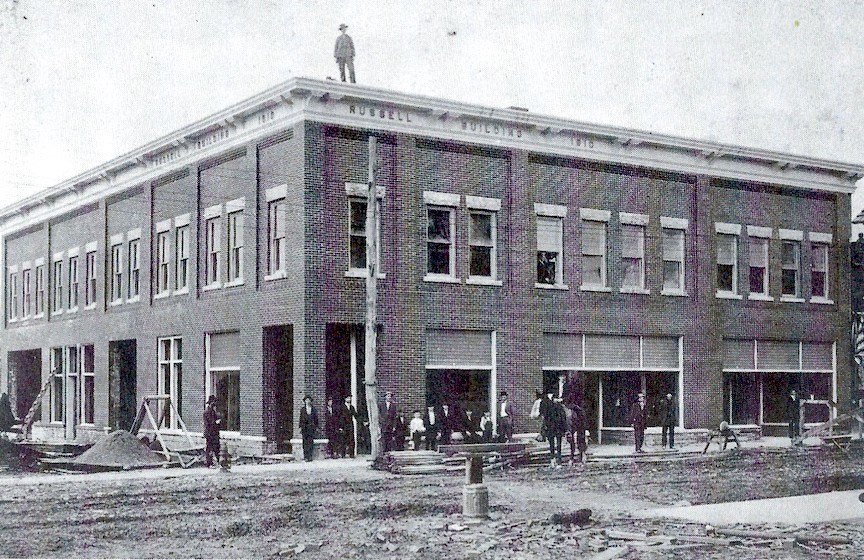
Russell had a brilliant mind and became quite impressive in business affairs while constantly meeting the highest expectations promoting the town’s interest. During the early 1900s he built the Russell Hotel on the corner of Locust Street and what is now Main Street. The building was a general store on the main level and a hotel in the upstairs section. He also successfully operated sawmills in Cherokee, Macon, Swain and Graham counties.
Lucy McGhee was David Russell’s great-granddaughter, and in 1995 she shared a paper written by the first mayor of Andrews when he was 80 years old. The document was dated Aug. 7, 1936, which he called “Important Early Developments of Town” and he details the facts regarding the development of Andrews, and states that the town “has grown from two dwellings and one store to a progressive village of 1,748 citizens.” Even during the winter of his life, he was concerned with the progress for the Town of Andrews. The following was the ending of Mayor Russell’s paper:
“Andrews has been blessed with a progressive and enterprising citizenship which has resulted in many advantages superior to many towns of its size. It has a splendid system of water and sewage, paved streets, electric light and power system, four churches … and one of the best equipped high schools in the western part of the state. The writer of this article can see great possibilities for this section, but by reasons of my advanced age and physical condition I can do no more than urge the younger generation to put on an advertising campaign and bring to the attention of pleasure seekers and investors the beauties and grandeur of this famous section of the Land of the Sky.
Lucy McGhee wrote, “David Samuel Russell died in 1940 at the age of 84, and is buried in Valleytown Cemetery overlooking the valley he first saw and loved more than a century ago.”
I believe he would be pleased to know that he still has descendants living in this valley. Lucy died in July of 2016, but one of her three sons, Mark McGhee and wife Charlotte, still live in Andrews on the family land.
Kandy Barnard is a columnist for the Cherokee Scout. To talk about the Andrews Valley, call her at 828-361-3268 or email kandybarnard@gmail.com.